Monthly Archives: September 2012

Silence was the stern reply

A friendly journalist asked me if I had seen the paper from Norway which looked at cholesterol levels heart disease and overall mortality. Amazingly, as I have sensitive antennae for such things, I had not heard of the HUNT 2 study. Not quite so amazingly, no-one else seems to have heard of it either.
Strange, in a world where the most ridiculous dietary studies are plastered across the front pages of the newspapers, and get top billing on the BBC. You know the type of thing…. Eating red meat regularly ‘dramatically increases the risk of death from heart disease’ A typical headline from the Daily Mail.

But when a ten year study looking at cholesterol levels, overall morality, and heart disease comes out….Silence. I wonder why? Perhaps it has something to do with the results. (See below) http://onlinelibrary.wiley.com/doi/10.1111/j.1365-2753.2011.01767.x/pdf

A friendly journalist asked me if I had seen the paper from Norway which looked at cholesterol levels heart disease and overall mortality. Amazingly, as I have sensitive antennae for such things, I had not heard of the HUNT 2 study. Not quite so amazingly, no-one else seems to have heard of it either.


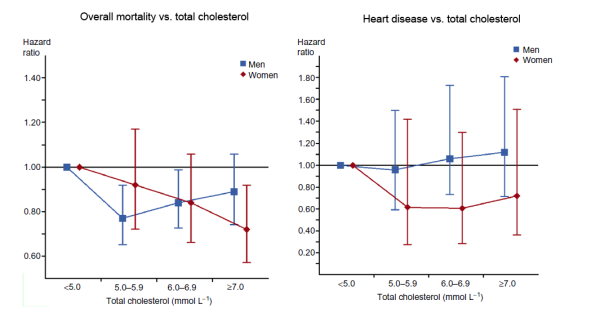
The graph on the left looks at overall mortality vs. cholesterol levels. The one on the right looks at ischaemic heart disease and cholesterol levels in both men and women.

As you can see, for women the story is very straightforward indeed. The higher the cholesterol level, the lower the risk of overall mortality. With regard to heart disease alone, the highest risk is at the lowest cholesterol level. For men there is more of a U shaped curve, but overall mortality is highest at the lowest cholesterol level.

This was a ten year study done in Norway, looking at fifty thousand people – with no pre-existing heart disease. So what we have here is five hundred and ten thousand years of observational data.

These findings do not surprise me in the least, for I have seen many other studies demonstrating exactly the same thing. The lower your cholesterol level, the shorter your life expectancy. Just to take one example. An Austrian study twice this size of this Norwegian one came to the following conclusions:

‘In men, across the entire age range, although of borderline significance under the age of 50, and in women from the age of 50 onward only, low cholesterol was significantly associated with all-cause mortality, showing significant associations with death through cancer, liver diseases, and mental diseases.’  http://www.ncbi.nlm.nih.gov/pubmed?term=adam%20%20eve%20cholesterol%20austria

Added together these studies looked at two hundred thousand people, with a total of two million years of observational data which is a pretty damned impressive amount of work and figures.

I am willing to bet that you have heard nothing about either of them. But how could you? The Austrian study passed by the mainstream media without a whisper, as did HUNT 2. The boy tried to shout that the Emperor had no clothes, but the crowd had stuck in ear plugs. For who wants to hear such an annoying message anyway?

Breast Screening – The Truth…

I am against over-medicalisation in all its forms. So, apart from being very skeptical about preventative medicine in the area of heart disease, I also worry about other forms of preventative medicine. Breast cancer screening is one area where the balance between benefit and harm may well slip towards harm. Yet, it is presented as an absolute good.

One man who is very critical of breast cancer screening  is Professor Peter Gotzsche, who is the clinical director fo the Nordic Cochrane Collaboration Centre, and has written a book called ‘Mammography Screening. Truth, lies and controversy.’ He outlines exactly what has been going on in this are, and makes it very clear that there are significant problems. Primarily with overdiagnosis (there are other problems, but no time for everything in one blog).

Overdiagnosis means finding ‘lumps’ of other suspcious things on mammography ‘lumps’ that would never have caused any problem.  How big is this problem. Well,  detailed pathological studies done in Australia found that in women who had died of other thngs (not breast cancer) had the following pathologies, any of which could lead to a ‘diagnosis’ of breast cancer if found on a biopsy :

Hyperplasia 12.6%
Carcinoma in situe 13%
Focal secretory changes 24.1%
Perilobular hemangioma 11.2%
Radial scars
(precursor of infiltrating ductal cancer)
7.7%

http://www.ncbi.nlm.nih.gov/pmc/articles/PMC1977023/?page=1

In other words, a very high percentage of women have ‘cancerous’ lesions in their breasts. Yet, around 4% of women die of breast cancer.  In the words of the authors of this study…

‘….in any case, the high frequency of ductal hyperplasia and CIS (carcinoma in situ) 25.6% suggests that only a small proportion of these must ever progress to invasive carcinoma.’

If only a small proportion of ‘cancerous’ lesion actually progress to invasive carcinoma, then the majority of those found would never cause any harm to the woman. Thus overdiagnosis must be a very major problem indeed. Ironically, the more detailed an accurate screening beomces, the more overdiagnosis will occur.

Anyway, I was unsurprised to see the recent headline:

‘Breast cancer screening does ‘more good than harm’ http://www.bbc.co.uk/news/health-19571173

‘Breast cancer screening saves the lives of two women for every one patient who receives unnecessary treatment, according to a major European review. There has been a fierce debate about the use of screening, and policy is being reviewed in England.

The latest study, published in the Journal of Medical Screening, said at least seven lives were saved for every 1,000 women screened. Health charities say the findings will provide further clarity for women. Tens of thousands of women die from breast cancer across Europe each year. The effectiveness of screening programmes across the continent was evaluated in a series of studies.

It concluded that for every 1,000 women screened, between seven and nine lives were saved and four cases were over-diagnosed.. Mammograms spot dangerous tumours, increasing the chances of survival, but also detect lumps that are essentially harmless, exposing some women to undue anxiety and surgery.

Screening doesn’t just save lives today or tomorrow, it saves lives 10-20 years down the line” Prof Stephen Duffy Queen Mary, University of London.’

I know that there is no possible way that anyone can know that for every seven and nine lives ‘saved’ four cases were overdiagnosed. This is scientific nonsense. The reality is that more cases must have been overdiagnosed than future invasive cancers diagnosed.

I have asked someone to forward me the full studies on which this BBC story was based.  I have only one part of it so far, and it is a part that worries me greatly, for it makes the following statement.

‘What these papers tell us is that the time has come to move away from relying solely on the older randomized trials of mammographic screening for the evidence-base, and to use data regularly collected and monitored from service screening programmes, with proper statistical analyses in addition to the results from the randomized trials. The authors of these articles set a precedent for how this could be done effectively.’ http://xa.yimg.com/kq/groups/14947167/193204470/name/benefits%20and%20%20harms%20of%20mammograms%202012.pdf

The time has come to move away from relying on randomized trials!

Once you move away from randomized trials you are no longer doing science. You are doing dogma. At which point the truth can never, ever, be obtained. When someone tells me we should use data regularly collected and monitored from service screening programmes with ‘proper’ statistical analysis – I know that THE TRUTH is being buried.

So long science.


A sudden flash of truth


 ‘Men occasionally stumble over the truth, but most of them pick themselves up and hurry off as if nothing had happened.’ Winston Churchill

Anyone reading this blog will know that I do not believe a raised LDL/Cholesterol causes heart disease. I am not going to bore you with my reasoning here. Suffice to say that it is a completely non-scientific theory that rapidly dissolves on contact with critical thought, or the evidence.

I recognise that this flies in the face of conventional thinking. Indeed, almost every day there is a new headline about the wonders of cholesterol lowering using statins. Recently Professor Sir Rory Collins re-iterated his wish that all adults over the age of the fifty should take statins. http://www.dailymail.co.uk/health/article-2194892/All-50s-statins-regardless-health-history-says-Oxford-professor.html

Just around about exactly the same time someone sent me a link to an article about the effect of statins on coronary artery calcification in diabetics. For those who don’t know, calcification of the arteries is a very powerful indicator that you have serious atherosclerosis in the arteries in your heart. The basic underlying cause of coronary heart disease.

To quote from WebMD on an article in the Journal of the American Medical Association (JAMA):

“A test that measures calcium deposits in the walls of the blood vessels supplying the heart is better than other tests for identifying patients at risk for heart attack and stroke. Coronary artery calcium score (CAC) was found to be the most accurate predictor of whether people would suffer one of these events, in a study published today in the Journal of the American Medical Association.

The test is increasingly used by heart doctors to identify heart disease, says cardiologist Gordon Tomaselli, MD, of Johns Hopkins University Medical Center. He was not involved with the study. “Someone who has calcium in their coronary arteries is no longer at risk for developing heart disease — they have heart disease,” he tells WebMD. “That is why more and more cardiologists are using this test.” (WebMD Health NewsAug. 21, 2012)

So you would expect, would you not, that statins would reduce the amount of coronary artery calcification. Or at least the progression of calcification. Furthermore, you would expect that this effect would be especially pronounced in people with diabetes as their risk of heart disease is around three to five times as great as in the rest of population.

Much my great lack of surprise, the study I was sent found the following (just read the conclusion if you like):

ABSTRACT:

Objective: to determine the effect of statin use on progression of vascular calcification in type 2 diabetes (T2DM).

Research and Design methods: Progression of coronary artery calcification (CAC) and abdominal aortic artery calcification (AAC) was assessed according to the frequency of statin use in 197 participants with T2DM.

Results: After adjustment for baseline CAC and other confounders, progression of CAC was significantly higher in more frequent statin users than in less frequent users (mean ± SE, 8.2 ± 0.5 mm(3) vs. 4.2 ± 1.1 mm(3); P < 0.01). AAC progression was in general not significantly increased with more frequent statin use; in a subgroup of participants initially not receiving statins, however, progression of both CAC and AAC was significantly increased in frequent statin users.

Conclusions: More frequent statin use is associated with accelerated coronary artery calcification in T2DM patients with advanced atherosclerosis.

[Saremi A, Bahn G, Reaven PD:  ‘Progression of Vascular Calcification Is Increased with statin Use in the Veterans Affairs Diabetes Trial (VADT)’ .Diabetes 2012 Aug 8.  [Epub ahead of print]]

So, there you go. Statins, which protect against heart disease (a bit), accelerate coronary artery calcification. Explain that one.

My explanation is simple. Statins do not work by lowering cholesterol levels. In fact, lower cholesterol levels lead to more rapid development of atherosclerosis. Any beneficial effect of statins is due to anti-coagulant effect – amongst other non-lipid effects.

Would a supporter of the cholesterol hypothesis care to come up with another explanation that fits the facts?

Anyway, here was a sudden flash of truth. Like supernova they light up the sky for a bit, then fade. Then the world will carry on believing in the cholesterol hypothesis, pretty much as before. Facts cannot destroy belief.

To quote Daniel Kahneman, Nobel prize winner in economics, on the irrationality of the financial system, and how people come to believe in things. He makes many interesting points. For example:

The way scientists try to convince people is hopeless because they present evidence, figures, tables, arguments, and so on. But that’s not how to convince people. People aren’t convinced by arguments, they don’t believe conclusions because they believe in the arguments that they read in favour of them. They’re convinced because they read or hear the conclusions from people they trust. You trust someone and you believe what they say. That’s how ideas are communicated. The arguments come later.’


Statin Nation

If you would like to see a fascinating counterblast to the current statin promotion madness I recommend you have a look at the following film made by Justin Smith.
(A bit of self promotion here, as I am – of course – one of the stars).

I strongly recommend, and hope you can help to make it go viral. This message is needed more than ever.