
‘A lie is halfway round the world, before the truth has a chance to get its boots on.’ A quote used most famously by Winston Churchill.
A few of you may have noticed a recent paper in the Lancet written by the Oxford Cholesterol Treatment Triallists Collaboration (CTT). Much to no-one’s great surprise it fully supported their long-held contention that statins have, virtually, no adverse effects [Often inaccurately called side-effects, as side-effects can be harmful or beneficial].
The central message of the paper is as follows. The reason why people report that they are suffering aches and pains, or other symptoms, is because they have heard about them, or read about them. In other words, they are imagining them. The so-called ‘nocebo’ effect.
The authors suggest that the main culprit for the disinformation causing this comes from the patient information leaflets themselves. Which can be found inside the tablet packaging, and are legally required to be there.
The authors have gone so far as to state that, based on the findings of their study: ‘ .there is a pressing need for regulatory authorities to require revision of statin labels and for other official sources of health information to be updated.’ My imagined scene.
Patient: ‘I’m sure I am getting muscle pains since starting on statins.’
Professor X: ‘No, you are not. You are imagining it. For the recent paper at the CTT has proved that all but four adverse effects are entirely imaginary. Please read this incomprehensible paper, full of clever statistics that you are, sadly, too imbecilic to comprehend and, by the way, ignore the leaflet.’
Patient: ‘Oh, OK, sorry. I will keep taking them.’
Professor X: ‘Yes, quite. I hate to say it, but you are stupid and easily led. Like most people – other than me, of course.
You can perhaps understand my joy at this article, and the worldwide headlines it created. I knew it would be jargon filled, full of complex statistics, and written in such a way as to make it virtually impossible to understand. Here is how the BBC reported its findings:
‘Cholesterol-lowering drugs called statins, used by millions, are far safer than previously thought, a major review has found.
Leaflets in packs should be changed to reflect this and avoid scaring people off using the life-saving pills, say the authors.
Statins do not cause the majority of the possible side effects listed, including memory loss, depression, sleep disturbance, weight gain and impotence, says the team funded by the British Heart Foundation. Meanwhile, they can slash a person’s risk of heart attacks and strokes.’
‘Slash a person’s risk of heart attacks and strokes’ – well that’s a scientific statement if ever I saw one.
All the other mainstream media outlets reported this study in very much the same way. Which I would define as, unquestioning acceptance. A long line of nodding dogs. There has been no real investigation into their claims, and certainly no criticism of any sort. What ended up in the media was, effectively, a summary of the press release.
‘Statins do not cause the majority of the conditions that have been listed in their package leaflets, including memory loss, depression, sleep disturbance, and erectile and sexual dysfunction, according to the most comprehensive review of possible side effects. The study was led by researchers at Oxford Population Health and published in The Lancet.’ Beep, message ends. 1
This is all most people will ever hear, or remember. However, I believe that a far more in-depth critique of this paper is needed.
What I hope to explain, in three blog posts, is that this may be one of the most highly manipulated and misleading studies I have ever come across, and I have seen some belters in my time. The assumptions they made are … contentious, to say the least. And they have not a scrap of evidence to support their conclusions.
So, as briefly as possible, I hope to highlight:
- The massive conflicts of interest at the CTT. Which is why they are the last organisation on earth who should have done this research. They set out trying to prove a point – and, surprise, surprise, they did.
- The games played to allow the researchers to come to their conclusions. Potentially, very dangerous games indeed.
- Why the data they used itself is enormously, and I would argue, fatally biased.
The first two blogs provide background and context. The final blog applies a microscope to the data, insofar as this is possible [As they won’t let anyone else see the data they used].
The massive conflicts of interest at the Cholesterol Treatment Triallists (CTT) Collaboration?
This paper emerged from The Cholesterol Treatment Triallist Collaboration (CTT). A group based at Oxford University in the UK. It was not written by Oxford Population Health, as stated in their press release. It is true that the CTT group sits within Oxford Population Health (OPH) … sort of. This is the explanation that will be used if they are questioned about it. ‘Don’t be so picky.’
However, I believe there is an important reason why the press release chose to highlight Oxford Population Health, not the CTT, and I think you will understand that reason after reading this blog. In truth, pretty much everything about his paper is misleading, even stating who did it.
This may seem a very minor issue to highlight, but details matter, and they can be very damning. I would allege that this press release represents a clear tactic to distract attention away from the organisation who actually did the study. This matters, because most people will not look beyond the press release and will therefore not link the study to the CTT. This has certain benefits, for reasons that should become clear.
You think I am being oversensitive and unreasonable? Then why did the press release fail to mentionthis study was done by the CTT? Did they not want to take the credit for it? Or were they trying to hide something.
Just in case you are wondering. Here is the title of the paper, with its affiliation, copied directly.
‘Assessment of adverse effects attributed to statin therapy in product labels: a meta-analysis of double-blind randomised controlled trials.’
Cholesterol Treatment Trialists’ (CTT) Collaboration 2
The important point I want to make is that the CTT has long and, some would say, inglorious history in this area. Over the years they have attacked anyone who has dared suggest that statins carry a significant burden of potentially damage effects. Including in the British Medical Journal (BMJ). As far back as 2013 there was a major bust-up over two papers published in the BMJ which suggested that statins had more adverse effects than were reported in clinical trials.3
Professor Collins demanded that the BMJ remove, and then apologize for, the articles published. Such was the kerfuffle he created that an independent review panel was formed to decide if the articles should be taken down. The panel found Professor Sir Rory Collins’ criticisms were not valid.
An independent review panel has rejected a demand by a prominent researcher that The BMJ retract two controversial articles. The report largely exonerates the journal’s editors from any wrongdoing.
As previously reported Rory Collins, a prominent researcher and head of the Cholesterol Treatment Trialists’ (CTT) Collaboration, had demanded that The BMJ retract two articles that were highly critical of statins.2
“The panel were unanimous in their decision that the two papers do not meet any of the criteria for retraction. The error did not compromise the principal arguments being made in either of the papers. These arguments involve interpretations of available evidence and were deemed to be within the range of reasonable opinion among those who are debating the appropriate use of statins.”
In fact, the panel was critical of Collins for refusing to submit a published response to the articles:
“The panel noted with concern that despite the Editor’s repeated requests that Rory Collins should put his criticisms in writing as a rapid response, a letter to the editor or as a stand-alone article, all his submissions were clearly marked ‘Not for Publication’. The panel considered this unlikely to promote open scientific dialogue in the tradition of the BMJ.””
The panel also had this to say.
“The panel did have one final comment. It became very clear to the panel that the fact that the trial data upon which this controversy is based are held by the investigators and not available for independent assessment by others may contribute to some of the uncertainty about risks and benefits. Different investigators may come to different conclusions with the same data … The panel strongly believes that the current debates on the appropriate use of statins would be elevated and usefully informed by making available the individual patient-level data that underpin the relevant studies”
Yes, you read that right. The CTT hold all the data on the major statin trials done by various pharmaceutical companies. And they will not allow anyone else to see it. Science, where art though.
But how could Collins have known, in 2013, that the articles were misleading? Here is a quote from the man himself in 2015, made to the Sunday Express newspaper:
Head researcher Prof Collins admitted he had not seen the full data on side effects. In an email to this paper he stated that his team had assessed the effects of statins on heart disease and cancer but not other side effects such as muscle pain.
Klim McPherson, professor of public health at Oxford University, said: “We know these drugs have side effects but we do not know if these have been assessed properly by the drug companies who carried out the trials.’4
So, by his own admission, in 2013, Collins did not have any data on the adverse effects of statins. Yet he attacked the BMJ on this very same issue. In fact, the CTT’s position on statins has been consistent for many decades now. Basically, they are fantastically beneficial drugs, and have almost no adverse effects. Various members of the CTT have stated this repeatedly. Extraordinarily, they even managed to make these claims, before they had the data to support it.
Sometime between 2015, and now, the CTT must have got hold of the missing data. Although the paper does not explain how, or from who, or exactly what these data were. It is … obscure. I think I know, but I am not sure.
At this point, a question to you, gentle reader. Do you believe that anyone working for the CTT – where Collins and Baigent are the leading members – could be considered unbiased. When it comes to the issue of statin adverse effects?
I would argue that even if there were no financial considerations at play, we are staring straight at massive intellectual bias. Collins, Baigent and the rest of those working for the CTT, have staked much of their status, and their reputations, on this matter. A touch of cognitive bias might be in play?
‘Cognitive biases in medical research are systematic errors in thinking that skew study design, data interpretation, and clinical decision-making, often leading to faulty evidence. Key forms include confirmation bias (seeking supporting evidence), anchoring (relying too heavily on early information), and publication bias (ignoring negative results).’
I believe that all three forms of Cognitive Bias are on full display here.
And, of course, there are financial issues to be considered here. Very significant ones indeed. The Cholesterol Treatment Triallists Collaboration was set up within Oxford University. It receives no direct funding from the pharmaceutical industry, something they are very keen to emphasise – repeatedly.
However, the CTT was established by Collins, and Baigent et al. alongside the already existing Clinical Trials Research Unit (CTSU) in Oxford. It is made up of exactly the same people.
Indeed, if you try to contact the CTT, you are actually referred to the CTSU site. Here is the e-mail address for the CTT. Email (Specific Research/Database): ctt@ctsu.ox.ac.uk. Yes, the CTT ‘at’ the CTSU.
I asked Google AI about contacting CTT, and this is what it brought up:
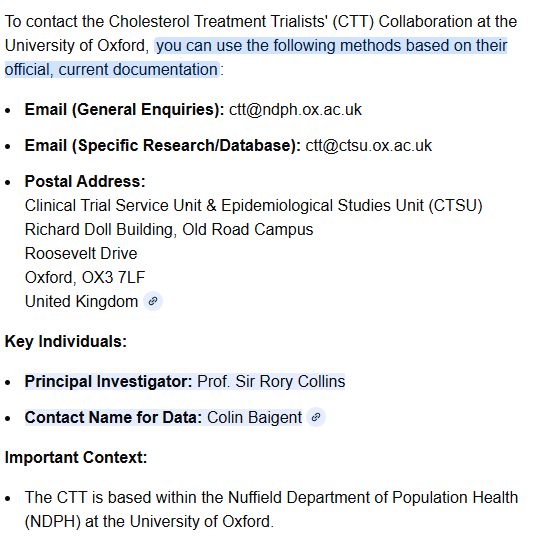
Any claim that these organisations can act independently of each other, in some strange way, is one hundred per cent pure … Don’t get it on your shoes.
Why is this an issue? Because the CTSU receives very large sums of money from the pharmaceutical industry to run clinical trials. Many of these involve cholesterol lowering agents, including simvastatin – as used in their initial HPS study. How much money are we talking about here?
The next section has been taken from a piece by Zoe Harcombe on the same Lancet article. She agreed to let me use it – because she has written about this many times, and I didn’t want to look it all up again, or tread on her toes.
Her section starts with the declaration that the CTSU had, by 2014, received ‘grants’ of £268 million for commercially funded research. How much have they earned since …who knows? No more declarations have been forthcoming……
[From Zoe Harcombe] The May 2014 declaration of funding (c. £268 million at that time, as above) was titled “Grants to Oxford University for any Clinical Trial Service Unit (CTSU) trials or other commercially-funded research over the past 20 years…”
‘My best guess as to how the CTT can try to claim no grant funding, given the self-declared grant funding, is that semantics have been relied upon between Oxford University, the CTSU and the CTT Collaboration. I’m open to any other explanations that may be on offer. I searched the latest CTT paper (the Lancet paper) for “Clinical Trial Service Unit” or “CTSU” and it appeared once – at the corresponding address “Correspondence to: Clinical Trial Service Unit…”
Whatever the semantics, the latest CTT paper focused on five statins. The manufacturers of the five statins chosen are Pfizer (atorvastatin), Novartis (fluvastatin), Bristol Myers Squibb (pravastatin), AstraZeneca (rosuvastatin), and Merck (simvastatin). The author declarations of interest took up over a page in the paper. Pfizer appeared 5 times, Novartis appeared 11 times, Bristol Myers Squibb appeared 3 times, AstraZeneca appeared 11 times, and Merck appeared 7 times.
Oxford University has strategic research alliances with several pharmaceutical companies including Pfizer, Bristol Myers Squibb and AstraZeneca. It has research partnerships with Novartis and Merck (Ref 21).
– “Pfizer has a longstanding research relationship with the University of Oxford” (Ref 22).
– “The Oxford-Bristol Myers Squibb alliance was established in 2015 … Oxford’s alliance with Bristol Myers Squibb continues to grow year on year, the total of Oxford-Bristol Myers Squibb Fellows is now 34 and many other collaborative projects are currently running” (Ref 23).
– “AstraZeneca (AZ) and Oxford have a long history of collaboration” (Ref 24).
While Novo Nordisk was not one of the companies helped by this paper, I noticed that “The alliance between Novo Nordisk and Oxford … has seen Novo Nordisk establish a presence onsite at the University of Oxford, with the Novo Nordisk Oxford Research Centre (NNRCO) employing up to 100 researchers between 2017 and 2021” (Ref 25).
Wow – 100 researchers – and how many people have been employed as a result of the few hundred million given to Oxford University for the CTSU or other commercially funded research?
There can be little doubt that relationships between Oxford University and pharmaceutical companies are of great mutual benefit. There can also be little doubt that it is inconceivable that any research would emanate from Oxford University that is critical of any drug made by any alliance companies. On the contrary, the higher the number of positive papers that can be published, the stronger the mutual alliance. [End Zoe Harcombe]
Yes, hundreds of millions in commercial funding. And that was twelve years ago. This figure will have grown considerably. In addition, hundreds of researchers have also been paid for by various pharmaceutical companies. Total cost? One hundred researchers at an employment cost of, at least, fifty thousand is five million, per year – minimum.
To claim, as they do, that the CTSU/CTT has no financial conflicts of interest is …what is the correct word here? Let me think.
At this point I will declare my own conflict of interest here – which has clear relevance to the discussion. Six years ago, I sued The Mail on Sunday for an article they published, way back in March 3rd 2019. I was accused, along with Zoe Harcombe and Aseem Malhotra, of being responsible for thousands of unnecessary deaths.
This was because we had ‘claimed’ that statins have more adverse effects than are widely reported. Also, that they were significantly less beneficial. With positive effects boosted by various forms of statistical manipulation.
The Mail on Sunday article stated that our talks, and blogs and publications had led to hundreds of thousands of people stopping their statins, leading to many thousands of excess heart attacks and strokes as a result. As one third of heart attacks are fatal, the implication, though not directly stated, is that many, excess deaths occurred. Hundreds, thousands?
Having, effectively, been accused of mass murder, I sued, along with Zoe Harcombe. And, yes, we won. [Which is why you cannot see the article anymore]. The libel case took over five years from start to finish. There was no evidence to support the central accusation of increased heart attacks and strokes. This accusation was based on a modelling study which had no outcome data on morbidity, or mortality. None.
Behind the scenes, Rory Collins and Colin Baigent were very active. They advised Barney Calman, the health editor on what to say. They even edited the paper. Here is one statement that Collins provided to Calman, which was in the article itself:
‘Professor Sir Rory Collins, the British scientist behind pivotal research into statins, says the potential consequences far outweigh that of the infamous MMR vaccine scandal, in which disgraced paediatrician Andrew Wakefield fabricated evidence to support his idea that the jab triggered autism in infants, leading to a decline in vaccination uptake and the resurgence of measles.’
Yes, Collins and Baigent, and various other Professors from the British Heart Foundation, were advising Calman on the best lines of attack. Collins and Baigent even congratulated him warmly after the article was published.
Below are just three of the hundreds of e-mails sent between the various players [All e-mails are on file. I am considering releasing the whole lot – as they are no longer confidential]. The first one here is from Barney Calman, health editor of the Mail on Sunday, to Rory Collins and Colin Baigent, among others, thanking them for ‘all their input’ into the article. [It includes Professor Nilesh Samani, medical director of the British Heart Foundation at the time].
Also named in the e-mail trail is Professor Liam Smeeth who was the lead author of the modelling study mentioned above. He has written widely on the fact that statins have no adverse effects. There is also Professor Peter Sever on the e-mail trail. And he is …stop right here Kendrick, libel goes both ways. A bit more info on Liam Smeeth…
‘Professor Liam Smeeth and Professor Sir Rory Collins are both prominent British academic experts in epidemiology and cardiovascular health who have closely intersected through high-profile, collaborative research on statins.’ From Google AI.
E-mail: From: Barney Calman To: Fiona Fox; Colin Baigent; Rory Collins; Professor Nilesh Samani; Sever, Peter S; Liam Smeeth Subject: [EXTERNAL] MOS/Statins Dear all, please find below our piece.
Thank you again for everything you’ve done to help so far. If you each separately send me back any amendments you have in tracked changes or some other trackable way, that’d be great. All comments welcome. BC by BARNEY CALMAN Health Editor
That was one e-mail proving that members of the CTT were commenting on, and even editing, the article.
After it was published, Rory Collins wrote this e-mail to Barney Calman:
E-mail From: Rory Collins Sent: Sun, 3 Mar 2019 18:07:05 To: Barney Calman Cc: Colin Baigent Subject: RE: all changes made Sensitivity: Normal External Sender:
Dear Barney: What a pleasure to see such a hard-hitting evidence-based article on fake news related to statins … and the page 2 article with Matt Hancock’s very direct comments was an unexpected bonus. Best wishes. Rory
Fake news …indeed. Twelve minutes later, Colin Baigent wrote this:
E-mail From Colin Baigent: Subject: Re: all changes made Sensitivity: Normal External Sender
Dear Barney: I’d like to echo Rory’s praise for your article. Thanks very much for taking the trouble to understand the issues, and also for your willingness to address last minute concerns, as I think the final product was admirable. Best, Colin
‘An admirable article’ … Although, as it turns out, it was also a libellous article. And you guys helped him to write it. Good job.
I knew where, and from whom, Calman was getting his information right from the start. Before the article had been published. To me, it was glaringly obvious that it had the CTT’s fingerprints all over it. Shortly before the article was published, Calman wrote to me, asking for my comments on the article (which he did not include in the e-mail), giving me twenty-four hours to respond to the various points he was making.
I then sent this e-mail on 28th February 2019 to others who share my views on statins:
On Thu, Feb 28, 2019 at 12:05 PM, malcolmken@doctors.org.uk [thincs] wrote:
Dear all,
The Mail on Sunday have contacted me about an article they plan to run, attacking me, and us. It is the usual Rory Collins attack.
I have been given until tomorrow to reply. Does anyone have any good, concise ammunition?
Regards
Malcolm
Yes, these guys work tirelessly behind the scenes to destroy the reputation of anyone who dares to question statins. This time their activities, normally unseen, were exposed in documents that were required to be released to the court before the libel case was heard.
I think that is enough information about the conflicts of interest at play here. You may still feel that the CTT is fully independent, and their objectivity remains beyond question. If so, then I do not suppose that anything I write, nor any other evidence, could convince you otherwise.
Summary
- The CTT, members of whom wrote the Lancet paper, have been aggressively attacking anyone who suggests that statins carry a significant burden of adverse effects for many years. Even when, by their own admission, they did not actually have the data on adverse effects.
- The CTT, who also have all the data from the statin trials, will not share it with any other researchers. Claiming commercial sensitivity/confidentiality.
- The CTT is intimately related to the CTSU, is part of the CTSU, and the CTSU has gained hundreds of millions of pounds in funds for running clinical trials on behalf of the pharmaceutical industry.
- My own conflict of interest is that individuals within the CTT have attacked me directly, and indirectly, many times over the years. Their behind-the-scenes activities were laid bare in court disclosure documents.
I think it is important for everyone to understand this background before moving on. And I feel the need to repeat that this was not a study led by Oxford Population Health. It was a study by the Cholesterol Treatment Triallists collaboration. A group with a very long history in this area, which they may not have wished to publicise. I believe the CTT are far too conflicted to have carried out unbiased research on statins.
3: https://www.bbc.co.uk/news/health-28602155
4: Rory Collins wants to see safety checks made for statins | UK | News | Express.co.uk
 Dr. Malcolm Kendrick
Malcolm all I can say in response to what they claim is – For @#ck’s Sake
As I have read your books I knew immediately what was going on.I feel sorry for the people who do not have an inbuilt curiosity to learn. Thank you very much John Street
According to Medscape’s report on Feb 9th the:
Researchers compiled 66 non-muscle, non-diabetes outcomes that statin labels claim may be caused by these drugs — including cognitive problems, depression, sleep issues, kidney injury, sexual dysfunction, liver disease, and many others.
This is stunning. Exclude what are possibly the two most widely bothersome adverse effects and then look at all the others listed. And then go so far as to suggest rewording of the information leaflets? My goodness me – sounds really impressive and seriously concerned to make sure people taking statins are properly informed.
Yes, I saw that paper and looked at it and realised that it had p-value-itis. I was impressed by how many p-values there were per square centimetre. You have to be masochist to work through it. The trouble is that a p-value is not some independent supra-human metric, it depends on a human deciding a cut-off point for some variable. I had a discussion with my GP some years ago on this mentioning a previous paper by Professor Sir Rory Collins and Professor Peter Sever on the nocebo effect where some research was pulled in to show such where creatine kinase was not flagged as a problem unless it was 10 times normal. As I was leaving the consultation my lovely GP did mention that as I had got so far OK (well over 80) a statin would not make much difference anyway.
Anyway, the zing bat is another paper December 2025 – “Statin Use Is Associated With a Decline in Muscle Function and Mass Over Time, Irrespective of Statin Pharmacogenomic Score” PMID: 41267182 PMCID: PMC12634476 DOI: 10.1002/jcsm.70132
What they fail to realise is then many people given the astatination pill stop taking it because of the horrendous adverse effects & they don’tbtell the quack or their pharma dealer & they bin or burn the pills I have now gone from burning to telling quacks, nurses, consultants &c that my wife doesn’t & won’t take them anymore due to intense leg cramps, continuous dancing legs during sleep & memory & cognitive impairment, I saud to one hospital cardio nurse “you do know that there is growing evidence that they cross the blood brain barrier don’t you?” She didn’t respond. “And,” I continued, “that artovastatin is by far the worst offender!” Silence with an expression that I read as I’m not going to chalkenge what he is saying because I honestly don’t have a clue whether he us right or not.
My wife just had a mitral valve replacement, shevwill not be having statins norvwill she be eating a cholesterol free diet as recommended. She stopped smoking & has cut her sugar & carb intake & I am trying ti give her a reasobably balanced diet with a decent saturated fat intake & sufficient but not too much salt, which is also anither health giving substance high on their hit list.
God bless you for all you have brought & bring to the table. Warmest regards, John Thornborrow
Fascinating, and horrifyingly predictable. I look forward to reading more.