
My son tends to dismiss the idea of watching any film from before about say, the year 1990. Terrible special effects, he informs me, and just too old. As for anything in black and white … no, just, no. Why watch old stuff, it’s rubbish. The fool.
In science there also seems to be a tendency to think that things are constantly moving forward, building on what has gone before. Old research and ideas, become obsolete, and fade from memory. There is no need to look back. We can learn little, or nothing, from things we did a hundred or more years ago.
True? Let me take you back to a land that seems far away and long, long ago. A place where the sun was used as a powerful ‘medicine’. Patients with tuberculosis (TB), or those with non-healing wounds, or mental illness, and many other things. They were wheeled into solariums to make the most of the sun’s rays. Many hospitals had great big windows to let in sunlight.
Years ago I read a fascinating book on this called ‘The healing sun’ which looked at how the sun was used to treat many illnesses. Often with impressive results. It certainly awakened my interest in the area. And, because I have an obsessive interest in heart disease, I focussed on nitric oxide (NO), which is synthesised when the skin is exposed to the sun. [This is not the only way NO is created in the body, but it is important].
Nitric oxide is a molecule that is now understood to be critical for cardiovascular health, although it was not known to have any role a hundred years ago. Until recently it was not known to exist inside the body. in fact, the idea that such a highly reactive compound could have a positive role to play was considered bonkers. Super-reactive – and damaging.
I would like to point out that sunlight does many more things than create nitric oxide and, of course, vitamin D. Mostly good. With so many potential benefits why did the era of ‘solar treatment’ fade into darkness? I think it is almost entirely due to the arrival of antibiotics. A whole bunch of terrible infections, which killed so many millions became treatable – virtually overnight. Sunlight was no longer required, or so it appeared. We had a new solution. Faster, and more effective.
And then came the slow, but inexorable, one-hundred-and-eighty-degree turn. The sun began to be viewed as dangerous. From ‘healing sun’ to ‘bringer of death’. Has this been a good move? In my opinion, absolutely not. Let me show you a graph from a long-term study done in Sweden. It looks at probability of death, in three groups.
- Those who avoid sun exposure.
- Those with moderate sun exposure.
- Those who actively sought out the sun1.
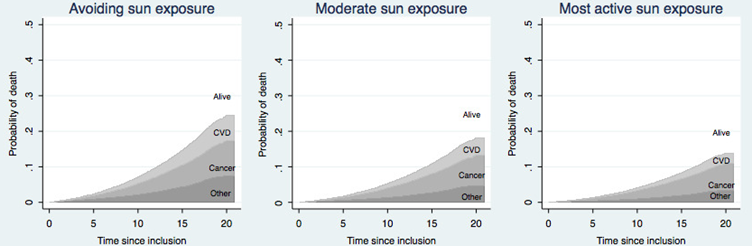
Over a twenty-year time period, those who actively sought the sun were ten per cent less likely to die – of anything, than those who avoided it. This was an absolute, not a relative risk.
On the basis of this study, sunlight would be considered a miracle drug. Everyone in the world urged to take it, every day, without fail. The pharmaceutical company with a patent for any such medicine would become rich beyond the wildest dreams of avarice. You would never hear the last of it.
I make this somewhat bold statement because there is no medication, nothing else at all, that comes close to this level of overall health benefit, and life extension. Nothing … at all. Stopping smoking would be almost as good, providing about eight to ten years of added life. But that is not really the same thing.
That paper was published ten years ago. A more recent one, from 2020, had pretty much exactly the same thing to say about sunlight. The title says it all, really:
‘Insufficient Sun Exposure Has Become a Real Public Health Problem.’
‘This article aims to alert the medical community and public health authorities to accumulating evidence on health benefits from sun exposure, which suggests that insufficient sun exposure is a significant public health problem.
Studies in the past decade indicate that insufficient sun exposure may be responsible for 340,000 deaths in the United States and 480,000 deaths in Europe per year, and an increased incidence of breast cancer, colorectal cancer, hypertension, cardiovascular disease, metabolic syndrome, multiple sclerosis, Alzheimer’s disease, autism, asthma, type 1 diabetes and myopia.’ 2
Eight hundred and twenty thousand deaths a year … seems a lot. Their figures, not mine.
My own view is that the big bright thing up in the sky … Well, it has been shining down on all life forms – all of them on land at least – for five hundred million years – give or take. And for most of our existence, humans have spent the majority of daylight hours outside. Thus, from an evolutionary perspective, it is probably not a great idea to avoid the ‘giver of life’, as I now like to call it. We may be missing out on something, or several somethings, which are rather important.
Over the years, there have been many studies demonstrating that sun exposure is really important for our health and wellbeing. But none of them had the slightest effect … on anything. Instead, we are increasingly told to cower away in terror. In Australia, land of ‘slip slap and slop’, they are now creating massive sunshades around schools, so that children who dare to go outside and play will be protected from the sun at all times. Hoorah. Good job.
My previous blog was about disruptive science. An area where there has been a drastic contraction over the last fifty years. Why? Well, one of the main reasons is that disruptive science seems to have little, to no, effect. ‘My mind is made up, do not confuse me with the facts.’ Why bother going against the mainstream view when it achieves the square root of bugger all.
The mainstream view in this area is that sun exposure causes skin cancer. Which means that any discussion on potential benefit is shut down immediately. Yes, there is some robust research to show that fair skinned people, living in hot and sunny lands, are more likely to develop skin cancer.
However, the evidence that there is an increased risk from malignant melanoma is far from clear. There are many different forms of skin ‘cancer(s)’, and most are very easily spotted and easily treatable, and removed. Whilst unpleasant, most of these are not remotely life threatening.
Australia has been banging the ‘anti-sun’ drum for decades. To great effect?
- In 1982, 596 people died of malignant melanoma.
- In 2023 1,527 people died of malignant melanoma
That represents a 2.6-fold increase. In case you were wondering.
The population of Australia went up by 1.8-fold during the same time period. Although I am informed by Google AI that ‘The age-standardised mortality rate for malignant melanoma in Australia has generally remained stable or decreased over the last twenty years.’ You think?
I think 2.6 is a bigger number than 1.8. Thirty per-cent bigger. Yes, I know you can play statistical games to create ‘age-standardized’ rates, whereby 1.8 becomes a larger number than 2.6. ‘Bibbity bobbity boo.’ Or. ‘War is peace, freedom is slavery…etc.’
Leaving such, reality distorting statistical manipulation aside, there are many other diseases that you can die of including, let me think: breast cancer, colorectal cancer, hypertension, cardiovascular disease, metabolic syndrome, multiple sclerosis, Alzheimer’s disease, autism, asthma, type 1 diabetes …etc.
If you protect against one thing, but in so doing, increase the risk of many others, you have just done significantly far more harm than good. To look at just one of the other potential forms of death that sun exposure could protect us from – colorectal cancer:
Gorham et al examined five studies on association of serum 25(OH)D (vitamin D) and colorectal cancer risk. A meta-analysis indicated a 104% higher risk associated with serum 25(OH)D <30 nmol/L compared to >82 nmol/. 3
- Malignant melanoma kills around two thousand five hundred people a year in the UK.
- Colorectal cancer kills around seventeen thousand people a year in the UK.
This ratio of around one, to eight, is pretty much the same in most other countries. So, dear reader, which of these forms of cancer should you be more interested in preventing?
Simple sum here – assuming ‘best/worst case’ scenarios in either direction:
- Malignant melanoma kills 2,500 per year. If avoiding the sun prevented this completely, we could save 2,500 lives.
- Colorectal cancer (CRC) kills 17,500 per year. If avoiding the sun increases the risk of death by 104%, we have caused 18,200 excess deaths.
Would the figures change as dramatically as this? Almost certainly not, nowhere near. My figures represent a thought experiment. However, here is what Google AI informs me about colo-rectal cancer:
‘There’s a significant and concerning rise in bowel cancer among young people in the UK, with rates in those under 50 increasing by around 50% since the mid-1990s.’ This is a trend seen around the world. As for Australia. ‘Yes, there’s a significant and concerning rise in bowel cancer among young Australians (under 50), with Australia having the world’s highest rates for this age group.’
Highest rates of CRC in the country where sun exposure is dreaded more than any other? Has anyone even suggested sun exposure, or the lack of it, may play a role? Nope, complete and utter silence on the matter. Can’t even be mentioned, it seems.
Moving on from bowel cancer, I feel the need to make the point that the most significant impact on dying, if you avoid the sun, appears to be on heart disease. This kills 175,000 people each year in the UK. Reduce that number by one and half per-cent you will have saved as many lives as can possibly die of malignant melanoma. Logic, where art though?
How can the concern about one disease trump all others so completely? Primarily, I believe, it is because dermatologists have managed to gain dominance in the world of sun exposure, with their very simple message. ‘Sunshine damages the skin and causes skin cancer, and so it must be avoided at all costs.’
Focussing on one thing to the exclusion of all else is a cognitive bias known as the focusing effect/illusion. For a dermatologist malignant melanoma is their number one issue/disease. Any suggestion that the sun may be good for us is ruthlessly stomped on. ‘Your ideas are killing people’ is the normal line of attack – believe me, I know this line of attack well.
And the public have been convinced. And the medical profession has become convinced – as has almost everyone in the entire world. Try telling the average person that sun exposure is extremely good for you, and they look at you as if you were mad, bad, and dangerous to know.
I don’t find this type of concrete, straight line, focussed thinking, strange anymore. Over the years I have stumbled across many areas of medicine where bad ideas have taken hold, and simply cannot be shifted. Indeed, they only seem to strengthen under attack.
I have been banging on about saturated fat for decades. The evidence that saturated fat is bad for you has always been weak, to non-existent, to totally contradictory. Yet, and yet, the idea continues to hold sway over most of the population. With little sign that it is losing its grip. One day, perhaps, I can dream.
Salt … if there is any good evidence on this, it suggests that salt is good for you. But the idea that salt is harmful is also immovable, and unchanging. Evidence that it reduces life expectancy, there is none. And I mean … none.
So, what does it take to change thinking. If I knew how to sweep aside wrong ideas, I would have managed it by now. Disruptive science? Disruptive evidence? It is actually out there, but no-one pays much attention to it. In general, it is first mocked, then attacked, then dismissed.
Somehow, somehow, we have to think in different ways. I was going to say better ways, but that sounds a little on the elitest side. ‘I think better than you.’ When it comes to sunshine, it really isn’t difficult to change the thinking, is it?
I cannot find any evidence, anywhere, that it is anything other than extremely good for us. Ergo, hiding away from the sun is bad for us. One of the worst things we can possibly do, and it is also one of the easiest, and most pleasurable things, to rectify. Go out and sunbathe. [Yes, of course, I have to add, but do not burn. As if everyone in the world is a complete idiot that cannot understand even the simplest idea.]
But, but, but …instead, we have all been – made to be – terrified of skin cancer. A condition which kills very few people each year. It seems impossible to move the thinking beyond this barrier … bonkers. And very harmful indeed.
In my next blog on disruptive science, I will look again at sunshine, from a different perspective, including the question. Does it actually increase the risk of malignant melanoma?
1: https://pubmed.ncbi.nlm.nih.gov/26992108/
2: https://www.mdpi.com/1660-4601/17/14/5014 3: https://www.sciencedirect.com/science/article/abs/pii/S0749379706004983
 Dr. Malcolm Kendrick
We need more people like Dr Malcolm Kendrick. My podiatrist’s opinion is that the covid vaccine is a waste of time and money as it doesn’t achieve anything. Another topic to research?
Best regards
Malcolm Howard
Vaccination is the third rail of medical research. Not to be touched, unless you are sure you can withstand a few hundred thousand volts. One day, one day, perhaps.
Na! Megavolts from multiple directions. As I see it, there is increasing ‘vaccine hesitancy’. Populations will become healthier and that hesitancy could become flight. The covid-19 vaccines (two fictions in tandem) were that step too far, the harms are too obvious. Sadly, I am sure some malicious conspiracy is working out a plan to attempt another scam, mandatory digital ID was clearly a part of this. I enjoy reading Steve Kirsch year after year asking those keen vaccinators to show him wrong, offering millions of USD – and getting no takers.
After two Moderna covid shots and three boosters I have gone from 68 years of robust health to a subsequent four years of severe coronary artery disease with angina (CAC 2000), secondary Reynaud’s, Hashimoto,s thyroiditis and most recently Guillain-Barre syndrome. No one else in among my four siblings took the shots–no problems. Post hoc etc. Not long covid but long vaccine in my opinion. No more “improvement” of my immune system for me.
Aaron Siri’s book Vaccine Amen is worth a read. He seems to be riding that ‘third rail’ by legally challenging vaccine damage with actual, you know, evidence.
I find the work of Dr Christine Stabell Benn very interesting. She has been studying the side effects both good and bad of various vaccinations for many years in Africa. She lists several attenuated vaccines that have harmful side effects. As a result I have refused another tetanus jab despite being a keen gardener as tetanus alone here in France no longer exists. It is DPT or nothing. DPT is according to Stabell Benn one of the worst vaccines for bad side effects. After my annual flu vaccination in autumn 2010 I was ill all winter – palpitations, dizzy spells, sudden blood sugar drops, headaches and brain fog. This went on till mid May 2011. My GP even sent me to see a cardiologist. I later found out that the 2010 annual vaccine contained the swine flu strain (after the 2009 pandemic that never came). This is another of Dr Stabell Benn’s villains. I stopped having flu jabs . I actually feel much better in winter than when I was having them! I take Calcifediol drops each day and I actively sunbathe for most days when it is sunny and hot enough – except during heatwaves. Even in winter there are days here when I can sunbathe or garden in a t shirt. I entirely agree with you that the sun is vital for good health . But it has a big drawback – it cannot be patented.
You’re such a sensible man Dr Kendrick, we need someone like you running the country.
I agree with everything you’ve written on many subjects, isn’t it a pity that more people and institutions don’t listen, or at least rethink some of their views. Sometimes the old ways are the best, without the constant need for ‘improvement’. How many times have the goalposts changed, yet we all accept it because our medical professionals are meant to be the experts.
Everyone feels such much better when the sun shines and I for one make the most of it. I’m looking forward to the next part.
Some people (quite a lot, unfortunately) are stupid and complacent. And some other people are intelligent, energetic, and very selfish. Many of the second group focus on “making” money.
Odd phrase. Anyone who actually “makes” money is a counterfeiter, committing a crime that is very severely punished. What is meant by “making” money is almost always taking it away from other people – perhaps by force, perhaps by persuasion.
Turns out that most of the stupid, complacent people (“sheep”, if you will) are very easy to persuade. The selfish people (“wolves”) appreciate that, and exploit it to the limit.
If we had better education it would be a first step forward. Unfortunately those of the selfish who control government and education saw that coming long, long, ago and took steps to prevent it. Instead, education has been getting steadily worse – to the advantage of the wolves.
Many are schooled but only a very few are educated.
Keep up the good work, we have been following you for years and have read all your books. Looking forward to next instalment, many thanks, John and Felicity Moore
Good sense but what of all the other factors ie, chemical pollution of water, food, the air, the depletion of the soil through industrial agriculture, that have changed the world we live in? How do we measure the synergistic effects of multiple novel chemicals on us and how they impact our immune systems? Our bodies (never mind our perceptions!) are under assault!
Indeed…that occurred as I read the Article. There are many ‘unnatural’ substances in our environments that impact the body. It cannot be due to lack of sun exposure that cases of colorectal cancer have increased in ever younger cohorts, although links could be made to people spending more time indoors working from home ( gone the daily commute and the exercise getting to the train station or bus stop).
It would be interesting to know if enclosed religious orders ( eg, Carmelite nuns) experienced cancers to the same relative extent as ‘ordinary’ citizens with regular sun exposure.
this exact topic, well the study of those in the world without electric light shows much much lower risks of breast cancer with no indoor lighting I follow Dr Martin Moore-Ede on the subject, he too says we need lots of sun esp in the early morning, he’s another very clever sensible brit.
My email comment seems to have got blocked, but to summarise, thank you once again for having subverted ‘accepted’ science so convincingly.
Bill
Bill,
An interesting article from the Macclesfield GP :
Denis
Sent from my iPad
As always, I am appreciative of your willingness to approach the unapproachable narratives. You give me hope.
Dear dr Kendrick,You certainly opened my eyes already some time ago. It does require one to leave (ever sown) fear behind and to be willing to change your mindset. E.g. your discussi
Well observed Dr K. However the opposite side of this coin is also a block upon progress. I am not holding my breath in anticipation of low dose lithium orotate being “accepted” as a counter to neuro-degenerative diseases despite the very promising Harvard based research. 1 year to the possibility of private prescription – 5 years at least before the NHS wakes up to this treatment?
Been taking 1mg, gradually upped to 5 mg a day for a couple of years now – subjectively beneficial effect on mood, SWMBO agrees. Cheap and easy to order (from e.g. iHerb) here in France – not sure about UK rules.
There’s very little vitamin D in food, including that which is fortified with vitamin D3 or the less effective, unnatural, vitamin D2.
In the absence of vitamin D3 supplementation, it would be best to get some amount of ultraviolet-B skin exposure in order to convert 7-dehydrocholesterol into vitamin D3, rather than get little or no such exposure and so have an even smaller supply of vitamin D3.
The UV-B light which creates vitamin D3 in our skin, ca. 290 to 305 nanometres wavelength, is at the very short wavelength (high frequency and so high energy per excited electron) extreme of the solar spectrum which reaches the Earth’s surface. There’s not much shorter UV-B coming from the Sun anyway.
This same range of wavelengths doesn’t just break a carbon-carbon bond, opening up one of the carbon rings in 7-dehydrocholesterol. It also breaks bonds in DNA, and so kills cells and predisposes those which survive to cancer.
There’s no way around this. The natural source of almost all the vitamin D3 our ancestors relied upon (not counting some and some 25-hydroxyvitamin D in livers of some animals and fish) damages skin and raises the risk of cancer.
The liver hydroxylates skin-produced and ingested vitamin D3 cholecalciferol to become a different compound: 25-hydroxyvitamin D calcifediol (AKA “calcidiol”), with about 1/4 of the vitamin D3 molecules becoming 25-hydroxyvitamin D which circulates in the bloodstream. “Vitamin D” blood tests measure the circulating level of 25-hydroxyvitamin D. Doctors and some researchers refer to this as “vitamin D” too, but this is a mistake. It is a separate compound with a different role in the body. See Reinhold Vieth 2004 https://sci-hub.se/10.1016/j.jsbmb.2004.03.037.
The third compound, calcitriol (1,25-dihydroxyvitamin D) has one well-known hormonal function, but the immune system uses if for intracrine and paracrine signaling, inside and between nearby cells. These signaling systems have nothing to do with hormonal (endocrine) signaling.
Without supplementation, a moderate amount of UV-B light (for white skinned people, those with black skin need a great deal more to create any given amount of vitamin D3) is optimal since the improvement in the resulting circulating 25-hydroxyvitamin D level, above the terribly low level which would occur without UV-B exposure, is much more beneficial to the immune system, including regarding cancer suppression, than the increased risk of cancer which it causes at a cellular level.
If the immune system worked fine with the same level of circulating 25-hydroxyvitamin D as the kidneys need in order to play their part in regulating calcium-phosphate-bone metabolism, then modest amounts of UV-B skin exposure (again assuming that supplementation was not available) would be the healthiest approach. The exposure would need to be all year round, since the half-life of vitamin D3 in the bloodstream is a week or so and of 25-hydroxyvitamin D is a month or two.
Here in Australia skin cancer is a big problem. Slip-slop-slap is widely respected and followed. However, without proper vitamin D3 supplementation (the largest capsules in shops and pharmacies is 25 micrograms = 1000 IU) this sun avoidance causes many harms.
The best approach is proper vitamin D3 supplementation, being more relaxed about low level sun exposure and covering up properly when the sun is high in the sky.
It is widely recognised that 20 ng/mL = 50 nmol/L = 1 part in 50,000,000 by mass circulating 25-hydroxyvitamin D is sufficient to supply the kidneys. All doctors know this and government vitamin D3 supplementation recommendations aim to attain this level. These recommendations are typically, for adults, for 10 to 15 or at most 25 micrograms supplemental vitamin D3 a day, on average. This is 400, to 600 or perhaps 1000 IUs (“International Units”).
However, the immune system needs at least 50 ng/mL = 125 nmol/L = 1 part in 20,000,000 by mass circulating 25-hydroxyvitamin D to function properly. The clearest, most direct, observations of this are in a 2014 article reporting on the risk of post-operative infections in 770 morbidly obese people who underwent the same Roux-en-Y gastric bypass surgery, at Massachusetts General Hospital.
See the two, similar, graphs at the end of Quraishi et al. “Association Between Preoperative 25-Hydroxyvitamin D Level and Hospital-Acquired Infections Following Roux-en-Y Gastric Bypass Surgery” JAMA https://jamanetwork.com/journals/jamasurgery/fullarticle/1782085/ .
The risk of post-operative infections of two types (hospital aquired general infections and surgical site infections) is much the same and varies enormously according to the pre-operative 25-hydroxyvitamin D level. At or above 50 ng/mL = 125 nmol/L the risk, of each kind of infection, is about 2.5%, which is a very good outcome. This shows the immune system is protecting well against the generally bacterial pathogens which cause these infections.
The risk rises with lower levels. At 20 ng/mL = 50 nmol/L, the risk of each type of infection is 25%.
At 10 ng/mL = 25 nmol/L, the risk of each type of infection rises to 40%.
People suffering from obesity do not convert as much vitamin D3 to circulating 25-hydroxyvitamin D as those not so suffering, due to lower hydroxylation rates in the liver and due to both compounds being absorbed by excess adipose tissue: https://vitamindstopscovid.info/00-evi/#obesity-deficit .
However, there’s no reason to believe that people suffering from obesity need a higher level of circulating 25-hydroxyvitamin D to run their immune systems. So we can reliably conclude that everyone needs at least 50 ng/mL = 125 nmol/L circulating 25-hydroxyvitamin D to be healthy.
This requires an input of more than 2.5 times whatever amount of vitamin D3 results in 20 ng/mL = 50 nmol/L circulating 25-hydroxyvitamin D, since there is a self-limiting process which degrades circulating 25-hydroxyvitamin D at a rate proportional to its level. (It is irreversibly hydroxylated on the 24th carbon which leads to the resulting molecule being broken down by enzymes.)
Food – fortified or not – cannot supply more than a small fraction of the amount of vitamin D3 we need to attain at least the 50 ng/mL = 125 nmol/L circulating 25-hydroxyvitamin level we need to be healthy.
For 70 kg body weight without obesity, we need, on average, per day, about 125 micrograms (5000 IU) of vitamin D3, either ingested or produced in the skin by the actions of UV-B light.
White-skinned people can generate this by exposing a lot of their body to the UV-B present in high-elevation sunlight, without clouds, glass, clothing or sunscreen intervening. See Miyauchi and Nakajima 2015 “Determining an Effective UV Radiation Exposure Time for Vitamin D Synthesis in the Skin Without Risk to Health: Simplified Estimations from UV Observations” https://onlinelibrary.wiley.com/doi/10.1111/php.12651 (Like many other researchers they believe that we only need 20 ng/mL = 50 nmol/L circulating 25-hydroxyvitamin D to be healthy.) There’s not extra benefit, for vitamin D3 production, in a single day, of exposing the skin to more than about 1/3 of the UV-B which would make the skin pink (sunburn, from killed cells).
Low elevation sunlight, in the early to mid morning, or later in the afternoon, contains much less UV-B than that which arrives in the middle of summer days.
Far from the equator, this could only be achieved all year round with UV-B lamps (which require eye protection).
However, this level of UV-B exposure, year after year, will greatly raise the risk of skin cancer, even with good 25-hydroxyvitamin D levels.
This is the natural way of attaining the vitamin D3 we need, but it is impractical and dangerous compared to proper vitamin D3 supplementation. “5000 IU” vitamin D3 a day sound like a lot – especially if one believes that “vitamin D is a hormone”. (It is not – neither is 25-hydroxyvitamin D). However, this is 1/8000th of a gram a day, on average – a gram every 22 years.
New Jersey based Professor of Medicine, Sunil Wimalawansa’s recommendations of how much vitamin D3 to supplement, according to body weight and obesity status, are at https://www.mdpi.com/2072-6643/14/14/2997 and https://vitamindstopscovid.info/00-evi/#00-how-much.
Within some limits, sunlight exposure is surely healthy and there may well be other benefits from skin exposure than vitamin D3 synthesis. However, it is neither practical nor healthy as a way of attaining the vitamin D3 we need to be healthy, now that proper vitamin D3 supplementation is easy to achieve.
Please see the research cited and discussed at https://vitamindstopscovid.info/00-evi/. Low 25-hydroxyvitamin D levels (and today, most people’s levels are much lower than 50 ng/mL = 125 nmol/L) greatly increases the risk of severe outcomes from infectious disease, transmission of influenza and many other diseases such as COVID-19, cancer, dementia https://vitamindstopscovid.info/00-evi/#3.3, auto-immune inflammatory conditions and, in pregnant mothers to be https://vitamindstopscovid.info/00-evi/#3.2, the risk of pre-eclampsia, pre-term birth, and in her child, autism, intellectual disability and other neurodevelopment disorders such as schizophrenia and ADHD.
Well, I’ve been taking Vit D3 4000 IUs /K2 100ug for the past 25 years, since returning to the UK from Southern Africa (I’m now 80). In Dec 2020, I caught Covid when I was 75. I had it for about 5 days, got pneumonia in my lower left lung, cured with antibiotics and no other symptoms. BTW, I don’t catch colds and that last time I had the flu (or at least the symptoms) was in 1975, so I think the Vit D connection to a good immune system is irrefutable.
Covering up when the sun is high in the sky is exactly the wrong thing to do. The rays that produce Vit D are only present during those peak hours. At other times they are deflected by the atmosphere. I can give you the background info on this. My email is dwjens@gmail.com
Exactly. Getting some (short) sun exposure around noon from April to September (in the northern hemisphere) will get you a higher UV B / UV A ratio.
UV A does nothing for Vit D. It penetrates deeper into the skin and may alter cells rather than killing them. There is an overview paper by Prof. Holick that cites data from ~1900 California that office workers had much higher rates of melanoma than roofers who had higher rates of the other kinds of skin cancer. Tentative explanation: uncoated single pane windows at the time blocked UV B but allowed UV A to pass.
It is UVA that produces nitric oxide . The sun also produces other wavelengths like infrared red which are supposed to have beneficial effects.
‘Focussing on one thing to the exclusion of all else is a cognitive bias known as the focusing effect/illusion. For a dermatologist malignant melanoma is their number one issue/disease.’
As you point out, saturated fat and salt are two excellent examples of this. A Midwestern Doctor on Substack wrote an article a while back about sunshine and dermatologists, pointing out that dermatology was kind of a backwater specialty until the revenue stream from sunshine/melanoma anxiety was developed. Now everyone over 50 goes to the dermo every six months to be liberally sprayed with liquid nitrogen. Follow the money!
I remember during Covid seeing a picture of rows and rows of hospital cots out in the sunshine during the Spanish flu epidemic. If you’re feeling poorly, it feels good to have sunshine on your face. Yet modern medicine seems to have obliterated evolution from any consideration. They probably don’t watch black-and-white movies either.
There’s an interesting connection between polyunsaturated fats (mostly linoleic acid, or in current parlance “seed oils”): avoiding PUFA seems to make one less likely to sunburn. it seems to have worked for me. When I moved to the southern Utah desert and stopped using sunscreen 10 years ago, I stopped getting sunburns, despite not avoiding the sun. Tucker Goodrich has written quite a bit about this, starting with https://tuckergoodrich.substack.com/p/my-vitamin-d-experiment. My introduction to the subject was thanks to George Henderson https://hopefulgeranium.blogspot.com/2019/01/dont-drink-oil-and-fry-in-sun-link.html
Spot on. So, I consciously went high sat-fat/low carb about 8 years back. I have always been a high butter consumer. I’m now 74. One thing I have noticed is that I do not get sunburn, and I am fair-skinned and blue-eyed (Scot-Irish). I live in the outskirts of London, UK, and I play a lot of golf and I cycle (no car), and I also work on the golf course all year round. I am often amused by many of my golf colleagues slapping sunblock on. London also has very good sunshine levels. Moreover, I have lived and worked in many, many very high-sunshine countries (including 4 years in Oz, and that mostly in WA in the bush [surveying]), and I have never used sun-block. I (and others) have also noticed that the so-called liver spots on my hands have more or less vanished despite increasing sun exposure in my later years. Dr Mike Eades made mention of this rumoured effect about 4 years back. He asked his blog readers for comments, but I don’t recall he ever followed up with his/their thoughts on it, but my results have been dramatic. However, I also do not take any medications, and I am un-mRNA vaxxed with no known health issues – other than drinking too much beer.
Thank’s for shining a light on the sun!
Dear Malcolm, I hope you are well. It’s always good to read your posts. It reminds us that there are still doctors with a scientific spirit. And that brings some hope!
I agree with you. An elementary rule of human physiology is that it always functions within a trade-off between opposing trends. And this shows that the negative effects of any interaction with the outside world generate a U-shaped curve: Sun exposure is progressively less negative (or more positive) up to an optimal point, when it exceeds that point it becomes progressively more negative (cell damage and death, resulting inflammation, etc.).
Those who recommend avoiding sun exposure are only considering the right side of the curve (increased damage with increased sun exposure) and ignore the left side that shows the positive effects. They make this into supposed science that they transform into a religious recommendation for the practice of the faithful. The same goes for salt, cholesterol, etc. And sometimes they resort to political power to enforce their distorted view.
Ah, how far we still have to go to make official medicine a credible science!
Thanks MalcolmWe se
Good common sense -how we let the minority agenda driven so called health professionals direct life baffles me. Must be some overall bizarre plan. You let me talkbollocks about skin cancer and I’ll support you in chopping young boy’s penises off if they are feeling a bit sad and confused
Well, maybe.
1 — As Lindqvist et al point out:
“First, it is not possible to differentiate between active sun exposure habits and a healthy lifestyle, and secondly, the results are of an observational nature; therefore, a causal link cannot be proven. A further limitation is that we did not have access to exercise data from study initiation; however, similar sHR values were obtained when including exercise for those women who answered the second questionnaire in 2000.”
Bottom line: you don’t see a lot of fat, lazy, slobs getting significant solar exposure – so I’d bet, if I had to, on the magic effect coming from the combination of being in sunlight and whatever the person is doing during that time. i.e. sunbathing isn’t by itself, going to do much.
2 — on allergies to facts.. once people commit, and particularly if they see other people doing the same thing, some become so committed that they cannot be made to change – hence Jonestown etc etc. You may, in that context, want to read Festinger et al (in the original, much of what’s “known” in academia about their work is wrong).
Please keep up the good work. Somebody needs to, and many of us depend on you and other critical thinkers. I had bypass surgery 5 years ago and I was amazed at how much the nurses, doctors and nutritionists yammer about cholesterol. When you tell them your cholesterol isn’t high, even by their (drug company) standards, they say “Ah!. But statins also work in other ways. Well of course, I’ve known that for 25 years, thanks to you and others. But it has only been in the last 5 years or so, that they say that. Because of COVID, I slipped through the cracks and only see one doctor annually for a “wellness check”. Never had a cardiologist check. Curiously I only have to take 20mg of Atorvastatin. Maybe because my dreaded cholesterol was never high. But this is my curse. I only take it for it’s possible 3% benefit, as long as I don’t have any side effects. My wellness doc is totally sold on cholesterol, to my dismay. I think things have only gotten worse over time. No one questions the dogma and it just becomes more solid. I’ve been following your writings for 25 years, please stay well and don’t stop. Maybe 200 years from now someone will discover The Clot Thickens and a new idea will emerge. “Hey, check this out… maybe he’s on to something…” Ron Logan
Thank you Malcolm, I’m always pleased to see that you are still alive and still pointing out stupidity wherever it arises. I need to see a doctor about a non-cancerous thing on my ear, but I’ve been putting it off because I’m worried that they will keep looking and testing and scraping until they find something “suspicious” and then off I will go down the slide of Health Care in America, where you can’t really trust the medical system because it generates such huge profits for everyone involved.
Thanks for your wise words and common sense !
I’ve got a real downer on the medical profession and the NHS due to recent events, personal and public. However, you give me smidgen of hope that there are some who are not morons or corrupt – keep it up.
Dear MalcolmThis is very interesting.
Here’s a great 2019 article updated in 2024: “Is Sunscreen the New Margarine?” https://www.outsideonline.com/health/wellness/sunscreen-sun-exposure-skin-cancer-science/
If blocked by the paywall, alternative link (do not fear the “I am not a robot” checkbox): https://archive.ph/HUmmT
Hah! I was just about to track down the link. Thanks for posting
Of course a medical establishment will say the reason why only 2500 people die of malignant melanoma each year is because of their anti-sun advice. They would say, if people go out to the sun many more would die. We’re saving lives!
Totally ignoring anything that shows that the sun is good for you.
Speaking as an Australian who has had a few kinds of skin cancer removed (many years ago, and nothing since), I’m still going to agree with you, Malcolm.
I spent my entire childhood, I was informed by my large family, in the wide, wide river right next to which our house was situated – sitting in it up to my neck when very little and playing around in it when a bit bigger. And in my post-pubescent years ‘down at the beach’ – meaning, our various superb sea beaches. I had, in other words, a typical Australian childhood of that era.
And here I am at 82, brown-faced and with the occasional solar keratosis, possessed of a body that, whilst it’s too large, I am proud of. No-one believes my age.
Could it possibly be because my early years were spent in the sun …? 😀
Excellent.
I’ve been struggling with why you can’t change anybody’s opinion about anything they’ve made their mind on, especially vaccines. However I’ve been reading “the brain that changes itself” by Norman Doidge. It’s about 20 years old. At last light dawns. If you deliberately feed people with exaggerated fear alongside a new crisis it actually changes the brain. Huh! It seems then there is no going back.
well said and about time. See my blog on sun exposure here.
http://www.takebackyrhealth.com/starttanningnaturally
My late mother who died aged 91 back in 2017, I can recall her sunbathing regularly in the back garden. Now sun is somewhat in short supply in the city of my birth (Glasgow) so hazard may be low. But when I was quite small (1960s) she and my father were early entrants to the Spanish holiday where she would coat herself in olive oil and lie out – tans were fashionable then. Anyway, wise or not, she left this earthly life with bad arthritis but no cancer. I suppose this reads abit like saying smoked 20 a day died 100 – so proves nothing, but strange how trends change. And maybe the ozone layer was more protective then. Enjoyed the blog Dr K – I look forward to the book. Allan Pollock
My late mother died aged 91 in 2017. She was a sun lover and as I child I remember her sunbathing in the back garden. As that was Glasgow where the sun only occasionally shone the hazard may have been low. But my parents were early entrants into the Spanish holiday where my mother would lie out coated in olive oil (I guess it was pre suntan lotion days) and get a nice tan. Ok the ozone layer may have been in place and like the 20 a day smoker who lives to 100 one data point proves naught. Still she left this world with bad arthritis but no cancer. Another good article Dr K and I look forward to reading the book. Allan P
Hmmm. My wife’s comment was, if sunlight exposure is such a significant factor, how do the Asians go, who generally are fanatical about avoiding sun exposure. South Koreans, Japanese, Chinese – the ones in Australia can ofter be seen under parasols and long sleeves and trousers. Sun bad, they explain, white skin good – the south koreans in particulare dedicate much make up to preserving a skin as white as possible. So I checked the longevity stats; after all, the Japanese were reknowned for longevity when I was a kid. Aaaand:
Obviously there can be heaps of confounding factors here, not just sun exposure, but our family is definitely an outlier in our sun exposure beliefs – one reason we could shrug off the insults from the covid fanatics so easily, been doing it for years with vaccines (which you can keep quiet about) and sunscreen on the kids (which you can’t) – which are, get as much sun as you can without getting burnt, and if you are going to get burnt, go inside or cover up. Never, ever coat your skin with a cocktail of untested chemicals. Believe me, the horror in the eyes of school mums when they realise that the kids never have sunscreen – murderer, child abuser …… leaves vaccine criticism for dead.
So, if Aussies did an about turn and started embracing the sun, would our life expectancy leap to 93 years? Up from 74.6 in 1980? Which is when slip slap slop started.
Statistics. What a minefield.
A couple of questions if I may.
Would regular exposure to an ultra violet light source have the same benefit without the risk of burning?
How much direct exposure to the Sun would a fair skinned person need? Obviously this will depend on latitude, time of day, cloud cover and likely other factors. Is there any simple rule of thumb guide?
While I am a layman with no relevant qualifications, may I suggest that the answer – or most of it – lies in gradual adjustment?
Many of the people who get burned by the sun do so because they are indoors most of the time, resulting in pale skin, and then rush out when they have the chance and overdo it. The culture of office and school is much to blame in this respect; humans evolved out of doors. Although that was in Africa, where the sun is pretty hot all year round, young children would play outdoors and acquire a good tan early on, which would last lifelong.
Even in the benighted region of frosts and rain that is Britain, if one is careful to take advantage of every sunny interval from, say, April when the sunshine begins to be strong enough, to go out and tan, by the time the sun gets hotter the skin will be adapted to it and ready to acquire a deeper tan. Unfortunately, we are condemned to more than six months of gloom or at least feeble sunshine. But then our ancestors did not evolve here.
Walking around clad only in shorts, socks, and shoes, one gets a few funny looks. But it’s well worth it. (Do retain the shorts though – one brave individual walked from Lands End to John O’Groats stark naked, but he was arrested several times en route).
In contrast, I can’t help noticing how many people, young and old, see fit to shroud themselves in heavy clothing as if sunlight were a deadly poison. I cringe when I think what their Vitamin D and NO status must be.
The impressive Dr Stephanie Seneff (who moved to Hawaii in search of the sun, among other reasons) is eloquent about the benefits of sunshine. As Dr Kendrick says, they are by no means limited to Vitamin D and NO. You can read about it (incidentally, towards the end) in her denunciation of glyphosate, “Toxic Legacy”.
https://stephanieseneff.net/
Thank you for yet another excellent no-BS article, Dr. Kendrick. You, sir, are a much-needed prophylactic in our increasingly full-of-BS world.
we make melanin for a reason, we have photoreceptors in our eyes and on our skin called opsins, of course we are supposed to be in the sun it charges our batteries…literally! Since I woke up to the lies about the sun I’ve saved a lot of money not having to buy sun cream anymore. Thank you Malcom for yet another brilliant article keep em coming!
Thank you Dr Kendrick, another sensible and clear article. I’ve been looking into sun and vitamin D since the covid era, and also became very interested in nitric oxide.
My research led me to quit using mouthwash due to its killing off beneficial oral bacteria that start the production of NO. I noticed improvements in my heart health and blood pressure immediately. There are studies linking its use to increased blood pressure so it’s worth a look.
I also eat beetroot daily ( a vegetable I shunned all my life) due to its nitrate content. I blend it in a smoothie with orange juice and ginger and if you drink it cold it doesn’t taste too bad!
40 some years ago a very important book came out titled Health and Light by John Ott. He explored the benefits of full spectrum sunlight including how important it was for it to enter through our eyes. Window glass, auto windshields prescription eyewear, and especially sunglasses prevent healthy rays from benefiting our system. Our endocrine system needs it. Lately Andrew Huberman from Stanford talks along the same lines.
Also it is important to consider that Vit D is only made in the skin during peak hours and is virtually absent during most of the winter in non tropical lattiudes
“…Vit D is only made in the skin during peak hours and is virtually absent during most of the winter in non tropical [latitudes]”.
Which inclines me to think of humans as somewhat unnatural “invaders” of northern places. Not to say (quite) that we don’t belong here – but definitely that we should be aware of the hazards arising from a somewhat unnatural environment, and take steps to compensate.
Of course I can clearly see the shrieking and accusations if I were to say anything like that to the broader public. I’d be a racist first of all, naturally, and then I’d be accused of “condemning” all migration…
But it’s incontrovertible fact that people of Asian or African origins here in Britain are more susceptible to the diseases associated with lack of sunlight. During Covid, some Asian doctors realised that they and theirs needed much more Vitamin D than white people, and arranged to supplement accordingly.
As always, it’s fundamental to distinguish clearly between “is” (facts) and “ought” (normative rules of behaviour).
“Get your facts first, and then you can distort them as much as you please”.
Mark Twain
Such an excellent piece MalcolmFully with you
Once again thanks Malcolm. Sunlight/ Vit D have similar obstructions to saturated fats. Big sun screen is the opposition to say the least of the egos of dermatologists, after all skin Cancer has raised their prominence! I think it was Sam Shuster, a dermatologist of some note, who questioned whether sunlight led to malignant melanoma. Look forward to your follow up article.
Neil
“I make this somewhat bold statement because there is no medication, nothing else at all, that comes close to this level of overall health benefit, and life extension. Nothing … at all”.
May I humbly mention that Tony Edwards, in his books “The Good News About Booze” and “The Very Good News About Wine”, makes a similar claim for red wine in moderation? And although he is “merely” a journalist (like, for instance, Gary Taubes”, his books are backed up by masses of references to the scientific and medical literature.
If both Mr Edwards’ and Dr Kendrick’s claims are correct, it may go a long way to explain why the vague idea that there is something healthy about the Mediterranean and other such places. Sunshine… and wine. Mmmmmmmmmm.
An excellent, eye-opening piece. Thank you and please keep them coming.
Andrew
I totally agree Malcom. Edgar Cayce also knew the benefits of sun bathing .
appreciate your tireless efforts to research and inform.
kind regards
Roger Lanham NZ
I would submit that modern medicine has been driving backwards for the last 100 years. Look around…are people any healthier than 100 years ago? Other than being relatively competent at emergency medicine (so they can keep you alive longer to rape your health and wallet) modern medicine has been a failure.
Toxic and poisonous drugs and vaccines are not the answer and never will be. I’ll take the sun everyday of the year over any drugs or even supplements. I don’t think we know all that much about how the sun keeps us healthier. But the doctors are experts on disruptive chemical drugs.
True, maybe people are living longer but that is not so much because of medical advancement regarding healthier living. So many other factors are involved.
My younger brother died of Melanoma in early 1997 at age 45. At the time, I was told it might be hereditary, that I need to get checked for skin cancer and I need to watch my time in the sun. Well, I did get checked out and there was nothing to see. I haven’t been to a dermatologist since. And much of the time I tried to get more sun and especially over the last 15 years in my 60’s and 70’s. I never use sunscreen. I don’t believe in genetics either.
Medicine and science have been far, far corrupted over the last 70 years. So whatever the doctors and fake medical experts say, I might do the opposite. If the sun was dangerous, mankind would have gone extinct thousands of years ago along with every other living thing. Great work, Dr. Kendrick.
Thank you Dr. Kendrick! Regards from an engineer of Logroño (spain), 😉 land of good wine and its nitric oxide! I will read it in detail, i hope we could be in contact, i attach you what am i reading!!
Aitor Ordax
Enviado desde Outlook para Androidhttps://aka.ms/AAb9ysg
In South Africa in the 1960s we used to lie in the sun for hours to get a good tan. For a really deep mahogany tan people would smear themselves with olive oil or Brylcreem. No one was scared of skin cancer. Lung cancer was a different story. Everyone smoked in those days.
Maybe the absence of melanoma was because we still had a high proportion of saturated fats in our diet. (Many people who give up seed oils comment that they no longer get sunburn.) My mother never used seed oil. I started using it when I left home and started cooking for myself, but there was no such thing as low-fat food. We still used butter because yellow margarine was banned to support the dairy farmers.
So far, touch wood, I have no signs of cancer at age 77. My mother, however, died of bowel cancer in 1960. A non-smoker, she wasn’t a dedicated tanner, but didn’t avoid the sun either. In her case there was probably a strong hereditary component because her mother had the same problem.
such good sense you write – always. Thank you. It’s a pleasure to read your blogs again.
I have some skin in the game (pun intended) as my mother died from malignant melanoma. She was a fair-skinned redhead – as am I. She never holidayed abroad or actively sunbathed BUT she was a keen gardener and out in all weathers without any protection. She’d has several solar keratosis lesions removed from her face in the previous 10 years then a mole on her leg went rogue. She lived 5 years from diagnosis of a melanoma stage two which I believe is about average. It was already ulcerated when diagnosed (I don’t know why she didn’t spot this earlier).
As I have the same colouration and had a couple of sunburns in my teens I am careful but try not to be paranoid and I do take a Vitamin D supplement, especially in the winter.
Thought: Could some of the benefits of sun exposure in the first group on your graph also be due to other lifestyle choices? Eg, is this group more likely to be fitter, engage in outdoor pursuits such as walking and hiking, and possibly have a better diet?
Superb, as always Sir. I love all you do. The Clot Thickens is one of the most enlightening books I’ve ever read. Thank you.
You may find the substack of Zaid K Dahhaj ( called The Circadian Classroom) rather illuminating too. I can’t seem to post a link.
Thankyou for all the work you are doing to check up on whether the advice we are given has any real foundation.
I know of a very elderly farmer who was advised when working many years ago to take extra salt. He has survived both salt and sunshine but physical exercise may have helped.
I would be interested in research into Vitamin B12. I am aware of cases where testing for this was omitted until too late. I think the required level for this vitamin was set somewhere about the 1920’s and it differs for different countries. I have read a book by Dr Joseph Chandy who had good results from prescribing injections of it but was banned from doing so. I would like to know if he was correct.
Thanks again and all good wishes
Up until a couple of years ago, the NHS used to test for Vit B12 levels as part of their now erroneously named, annual health check [sic] ditto Vit D(3). It seems all the talk about preventative health measures is just that, talk.
Excellent summary of the situation, thanks. Dr David Grimes’ blog has a picture of some schoolchildren in 1961 being exposed to artificial sunshine. From an arc lamp, I assume.
I now proceed on the basis that the NHS & BBC are wrong about
1 saturated fat
2 salt and
3 sunshine
and that they are misleading about
1 alcohol and
2 nicotine.
Any more?!!
I’ve never (at age 72) used sunscreen, nor has a friend (now 84). I assume there are other ‘white indigenous’ people in the UK who were vit.D-deficient nearly all their life because they tan the moment the sun appears and this reduces vit.D synthesis. It’s good in the Med. because you’ll rarely burn. It’s most unhelpful north of the Alps.
This Norwegian website may help some people to calculate how much vit. D they can make from sun exposure in an almost sunless climate like Ireland, the UK and indeed Norway:
fastrt.nilu.no/.
White people of ‘skin type 4’, even 3, might welcome the equivalent of an artificial sun from roughly 21st October to 21st February. In southern England there is no real sunshine over that period. In Scotland it is even worse. What to do … import a Sperti lamp??
“I now proceed on the basis that the NHS & BBC are wrong about…”
Nearly everything important?
“If ‘everybody knows’ such-and-such, then it ain’t so, by at least ten thousand to one”.
– Robert Heinlein, ‘Excerpts from the Notebooks of Lazarus Long’, “Time Enough for Love”
Thank you Dr Kendrick, another sensible and clear article. I’ve been looking into sun and vitamin D since the covid era, and also became very interested in nitric oxide.
My research led me to quit using mouthwash due to its killing off beneficial oral bacteria that start the production of NO. I noticed improvements in my heart health and blood pressure immediately. There are studies linking its use to increased blood pressure so it’s worth a look.
I also eat beetroot daily ( a vegetable I shunned all my life) due to its nitrate content. I blend it in a smoothie with orange juice and ginger and if you drink it cold it doesn’t taste too bad!
Good morning Doctor.
Very interesting. My friend has secondaries from bowel cancer, my wife has hereto undiagnosed bowel problems. I really hate to hear that so many things could be better if we paid only attention to cheap (or free) ‘proven’ natural preventions / remedies rather than just cold, ugly cash.
On a brighter note, I’d like to sincerely thank you for your determined stance on saturated fats – I am into a rather enjoyable life-phase of consuming frightening quantities of park scratchings. Oink.
I live in Perth — where we have blue skies and sun for months at a time. 3-4 days per week at mid day, I lie in the sun with no sunscreen – 10 minutes on both sides for the purpose of getting D… and so that I do not look like a fish belly.
I live in Perth — where we have blue skies and sun for months at a time. 3-4 days per week at mid day, I lie in the sun with no sunscreen – 10 minutes on both sides for the purpose of getting D… and so that I do not look like a fish belly.
Yet another example of what happens when “science” or western medicine tries to improve upon nature. Most of western medicine seems to be an attempt to prove evolution didn’t get it right and an attempt to fix it.
Thank Malcolm- great article. But I don’t remember part one. Would you let me know where I can find this please?
Martin
_______________ Martin Chambers +447900433403
The expression “the square root of bugger all” is clearly meant to imply that its square root is smaller than “bugger all”. This means that “bugger all” is bigger than 1.
I hope this analysis is suitably disruptive.
Thanks again Dr. Kendrick for another excellent article.
People have been brainwashed into thinking that rubbing some science experiment chemicals on to the skin is “healthy”.
It’s about time that someone does a study on the effects of the sunscreens on the skin, to my mind the incidence of skin cancer seems to have increased with the use of these chemicals. I note that there are now occasional comments about this in the msm so I am not the only one with this train of thought. I used to bake in the sun in hot countries, tried sunscreen when it first appeared on the market, result – covered from head to toe in red weals, I chucked the sunscreen, never used it again and continued to continued to bake, I’m 80 next year, fortunately in good health.
The trouble is too much money would be lost by the manufacturers if there is a connection so it’s never going to happen.
Another bit of research for Dr Kendrick perhaps?
Thank you for all your research and interesting thought provoking emails, they should be compulsory reading for all budding medics to encourage them to think outside the box.
As Aldous Huxley said – Medical science has made such tremendous progress that there is hardly a healthy human left.” Amen to that!
We had a student worker in our office who pronounced that he wouldn’t watch movies that are older than he. Was also opinionated and not open minded. What a waste that he is studying a natural science.
Does he study science that is older than he is?
The other often overlooked aspect is that ingesting PUFA (polyunsaturated fatty acids) may make you more susceptible to sunburn. I was inclined to dismiss this when hardcore keto fans started promoting this but I did an experiment on myself. I am usually careful to limit my intake of PUFA. To my surprise, I found that I can expose my torso (which by than hasn’t seen any sunlight for about 8 months) to a full hour at noon on the lake on the first hot day in late May or early June without even the slightest discoloration or tingling. That would not have been possible when I was not as strict.
On the other hand, when travelling I cannot be as picky with food, and I got a sunburn on my face and neck (which are usually a little tanned) on the South coast of England early last June for a similarly short exposure and in spite of using sunscreen (which always containds sunflower oil).
PS: Why do PUFA potentially promote sunburn and skin cancer? They contain double bonds that are easily broken just by sitting there (turning rancid) or by being hit with UV light. When they break, you get some highly toxic or reactive species. PUFA get incorporated into cell membranes so it is easy to see how they would damage DNA. PUFA absorbed through the skin may be absorbed into cells or just stay between cells. Free radicals formed outside the cells might not be as bad as those formed inside the cells but it is still beyond me why virtually all sunscreen products contain sunflower oil.
Note to self: plan experiment for June to compare no oil, sunflower, olive and coconut oil on pale torso.
Now how about Omega 3 PUFA? Cold water fish have substances to keep their fats from going rancid, but they also don’t need to protect against sunlight, neither do Inuit. I guess that is an experiment for another year for me to do a Sardine fast before my first sunbath of the year.
Sun, Sun, Sun… https://x.com/newstart_2024/status/2014040030776348736?s=20
Well, it might flip things upside down for Swedish women, presumably living in Sweden, but that’s all. Dr. K. sarcastically congratulates us for: “In Australia, land of ‘slip slap and slop’, they are now creating massive sunshades around schools, so that children who dare to go outside and play will be protected from the sun at all times. Hoorah. Good job.” Yes, Malcolm, a bloody good job. You have no idea of our Aussie sun. If the kids are to go out at all in summer when, anywhere on the mainland, temperatures frequently exceed 40 degrees in the shade then shade structures ensure that the kids can at least go outside, rather than be kept in the classroom. Parts of the country see temps over 50. It’s not just sunburn (which a Swedish woman would probably experience after about ten minutes, fried Swede) but heat exhaustion and dehydration which the shades minimise. We don’t even need sunshine – even I, with a slight olive complexion, can get sunburnt on a cloudy day if I’m not careful.
Australia and the sun have been around for a long time, as well as its human population. Have they just figured out the benefits of shade when it’s hot ?
This smacks more of systemic failure and incompetence than anything else. The arabs seem to have got this issue under control, regardless, I suggest you read/reread Dr Ks excellent article.
According to Dr K we are stupid to be keeping kids in the shade – but no, the shade has been around for a long time. 49 in the south today. In the shade ….
Thinking about this a bit more, in Australia we have an aboriginal population of about 4% of the total. For a whole variety of reasons which are discussed in many, many books and papers, their life expectancy is 8.5 years lower than the Australian average. If we eliminate this discrete element of the population from the total, the average life expectancy for the rest of the population rises to 84.67, putting us firmly in 3rd place in the global longevity table below Hong Kong and Japan.
In terms of crude statistics, dividing the aboriginal population between those in remote and very remote areas and urban areas, the remote aboriginals lose another 4.5 years from the average – that is, their life expectancy is 13.0 years below the overall country average. So while sun, sun, sun may increase life expectancy for Swedish women, it has the opposite effect on Australian Aboriginals.
Of course I know that sun has little or nothing to do with their life expectancy, but that just shows the danger of looking at Swedish women and applying their sun habits to Aboriginals or anyone else. As I said in my earlier post, I very much doubt that increasing sun exposure will add 10% to Australian life expectancy. Especially for the Aboriginals who probably cannot increase sun exposure. And rather than knocking non-Aboriginal Australians for slip, slop, slap and school sunshades, it might be better to try to work out what has placed us at number three in the global life expectancy chart.
Eggs ‘n beer.
LOL. It was 42C here yesterday with rh of 10% and it will be like that again for the next twp days. Even the toughest Rangoon bandit can’t standit. Even if you have that pale northern European skin avoiding polyunsaturated oils will help you to not get sunburnt, also, if you want to get the most vitamin D benefit, keep your cholesterol levels as high as possible.
I wonder how many cases of skin cancer can be attributed to pufa plus statins?
Obviously evolution selects for appropriate skin types and behaviours to match local climates in stable human populations. Paler types who end up far away from their land of origin need to take a few precautions if they wish to endure.
The relationship between ultraviolet intensity and humidity and temperature:
https://www.researchgate.net/figure/The-relationship-between-ultraviolet-intensity-and-humidity-and-temperature-A-B_fig5_275660564
Thank you for another interesting article.
As an engineer with an interest in lean manufacturing I found your observations about dermatologists interesting. One of the great sins of lean is local optimization where one workstation maximizes output or efficiency at the expense of the overall output of the factory.
I have also observed the phenomenon of sponsored solutions, “I can fix this with heat treatment”, “no I can fix it with pouring temperature” etc
there is an excellent and ancient paper about the theory of multiple working hypotheses
here is a link to the article I previously mentioned, I ask all of my engineers to read it and return to it regularly myself;
https://www.science.org/doi/10.1126/science.148.3671.754
As usual, you have written a captivating blog. I love your analytical take on the medical industry. Keep asking the questions Dr. Kendrick!
Here’s a question to ponder with regard to the sun’s healing powers. Some time ago I read a study about the increasing cancer rates of office workers. You mentioned that back in the day hospitals had rooftop solariums or large windows.
Here’s a thought: Standard residential and commercial windows effectively block almost 100% of UVB rays—the primary cause of sunburn. However, they allow a significant amount (roughly 50% to 75%) of UVA rays—which cause skin aging and, over time, skin damage—to pass through.
Of course the dermatologist ninnies will blame any skin cancer they can on that carcinogenic orb in the sky. Or on sun tanning booths. Two very different things in my mind. The sun is life giving. Tanning booths can be safe if they offer the full spectrum of light like the sun as long as you’re not repeatedly burning yourself.
But sitting in front of large office windows… hey, we don’t want to scare the masses any more than we have – we’ll just blame the sun and leave those poor saps languishing in glass filtered sun rays, aka UVA.
Excerpt from a 1981 Comparative Study: PMCID: PMC2010880
“Evidence about the relationship of occupational exposure to sunlight andmelanoma is contradictory. Klepp & Magnus (1979) reported that working outof doors was associated with a small increase in melanoma in men but not women. In another case-control study Lancaster & Nelson (1957) found no suchassociation. Analyses of vital statistical data consistently reveal high melanomarates in professional and other occupational groups engaged in indoor office work (Lee & Strickland, 1980; Holman et al.,1980). In contrast farmers and fishermen have melanoma mortality rates below the national average, suggesting that working out of doors is not necessarily associatedwith an increase in melanoma.”
From an internet search on the subject:
“UVA rays do not effectively increase serum Vitamin D; rather, UVB rays are responsible for synthesizing vitamin D in the skin. While high doses of UVA might show minimal effect in studies, it primarily breaks down vitamin D3 in the skin and circulating blood, and can cause damage to the skin.”
Perhaps the sun is the scapegoat for our ignorance of the damage being caused by those lovely glass encapsulated offices that are the standard for today? And perhaps, like nutrition, it is best to get it from its natural sources? Dose dependent of course.
I live in the ‘sunny south-east’. Like last year I have rarely seen the sun this winter. Now we know it’s good for us – we’re not allowed it. The summer of 2024 it hardly shone at all.
As for discouraging thinking – I now look out for ‘thought terminating cliches’. James Lindsay has an excellent piece on this on X.
A study on hairless mice found that UV alone may not be THE cause of melanoma and some other skin cancers. The study findings indicate that mice fed PUFAs exposed to UV light had higher incidence of cancer and that saturated fat diets not only resulted in fewer skin cancers but that it was actually protective.
“Namely, the more salt you eat, the longer you will live. And, or course, vice-versa.”Association does not equal causation, reverse causation, survivor bias… to name a few….I’m a bit flabbergasted you didn’t think of those possibilities.
The only way to prove causation is, initially, through association. What you possibly meant to say is that association does not necessarily mean causation. But it obviously can do. Reverse causation, you must be thinking about something else here. Or perhaps you mean that severe illness causes low salt consumption? Seems unlikely, but there you go.
Survivor bias? Please explain how you think that may work in this case.
Fantastic article, totally agree and well said.
I’ve been interacting with Grok and Gemini, querying aspects of LDL, statins and atherosclerosis/CAD Attached some of these interactions you might find interesting. Regards Kirtikumar Krishnan BTech (IIT-B), MTech (Brunel), C Eng, MIMMM Australia