
‘A lie is halfway round the world, before the truth has a chance to get its boots on.’ A quote used most famously by Winston Churchill.
A few of you may have noticed a recent paper in the Lancet written by the Oxford Cholesterol Treatment Triallists Collaboration (CTT). Much to no-one’s great surprise it fully supported their long-held contention that statins have, virtually, no adverse effects [Often inaccurately called side-effects, as side-effects can be harmful or beneficial].
The central message of the paper is as follows. The reason why people report that they are suffering aches and pains, or other symptoms, is because they have heard about them, or read about them. In other words, they are imagining them. The so-called ‘nocebo’ effect.
The authors suggest that the main culprit for the disinformation causing this comes from the patient information leaflets themselves. Which can be found inside the tablet packaging, and are legally required to be there.
The authors have gone so far as to state that, based on the findings of their study: ‘ .there is a pressing need for regulatory authorities to require revision of statin labels and for other official sources of health information to be updated.’ My imagined scene.
Patient: ‘I’m sure I am getting muscle pains since starting on statins.’
Professor X: ‘No, you are not. You are imagining it. For the recent paper at the CTT has proved that all but four adverse effects are entirely imaginary. Please read this incomprehensible paper, full of clever statistics that you are, sadly, too imbecilic to comprehend and, by the way, ignore the leaflet.’
Patient: ‘Oh, OK, sorry. I will keep taking them.’
Professor X: ‘Yes, quite. I hate to say it, but you are stupid and easily led. Like most people – other than me, of course.
You can perhaps understand my joy at this article, and the worldwide headlines it created. I knew it would be jargon filled, full of complex statistics, and written in such a way as to make it virtually impossible to understand. Here is how the BBC reported its findings:
‘Cholesterol-lowering drugs called statins, used by millions, are far safer than previously thought, a major review has found.
Leaflets in packs should be changed to reflect this and avoid scaring people off using the life-saving pills, say the authors.
Statins do not cause the majority of the possible side effects listed, including memory loss, depression, sleep disturbance, weight gain and impotence, says the team funded by the British Heart Foundation. Meanwhile, they can slash a person’s risk of heart attacks and strokes.’
‘Slash a person’s risk of heart attacks and strokes’ – well that’s a scientific statement if ever I saw one.
All the other mainstream media outlets reported this study in very much the same way. Which I would define as, unquestioning acceptance. A long line of nodding dogs. There has been no real investigation into their claims, and certainly no criticism of any sort. What ended up in the media was, effectively, a summary of the press release.
‘Statins do not cause the majority of the conditions that have been listed in their package leaflets, including memory loss, depression, sleep disturbance, and erectile and sexual dysfunction, according to the most comprehensive review of possible side effects. The study was led by researchers at Oxford Population Health and published in The Lancet.’ Beep, message ends. 1
This is all most people will ever hear, or remember. However, I believe that a far more in-depth critique of this paper is needed.
What I hope to explain, in three blog posts, is that this may be one of the most highly manipulated and misleading studies I have ever come across, and I have seen some belters in my time. The assumptions they made are … contentious, to say the least. And they have not a scrap of evidence to support their conclusions.
So, as briefly as possible, I hope to highlight:
- The massive conflicts of interest at the CTT. Which is why they are the last organisation on earth who should have done this research. They set out trying to prove a point – and, surprise, surprise, they did.
- The games played to allow the researchers to come to their conclusions. Potentially, very dangerous games indeed.
- Why the data they used itself is enormously, and I would argue, fatally biased.
The first two blogs provide background and context. The final blog applies a microscope to the data, insofar as this is possible [As they won’t let anyone else see the data they used].
The massive conflicts of interest at the Cholesterol Treatment Triallists (CTT) Collaboration?
This paper emerged from The Cholesterol Treatment Triallist Collaboration (CTT). A group based at Oxford University in the UK. It was not written by Oxford Population Health, as stated in their press release. It is true that the CTT group sits within Oxford Population Health (OPH) … sort of. This is the explanation that will be used if they are questioned about it. ‘Don’t be so picky.’
However, I believe there is an important reason why the press release chose to highlight Oxford Population Health, not the CTT, and I think you will understand that reason after reading this blog. In truth, pretty much everything about his paper is misleading, even stating who did it.
This may seem a very minor issue to highlight, but details matter, and they can be very damning. I would allege that this press release represents a clear tactic to distract attention away from the organisation who actually did the study. This matters, because most people will not look beyond the press release and will therefore not link the study to the CTT. This has certain benefits, for reasons that should become clear.
You think I am being oversensitive and unreasonable? Then why did the press release fail to mentionthis study was done by the CTT? Did they not want to take the credit for it? Or were they trying to hide something.
Just in case you are wondering. Here is the title of the paper, with its affiliation, copied directly.
‘Assessment of adverse effects attributed to statin therapy in product labels: a meta-analysis of double-blind randomised controlled trials.’
Cholesterol Treatment Trialists’ (CTT) Collaboration 2
The important point I want to make is that the CTT has long and, some would say, inglorious history in this area. Over the years they have attacked anyone who has dared suggest that statins carry a significant burden of potentially damage effects. Including in the British Medical Journal (BMJ). As far back as 2013 there was a major bust-up over two papers published in the BMJ which suggested that statins had more adverse effects than were reported in clinical trials.3
Professor Collins demanded that the BMJ remove, and then apologize for, the articles published. Such was the kerfuffle he created that an independent review panel was formed to decide if the articles should be taken down. The panel found Professor Sir Rory Collins’ criticisms were not valid.
An independent review panel has rejected a demand by a prominent researcher that The BMJ retract two controversial articles. The report largely exonerates the journal’s editors from any wrongdoing.
As previously reported Rory Collins, a prominent researcher and head of the Cholesterol Treatment Trialists’ (CTT) Collaboration, had demanded that The BMJ retract two articles that were highly critical of statins.2
“The panel were unanimous in their decision that the two papers do not meet any of the criteria for retraction. The error did not compromise the principal arguments being made in either of the papers. These arguments involve interpretations of available evidence and were deemed to be within the range of reasonable opinion among those who are debating the appropriate use of statins.”
In fact, the panel was critical of Collins for refusing to submit a published response to the articles:
“The panel noted with concern that despite the Editor’s repeated requests that Rory Collins should put his criticisms in writing as a rapid response, a letter to the editor or as a stand-alone article, all his submissions were clearly marked ‘Not for Publication’. The panel considered this unlikely to promote open scientific dialogue in the tradition of the BMJ.””
The panel also had this to say.
“The panel did have one final comment. It became very clear to the panel that the fact that the trial data upon which this controversy is based are held by the investigators and not available for independent assessment by others may contribute to some of the uncertainty about risks and benefits. Different investigators may come to different conclusions with the same data … The panel strongly believes that the current debates on the appropriate use of statins would be elevated and usefully informed by making available the individual patient-level data that underpin the relevant studies”
Yes, you read that right. The CTT hold all the data on the major statin trials done by various pharmaceutical companies. And they will not allow anyone else to see it. Science, where art though.
But how could Collins have known, in 2013, that the articles were misleading? Here is a quote from the man himself in 2015, made to the Sunday Express newspaper:
Head researcher Prof Collins admitted he had not seen the full data on side effects. In an email to this paper he stated that his team had assessed the effects of statins on heart disease and cancer but not other side effects such as muscle pain.
Klim McPherson, professor of public health at Oxford University, said: “We know these drugs have side effects but we do not know if these have been assessed properly by the drug companies who carried out the trials.’4
So, by his own admission, in 2013, Collins did not have any data on the adverse effects of statins. Yet he attacked the BMJ on this very same issue. In fact, the CTT’s position on statins has been consistent for many decades now. Basically, they are fantastically beneficial drugs, and have almost no adverse effects. Various members of the CTT have stated this repeatedly. Extraordinarily, they even managed to make these claims, before they had the data to support it.
Sometime between 2015, and now, the CTT must have got hold of the missing data. Although the paper does not explain how, or from who, or exactly what these data were. It is … obscure. I think I know, but I am not sure.
At this point, a question to you, gentle reader. Do you believe that anyone working for the CTT – where Collins and Baigent are the leading members – could be considered unbiased. When it comes to the issue of statin adverse effects?
I would argue that even if there were no financial considerations at play, we are staring straight at massive intellectual bias. Collins, Baigent and the rest of those working for the CTT, have staked much of their status, and their reputations, on this matter. A touch of cognitive bias might be in play?
‘Cognitive biases in medical research are systematic errors in thinking that skew study design, data interpretation, and clinical decision-making, often leading to faulty evidence. Key forms include confirmation bias (seeking supporting evidence), anchoring (relying too heavily on early information), and publication bias (ignoring negative results).’
I believe that all three forms of Cognitive Bias are on full display here.
And, of course, there are financial issues to be considered here. Very significant ones indeed. The Cholesterol Treatment Triallists Collaboration was set up within Oxford University. It receives no direct funding from the pharmaceutical industry, something they are very keen to emphasise – repeatedly.
However, the CTT was established by Collins, and Baigent et al. alongside the already existing Clinical Trials Research Unit (CTSU) in Oxford. It is made up of exactly the same people.
Indeed, if you try to contact the CTT, you are actually referred to the CTSU site. Here is the e-mail address for the CTT. Email (Specific Research/Database): ctt@ctsu.ox.ac.uk. Yes, the CTT ‘at’ the CTSU.
I asked Google AI about contacting CTT, and this is what it brought up:
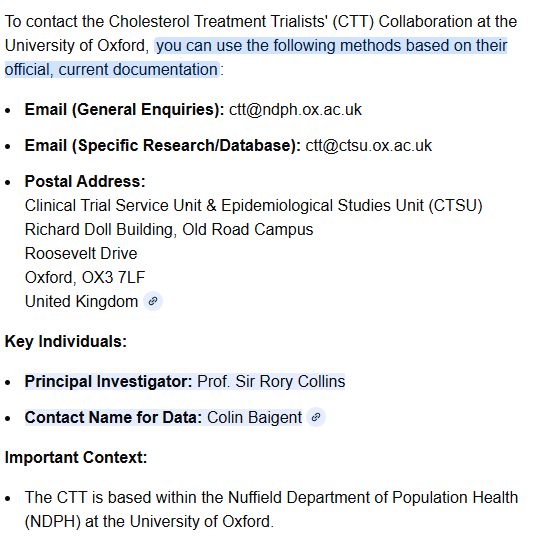
Any claim that these organisations can act independently of each other, in some strange way, is one hundred per cent pure … Don’t get it on your shoes.
Why is this an issue? Because the CTSU receives very large sums of money from the pharmaceutical industry to run clinical trials. Many of these involve cholesterol lowering agents, including simvastatin – as used in their initial HPS study. How much money are we talking about here?
The next section has been taken from a piece by Zoe Harcombe on the same Lancet article. She agreed to let me use it – because she has written about this many times, and I didn’t want to look it all up again, or tread on her toes.
Her section starts with the declaration that the CTSU had, by 2014, received ‘grants’ of £268 million for commercially funded research. How much have they earned since …who knows? No more declarations have been forthcoming……
[From Zoe Harcombe] The May 2014 declaration of funding (c. £268 million at that time, as above) was titled “Grants to Oxford University for any Clinical Trial Service Unit (CTSU) trials or other commercially-funded research over the past 20 years…”
‘My best guess as to how the CTT can try to claim no grant funding, given the self-declared grant funding, is that semantics have been relied upon between Oxford University, the CTSU and the CTT Collaboration. I’m open to any other explanations that may be on offer. I searched the latest CTT paper (the Lancet paper) for “Clinical Trial Service Unit” or “CTSU” and it appeared once – at the corresponding address “Correspondence to: Clinical Trial Service Unit…”
Whatever the semantics, the latest CTT paper focused on five statins. The manufacturers of the five statins chosen are Pfizer (atorvastatin), Novartis (fluvastatin), Bristol Myers Squibb (pravastatin), AstraZeneca (rosuvastatin), and Merck (simvastatin). The author declarations of interest took up over a page in the paper. Pfizer appeared 5 times, Novartis appeared 11 times, Bristol Myers Squibb appeared 3 times, AstraZeneca appeared 11 times, and Merck appeared 7 times.
Oxford University has strategic research alliances with several pharmaceutical companies including Pfizer, Bristol Myers Squibb and AstraZeneca. It has research partnerships with Novartis and Merck (Ref 21).
– “Pfizer has a longstanding research relationship with the University of Oxford” (Ref 22).
– “The Oxford-Bristol Myers Squibb alliance was established in 2015 … Oxford’s alliance with Bristol Myers Squibb continues to grow year on year, the total of Oxford-Bristol Myers Squibb Fellows is now 34 and many other collaborative projects are currently running” (Ref 23).
– “AstraZeneca (AZ) and Oxford have a long history of collaboration” (Ref 24).
While Novo Nordisk was not one of the companies helped by this paper, I noticed that “The alliance between Novo Nordisk and Oxford … has seen Novo Nordisk establish a presence onsite at the University of Oxford, with the Novo Nordisk Oxford Research Centre (NNRCO) employing up to 100 researchers between 2017 and 2021” (Ref 25).
Wow – 100 researchers – and how many people have been employed as a result of the few hundred million given to Oxford University for the CTSU or other commercially funded research?
There can be little doubt that relationships between Oxford University and pharmaceutical companies are of great mutual benefit. There can also be little doubt that it is inconceivable that any research would emanate from Oxford University that is critical of any drug made by any alliance companies. On the contrary, the higher the number of positive papers that can be published, the stronger the mutual alliance. [End Zoe Harcombe]
Yes, hundreds of millions in commercial funding. And that was twelve years ago. This figure will have grown considerably. In addition, hundreds of researchers have also been paid for by various pharmaceutical companies. Total cost? One hundred researchers at an employment cost of, at least, fifty thousand is five million, per year – minimum.
To claim, as they do, that the CTSU/CTT has no financial conflicts of interest is …what is the correct word here? Let me think.
At this point I will declare my own conflict of interest here – which has clear relevance to the discussion. Six years ago, I sued The Mail on Sunday for an article they published, way back in March 3rd 2019. I was accused, along with Zoe Harcombe and Aseem Malhotra, of being responsible for thousands of unnecessary deaths.
This was because we had ‘claimed’ that statins have more adverse effects than are widely reported. Also, that they were significantly less beneficial. With positive effects boosted by various forms of statistical manipulation.
The Mail on Sunday article stated that our talks, and blogs and publications had led to hundreds of thousands of people stopping their statins, leading to many thousands of excess heart attacks and strokes as a result. As one third of heart attacks are fatal, the implication, though not directly stated, is that many, excess deaths occurred. Hundreds, thousands?
Having, effectively, been accused of mass murder, I sued, along with Zoe Harcombe. And, yes, we won. [Which is why you cannot see the article anymore]. The libel case took over five years from start to finish. There was no evidence to support the central accusation of increased heart attacks and strokes. This accusation was based on a modelling study which had no outcome data on morbidity, or mortality. None.
Behind the scenes, Rory Collins and Colin Baigent were very active. They advised Barney Calman, the health editor on what to say. They even edited the paper. Here is one statement that Collins provided to Calman, which was in the article itself:
‘Professor Sir Rory Collins, the British scientist behind pivotal research into statins, says the potential consequences far outweigh that of the infamous MMR vaccine scandal, in which disgraced paediatrician Andrew Wakefield fabricated evidence to support his idea that the jab triggered autism in infants, leading to a decline in vaccination uptake and the resurgence of measles.’
Yes, Collins and Baigent, and various other Professors from the British Heart Foundation, were advising Calman on the best lines of attack. Collins and Baigent even congratulated him warmly after the article was published.
Below are just three of the hundreds of e-mails sent between the various players [All e-mails are on file. I am considering releasing the whole lot – as they are no longer confidential]. The first one here is from Barney Calman, health editor of the Mail on Sunday, to Rory Collins and Colin Baigent, among others, thanking them for ‘all their input’ into the article. [It includes Professor Nilesh Samani, medical director of the British Heart Foundation at the time].
Also named in the e-mail trail is Professor Liam Smeeth who was the lead author of the modelling study mentioned above. He has written widely on the fact that statins have no adverse effects. There is also Professor Peter Sever on the e-mail trail. And he is …stop right here Kendrick, libel goes both ways. A bit more info on Liam Smeeth…
‘Professor Liam Smeeth and Professor Sir Rory Collins are both prominent British academic experts in epidemiology and cardiovascular health who have closely intersected through high-profile, collaborative research on statins.’ From Google AI.
E-mail: From: Barney Calman To: Fiona Fox; Colin Baigent; Rory Collins; Professor Nilesh Samani; Sever, Peter S; Liam Smeeth Subject: [EXTERNAL] MOS/Statins Dear all, please find below our piece.
Thank you again for everything you’ve done to help so far. If you each separately send me back any amendments you have in tracked changes or some other trackable way, that’d be great. All comments welcome. BC by BARNEY CALMAN Health Editor
That was one e-mail proving that members of the CTT were commenting on, and even editing, the article.
After it was published, Rory Collins wrote this e-mail to Barney Calman:
E-mail From: Rory Collins Sent: Sun, 3 Mar 2019 18:07:05 To: Barney Calman Cc: Colin Baigent Subject: RE: all changes made Sensitivity: Normal External Sender:
Dear Barney: What a pleasure to see such a hard-hitting evidence-based article on fake news related to statins … and the page 2 article with Matt Hancock’s very direct comments was an unexpected bonus. Best wishes. Rory
Fake news …indeed. Twelve minutes later, Colin Baigent wrote this:
E-mail From Colin Baigent: Subject: Re: all changes made Sensitivity: Normal External Sender
Dear Barney: I’d like to echo Rory’s praise for your article. Thanks very much for taking the trouble to understand the issues, and also for your willingness to address last minute concerns, as I think the final product was admirable. Best, Colin
‘An admirable article’ … Although, as it turns out, it was also a libellous article. And you guys helped him to write it. Good job.
I knew where, and from whom, Calman was getting his information right from the start. Before the article had been published. To me, it was glaringly obvious that it had the CTT’s fingerprints all over it. Shortly before the article was published, Calman wrote to me, asking for my comments on the article (which he did not include in the e-mail), giving me twenty-four hours to respond to the various points he was making.
I then sent this e-mail on 28th February 2019 to others who share my views on statins:
On Thu, Feb 28, 2019 at 12:05 PM, malcolmken@doctors.org.uk [thincs] wrote:
Dear all,
The Mail on Sunday have contacted me about an article they plan to run, attacking me, and us. It is the usual Rory Collins attack.
I have been given until tomorrow to reply. Does anyone have any good, concise ammunition?
Regards
Malcolm
Yes, these guys work tirelessly behind the scenes to destroy the reputation of anyone who dares to question statins. This time their activities, normally unseen, were exposed in documents that were required to be released to the court before the libel case was heard.
I think that is enough information about the conflicts of interest at play here. You may still feel that the CTT is fully independent, and their objectivity remains beyond question. If so, then I do not suppose that anything I write, nor any other evidence, could convince you otherwise.
Summary
- The CTT, members of whom wrote the Lancet paper, have been aggressively attacking anyone who suggests that statins carry a significant burden of adverse effects for many years. Even when, by their own admission, they did not actually have the data on adverse effects.
- The CTT, who also have all the data from the statin trials, will not share it with any other researchers. Claiming commercial sensitivity/confidentiality.
- The CTT is intimately related to the CTSU, is part of the CTSU, and the CTSU has gained hundreds of millions of pounds in funds for running clinical trials on behalf of the pharmaceutical industry.
- My own conflict of interest is that individuals within the CTT have attacked me directly, and indirectly, many times over the years. Their behind-the-scenes activities were laid bare in court disclosure documents.
I think it is important for everyone to understand this background before moving on. And I feel the need to repeat that this was not a study led by Oxford Population Health. It was a study by the Cholesterol Treatment Triallists collaboration. A group with a very long history in this area, which they may not have wished to publicise. I believe the CTT are far too conflicted to have carried out unbiased research on statins.
3: https://www.bbc.co.uk/news/health-28602155
4: Rory Collins wants to see safety checks made for statins | UK | News | Express.co.uk
 Dr. Malcolm Kendrick
Malcolm all I can say in response to what they claim is – For @#ck’s Sake
I was on statins for 18 years and took myself off them 3 years ago. All the travel insurance company policies that I have seen, including those that cover specific medical conditions,say that ” I am not covered if I am not follwing my doctor’s advice” This means that I am forced to either take the medication, lie or not travel. Has anyone found a solution to this? I am 72 years old.
As I have read your books I knew immediately what was going on.I feel sorry for the people who do not have an inbuilt curiosity to learn. Thank you very much John Street
According to Medscape’s report on Feb 9th the:
Researchers compiled 66 non-muscle, non-diabetes outcomes that statin labels claim may be caused by these drugs — including cognitive problems, depression, sleep issues, kidney injury, sexual dysfunction, liver disease, and many others.
This is stunning. Exclude what are possibly the two most widely bothersome adverse effects and then look at all the others listed. And then go so far as to suggest rewording of the information leaflets? My goodness me – sounds really impressive and seriously concerned to make sure people taking statins are properly informed.
Yes, I saw that paper and looked at it and realised that it had p-value-itis. I was impressed by how many p-values there were per square centimetre. You have to be masochist to work through it. The trouble is that a p-value is not some independent supra-human metric, it depends on a human deciding a cut-off point for some variable. I had a discussion with my GP some years ago on this mentioning a previous paper by Professor Sir Rory Collins and Professor Peter Sever on the nocebo effect where some research was pulled in to show such where creatine kinase was not flagged as a problem unless it was 10 times normal. As I was leaving the consultation my lovely GP did mention that as I had got so far OK (well over 80) a statin would not make much difference anyway.
Anyway, the zing bat is another paper December 2025 – “Statin Use Is Associated With a Decline in Muscle Function and Mass Over Time, Irrespective of Statin Pharmacogenomic Score” PMID: 41267182 PMCID: PMC12634476 DOI: 10.1002/jcsm.70132
What they fail to realise is then many people given the astatination pill stop taking it because of the horrendous adverse effects & they don’tbtell the quack or their pharma dealer & they bin or burn the pills I have now gone from burning to telling quacks, nurses, consultants &c that my wife doesn’t & won’t take them anymore due to intense leg cramps, continuous dancing legs during sleep & memory & cognitive impairment, I saud to one hospital cardio nurse “you do know that there is growing evidence that they cross the blood brain barrier don’t you?” She didn’t respond. “And,” I continued, “that artovastatin is by far the worst offender!” Silence with an expression that I read as I’m not going to chalkenge what he is saying because I honestly don’t have a clue whether he us right or not.
My wife just had a mitral valve replacement, shevwill not be having statins norvwill she be eating a cholesterol free diet as recommended. She stopped smoking & has cut her sugar & carb intake & I am trying ti give her a reasobably balanced diet with a decent saturated fat intake & sufficient but not too much salt, which is also anither health giving substance high on their hit list.
God bless you for all you have brought & bring to the table. Warmest regards, John Thornborrow
That is a good change in diet. I always recommend: getting rid of Sugar (any fast carbs) and Seed-oils is the best you can do for your health!
Fascinating, and horrifyingly predictable. I look forward to reading more.
As soon as I saw this reported in the news I thought “Here we go again, I wonder who funded this study?”. I am glad Dr Kendrick has replied so timeously.
It is predictable that ‘research’ has been done to prove statins are beneficial! to the hundreds of thousands of recipients ( millions?) because they are so profitable to the manufacturers. Like those ‘covid’ ‘vaccines’, which weren’t so “safe and effective”, but which were money spinners. It’s the ‘one size fits all’ approach that is a threat to individual health. Medication ( statins) doled out in blanket fashion because people are in a particular age cohort. It seems to be the modus operandi for these drug cartels. Any adverse reactions are deemed ‘rare’. Tell that to the sizeable numbers in the ‘rare’ category for statins ( and the ‘covid’ jabs).
I am appalled that these organizations are still getting away with this garbage!
There is no way to readily explain how grateful we all are for your work. I share this with many of my friends that “get it”. I devour all your books and as a former nurse can verify so much of what you say just from past patient experiences. Luckily, at age 75 I have escaped needing ANY drug partially because when I am told by a doctor that I really SHOULD be on this or that, I then launch into: What is the NNT? What is the absolute risk of taking this med? etc etc. No physician NOR pharmacist has been able to respond to this. So I won’t take the med. I know to ask this only because of your books! I will be forever grateful. Keep it up!!!
Corruption in a field with the wrong incentive structure: drugs and surgery? Say it ain’t so, sir! Those dolts are losing ground every day and it’s up to the rest of us to help that along.
Looking forward with impatience to second and third partsTim O’Dowd. AustraliaSent from my iPhone
The study from the University of Kuopio in Finland, which followed 8,800 participants for 5 years, found that 50% developed diabetes while taking statins, compared to 4% in the placebo group. I know several people who took statins; they all experienced significant side effects, some even dying. I myself had a pulmonary embolism due to statins.
Follow the [fiat] money…
The attitude of some doctors is incomprehensible to me, and probably to other people as well. About 17 years ago, my mother, who had been taking statins for over 10 years, began to fall to the ground and didn’t have the strength to get up. She consulted orthopedists and neurologists, underwent a series of tests, took various medications, but progressively lost strength in her legs. In a consultation with a neurologist, I suggested that this could be due to the use of statins. I can’t forget the look of arrogance and even contempt with which he looked at me. Some time later, I asked my mother to stop taking statins. After that, she no longer fell to the ground, regained some strength in her legs, but not completely. It became clear to me what the neurologists refused to see: the problem was caused by the use of statins. My mother lived another 17 years with high cholesterol, but without cardiovascular problems, and died peacefully in her sleep a few months ago, at the age of 95.
The idea that adverse side-effects are the imaginary result of people reading that they exist is frankly absurd. I was taking statins for probably around a year, completely accepting at that time that they were good for me because the Dr said so and never having heard anything about adverse effects. Then I think it was NICE decided to double the dose. Now I am one of those lucky people who has never suffered from any back pain, but almost immediately upon taking the increased dose, I began to experience weird muscular spasms in my back, It took me a while to work out that it might be the statins causing them. But I eventually stopped taking them. Result? Pain disappeared. Since then I have read all the literature on the medication, including your excellent work and agree that the statins industry is a major scandal that will probably never be unmasked in public, continuing to net the pharmaceutical companies trillions of dollars worldwide.
I’ll forever live with the too early death of my husband whose cardiologist bullied him into taking an 80mg dose of Atorvastatin aiming for an LDL reading of <1.6. Even the GP was shocked and instead prescribed the dose at 10mg. Not to be. Sadly my husband acquiesced despite my urging not to give in. He was dead months later with an LDL of 1.6. Was it the high dose statin? I don’t know however I’ve continued to argue for my own statin free status and with a CAC twice reading at 0 I’ve held the statinators off.
‘Assessment of adverse effects attributed to statin therapy in product labels: a meta-analysis of double-blind randomised controlled trials.’
That is certainly a mangled title. I think what they are meaning to say is that adverse effects are a result of what is said on the product label. And that is certainly the tone of the ‘study’. However, for this to be an issue, one needs to know how many people have actually read the label. My suspicion is that less than 5% of people ever read the label. Not that my suspicion is relevant, because nowhere in the article does it refer to anyone reading labels, nor are there any studies on the population of label reading statin consumers and the relation to side-effects experienced by them. So the study bears no relation to the title, and is an even greater load of bollocks than it might at first have appeared to be. Which is saying something.
Thank you—I noticed this also. I’d guess what they’re trying to head off at the pass is journalists who are (slightly) more likely to read the label mentioning those side effects.
I am sorry for your loss, although glad your mother had 17 years of cardiovascular fr
As soon as I saw the headline on the BBC news, I was suspicious and anticipated your blog on the issue. My suspicions have been confirmed – thank you and I look forward to the next two parts.
I’m so pleased you’re writing about this. I keep getting texts from my surgery telling me to have an appointment with the ‘clinical physician’ . I’m vulnerable and I should be taking statins. I refused and said I’ll have a blood test for my own knowledge, of course I didn’t have high a cholesterol reading , they didn’t bother informing me of this, I had to ask for the results. A year later I get another text opening up the very same door. Makes my blood boil. They expected me to just agree and start taking statins for no reason 🤬. No doubt, they get paid for how much they prescribe, same as they did with the antibiotics.
How long before the enablers at the MHRA comply with the paper’s recommendations to re-write the patient information leaflet? Ironically most legal advice would be to put all adverse effects, even the smallest, in the leaflet. I guess dead people don’t sue.
A brilliant article. Thank you, Dr. K. I’ve just been put back on a statin after a heart procedure, I feel pretty miserable about it and full of doubt…….just saying. 😢
I just knew Malcom would come up with a convincing rebuttal of the latest claims about statins, and his opening salvo augurs well for just that. A tale of our times, where the fabricators of fake news accuse the purveyors of truth of disinformation.
I was advised by a nursing assistant recently at my GPs to study statins on the BHF website, before deciding whether to take them up. Given what I’ve just read, I certainly wont be proceeding with them, I have more faith in Dr Kendrick than in a bunch of shills. Obliged to you Dr Kendrick.
We can say no to drugs and vaccines. Before long, they will want all drug and vaccine labels to state only one thing: This product is safe and effective. But then, who reads the labels? Certainly not the brain dead doctors. And most patients have no clue either.
Hey doc, I just died taking your drugs. Doc says, no it’s just your imagination. Sadly, that’s where we are at.
You cannot keep putting toxic drugs and poison vaccines into your body and expect nothing to happen. If drugs and vaccines were the missing ingredient to a long and healthy life, we would be seeing the results by now. You have a much better chance of living longer and healthier by avoiding those drugs and vaccines.
I once asked ‘my’ GP about the info on the leaflet, could it be trusted and he laughed. Draw your own conclusions.
Well really my legs kept giving way underneath me as in I kept falling down on the statins.Vision kept going fuzzy as well. For goodness sake.
Following a review of my risk of a cardiovascular event in the next ten years, I pointed out to my GP at the time that my risk was about as low as it could be for a 60-year old based on factors like age, gender, ethnicity, smoking status, BMI, blood pressure, cholesterol levels, and medical history (QRisk 2). I was confident in doing this because I had recently been involved in some research about this.
My GP said “Yes, I’m wasting my time doing these consultations, but I’m required to do them.” He then pointed out that my cholesterol was higher than the recommended levels, and went on to say “ . . . but I don’t suppose you want to put any more poisons into your body, do you?”
This was 15 years ago and I think my medical record says “Refused Statins”, as I’ve never been asked again even though that GP retired a few years after that conversation.
I wish more GPs were as willing to be open minded and not just follow directions from above.
P.S. I take medication for hypertension, which I think is very important. My present GP is fortunately willing to work with me to choose medication that does not have adverse effects for me personally.
Thank you, Dr. Kendrick. I am one of the many unfortunates who suffered permanent muscle damage from a needless prescription of simvastatin from 2008 to 2012. No monitoring, but my CK reading of 20 x normal was discovered by chance and the alarm was raised. When referred to NHS specialists their attitude was very strange, complete denial and hostility. Now permanently disabled on the right side of my body.
Is it true that the original statin trial data and adverse effects from the late 70s has never fully been published and/or available? Similar to PFZ’s covid vax where they said they’d keep all the data under wraps for 75yrs. That tells you all you need to know if true.
If it’s a leaflet issue than why don’t patients just fall dead when they reach the mention ? Come on Sir Collin !
Ponder this statement for just a few moments: the new paper(s) are claiming that statins are safer than previously thought. For that statement to be true, wouldn’t it have to mean that half a century of clinical trials and other types of follow-up observations of statin users are inaccurate, that the health risks and benefits collected over tens of thousands of patients and many years are mostly in error? That seems a bit difficult to believe.
As a 60 year old woman with both parents having had atherosclerosis I want to do everything I can to protect myself from heart attack or failure. I eat pretty well, drink in moderation and don’t smoke, I’m active and keep fit…. I read the pros and mainly cons of statins but what are the other options?
Get on with your life.
Everyone in my family who took statins ended up with horrible dementia. My father, father in law and mother in law. Mum died before they could get her on them. She was age 77 and still with it.
The others died older but they weren’t really alive.
Keep up your good work.
Regards Marson Early
I was prescribed statins a few years ago. I started to experience bad nightmares. I would call them night terrors. They were so bad I was referred to the sleep clinic at the local hospital. The Consultant told me my sleep disturbance was caused by statin drugs and to stop taking them immediately. Needless to say I have never had the problem again.
The central message of the paper is as follows. The reason why people report that they are suffering aches and pains, or other symptoms, is because they have heard about them, or read about them. In other words, they are imagining them. The so-called ‘nocebo’ effect.
Many years ago I was put on Simvastatin; I took the first tablet on a Sunday evening and by Monday lunchtime I was so exhausted and in so much pain that I had to crawl on my hands and knees upstairs and spent the next 48 hours in bed. I didn’t return to normal for over a week. It is with great relief that I now know that Simvastatin was not to blame and that the whole episode was just a figment of my imagination.
(i) “a meta-analysis“: the principle of a meta-analysis is attractive but the practice often seems to be an exercise in cherry-picking.
(ii) Forgive me if I’ve told this story before. I asked a friend, a retired epidemiologist, about statin adverse effects. He said that far more of his statinated friends reported them than the literature encouraged him to think likely. “Do you take them yourself?” “Good God, no!”
Hi,
Took Statins for 6 months in 2022/3 and felt crap. I had 4 stents and a heart attack in 2022. I am 72, do not take statins but concentrate on a non inflammatory diet, exercise and golf. Works for me much to my cardiologist’s and GP’s chagrin. I do take disprin 3 times a week, meditate daily and take lots of turmeric and related supplements. I reduced my weight from 15 to 12.5 stone (I am 5ft 11’) after my event and track my blood pressure, it was high at 145 / 90 pre 2022 ,now 135/75. I have had my BP lower when I restrict my (croissants and cake)sugars more. Love your blog and often dip into your book The Clot Thickens. Keep up the good work!
I tried statins and and even the lowest dose was just terrible side effects after 3 weeks both mentally and physically. I am a high risk patient had bypass at 42 and have PAD.
I exercise daily and I am fit and healthy and 65 years of age Bike ride and gym and golf if you class that as exercise.
My question is that my cardiologist asked me to try Repatha which I am trialing and I am in week 3 has anyone had and history or effects on this medication
Yes all my markers are high
Another fabulous post – thank you for all you do Dr Kendrick. I’ve been reading your posts for years and love how you weave humour into VITs (very important topics). I’m a volunteer for BANT events (British Association for Nutrition & Lifestyle Medicine) and we would love to invite you to speak at our virtual event in June 2026. I believe attempts have been made to contact you without success. Can you please email me to ascertain yes/no whether you are interested? Thanks Sue
While the following doesn’t deal directly with statins, it’s an apt anecdote showing what’s wrong with medicine in general and cardiology in particular:
Last week I had a routine cardiology appointment. Other than what I think “normal” problems that a 64-year-old might present (e.g. some atherosclerosis, a 20% carotid blockage), my lipids are “too high”, TC is about 223 and LDL about 151. Well, a low carb diet can do that.
I met a new doctor with the firm. After explaining my distrust of statins, he
I have some familiarity with the first, having read all of Kendrick’s books. Indeed, its is a fairly colorful history and he covers it in agonizing detail in Statin Nation. The second was new-to-me.
It’s worth mentioning that a year prior, I’d had a similar conversation with the nurse, who pitched me on a PCSK9 inhibitor (evolocubmab, I think). Which I declined, again, because I read Kendrick.
Anyway, this latest iteration, I looked up inclisiran as it was “new to me.” After spending an hour or two on PubMed, using skills learnt from Doctoring Data and his other texts, I easily ascertained that, much like similar products:
Inclisiran does lower LDL quite effectively, but
What clinical trial data are available (still interim) there is virtually no change in adverse events, mortality, etc. when compared against control.
These drugs seem to get approved because they lower LDL, not because they’ve been shown to reduce the incidence of adverse events.
Inclisiran has the bonus feature of being a first of its type substance, some form of an RNA that temporarily (?) changes the liver’s behavior, resisting in its being a PCSK9 inhibitor.
None of the above speaks well for cardiology, I suppose. But none of this is to surprise one, given what Kendrick has recounted in his books.
I’m still willing to be non-invasively monitored by these “professionals.” At least with an MRI every few years I’m only subjecting myself to a fairly big dose of X-Rays.
But, even given all my skeptical knowledge, it’s still disconcerting that trained MDs or nurses who should know better recommend, apparently by script or reflexively, drugs that seem to offer little actual benefit to the patient, cost a lot (even if mostly paid by insurance) and somewhat more worryingly, especially in the case of inclisiran, haven’t even been on the market more than a few years! Sure, reprogram my liver to throw a monkey wrench into essential processes! Sign me up!
The final oddity is that these drugs seem to be intended as adjuncts to therapy and for more severe cases (e.g. FH cases). And here they are, being promoted to a healthy patient with only slightly elevated lipids….???
Follow the money…
A minor error: MRI does not use x-rays; it uses radio waves. I was probalby thinking of a CT scan, which does use x-rays. Oh well, fancy machines both, that let doctors take pictures inside my body.
Glad you checked that for yourself. I was vaguely contemplating a school-teachery correction
My wife has noticed something she calls the “statin shuffle” in old and not so old men. She had first hand experience of someone afflicted by statins . . . Me: neuropathy (still left overs in my right arm 12 years after giving up statins) -myopathy (couldn’t raise my arms – asked the doctor “At what point will I be unable to wipe my own bum”) and, during each year of taking them, my HbA1c drifted higher and after 4 years took me into T2D range.
/
Perversely, I thank statins! I was not in good condition for years before taking statins: tense, edgy and overweight, The statins tipped me over the edge. I had to find out what gave me T2D and how to get rid of it. Went down a warren full of rabbit holes leading to keto and recently carnivore. . . . Got rid of the overweight, the arthritis, parapsoriasis lesions on the skin and have better psychological health. Its the old story . . . if I only knew then what I know now!