
April 25th 2019
Thank you to those of you enquiring after my health. I have had a horrible cough and cold and proper ‘man flu’ for the last couple of weeks, now settling. Before that, skiing, before that lecturing. But enough about me.
Over the last few weeks I have watched a flurry of activity from all directions, as the attacks on red meat and saturated fat intensify. Walter Willett must be writing up a new research paper every five minutes, such is the wealth of material he has cascaded down upon a grateful world in recent weeks (I suspect others may be doing much of the heavy lifting on his behalf).
It also seems that the Lancet has given up any pretence of being an objective seeker of the truth. Instead, the Lancet appears to have become a mouthpiece for the vegan movement. Here is what the Lancet has to say about their new EAT-Lancet project.
‘Food systems have the potential to nurture human health and support environmental sustainability; however, they are currently threatening both. Providing a growing global population with healthy diets from sustainable food systems is an immediate challenge. Although global food production of calories has kept pace with population growth, more than 820 million people have insufficient food and many more consume low-quality diets that cause micronutrient deficiencies and contribute to a substantial rise in the incidence of diet-related obesity and diet-related non-communicable diseases, including coronary heart disease, stroke, and diabetes. Unhealthy diets pose a greater risk to morbidity and mortality than does unsafe sex, and alcohol, drug, and tobacco use combined. Because much of the world’s population is inadequately nourished and many environmental systems and processes are pushed beyond safe boundaries by food production, a global transformation of the food system is urgently needed.’1
Many out there probably agree with much of this statement, especially the parts about environmental sustainability and insufficient food to feed many people. However, even if you do, you have to ask what an investigative medical journal is doing in this space. There is no longer even an attempt to be mildly objective. The Lancet has simply taken sides. Which is the exact opposite of what any scientific journal should ever, ever, do. You may notice that Professor Walter Willett was the lead author of the article quoted above
Here is one statement that I would like to further highlight. Unhealthy diets pose a greater risk to morbidity and mortality than does unsafe sex, and alcohol, drug, and tobacco use combined.’
At this point I completely part company with Walter Willett. For it is the most complete and absolute nonsense. For a start, how did he calculate the figures? For example, sexually transmitted disease – and death. How many people die of this? How many people suffer, and by how much? Do we have any idea?
Well, we know that many children die from congenital syphilis. How many around the world? I checked the WHO publications on this, and there are only estimates to be had. HIV? Gonorrhoea? Hundreds of millions that are infected, and affected, but how many millions? How many deaths? Unknown really.
We can perhaps be a little clearer on the other things such as cigarette smoking. Just looking at one country, the US:
‘Cigarette smoking is responsible for more than 480,000 deaths per year in the United States, including more than 41,000 deaths resulting from secondhand smoke exposure. This is about one in five deaths annually, or 1,300 deaths every day.’ 2
The US population is around three hundred million. The population of the world around seven billion. If 480,000 deaths a year occur in the US, this would equate to eleven million deaths a year around the world.
Alcohol?
Around the world, about 1 in 5 adults were estimated to drink heavily in any given 30-day period. The burden of ill health for alcohol was less than for tobacco, but still substantial: 85.0 million DALYs [Disability adjusted life years]. Alcohol-related illness was estimated to cause 33.0 deaths per 100,000 people worldwide.3
Thirty-three deaths per 100,000 people worldwide is two point three million deaths each year from alcohol, worldwide. As for ‘illegal’ drug deaths.
‘Globally, UNODC estimates that there were 190,900 (range: 115,900 to 230,100) drug-related deaths in 2015, or 39.6 (range: 24.0 to 47.7) deaths per million people aged 15-64 years. This is based on the reporting of drug-related deaths by 86 countries.’4
This figure seems low, based on the CDC review of drugs deaths in the US
‘70,237 drug overdose deaths occurred in the United States in 2017. The age-adjusted rate of overdose deaths increased significantly by 9.6% from 2016 (19.8 per 100,000) to 2017 (21.7 per 100,000). Opioids—mainly synthetic opioids (other than methadone)—are currently the main driver of drug overdose deaths. Opioids were involved in 47,600 overdose deaths in 2017 (67.8% of all drug overdose deaths).’ 5
70,237 in the US would extrapolate up to 1.623 million deaths a year worldwide. Maybe other countries don’t hand out opiods like sweeties to everyone. Although, in the UK, we are certainly following suit.
So, we have some figures to go on. Somewhere in the fifteen to twenty million per year killed by unsafe sex, alcohol, drug and tobacco use each year. Who knows what the morbidity might be?
This is a gigantic figure, and we are supposed to believe that unhealthy diets are worse than this? I would challenge Walter Willett to find a single randomised controlled clinical study demonstrating that any dietary substance has significantly increased the risk of death in anyone, ever.
By unhealthy, of course, what the authors mean is animal fats/saturated fat, red meat, bacon, sausages and suchlike. Essentially, anything that is not vegan.
What of saturated fat? The last time it was possible to get an accurate assessment of saturated fat and deaths from CHD in individual countries was in 2008. After that, the figures mysteriously disappeared. Luckily Zoe Harcombe kept a copy and sent it to me.6
From these figures, I present you with a graph. Sorry, it is a bit complicated. So, please take a little time to study it, because it has two axes. The percentage of energy from saturated fat in the diet is the top axis, going from 0% up to 18%. As you can see from this, saturated fat intake is highest in France at 15.5%, and lowest in Georgia at 5.7%. Second lowest Azerbaijan, then Ukraine, then Russia.
The other axis looks at deaths from CHD. With the highest being Russia, then Georgia, then Azerbaijan, then the Ukraine.
The fact that stands out is that the countries with the lowest saturated fat intake had, on average, six times the rate of death from CHD, in comparison to the four countries with the highest saturated fat intake. I like to wave this graph at people who tell me that saturated fat in the diet is the single most important risk factor for CVD. I also like teasing vegans with it. Although they rarely respond well to teasing – as you may imagine.
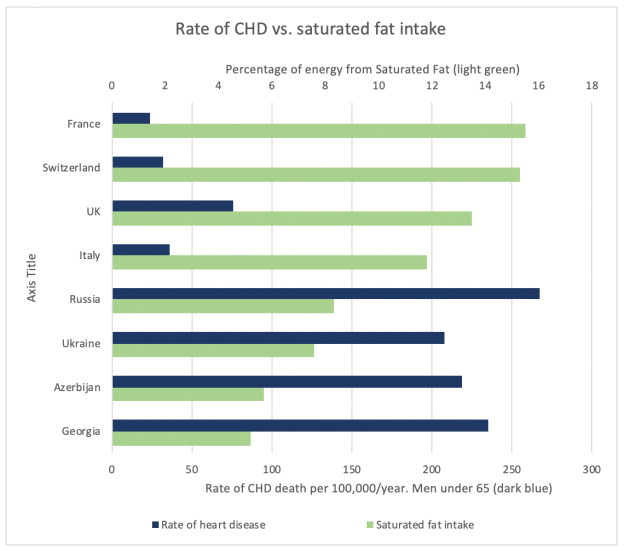
I would also like to enquire of Walter Willett what he makes of data like this? I presume he would just ignore it, or point to the vegetarians of La Loma California, or suchlike. But, as any scientists know, you cannot just pick and choose populations you like and ignore those that you don’t. Nor would I dream of saying that, from this graph, we can prove that saturated fat intake protects against CVD. However tempting that may be.
But I know that this is what the EAT-Lancet are likely to do, along with all other researchers who simply ignore things they don’t like. In fact, the games played to prove that saturated fat is bad for you, twist the fabric of logic well beyond breaking point.
Which takes to me to favourite paper of all time. ‘Teleoanalysis: combining data from different types of study.’ Published in the BMJ more than fifteen years ago. 7
The paper makes this statement:
‘A meta-analysis of randomised trials suggested that a low dietary fat intake had little effect on the risk of ischaemic heart disease.’ Good, I like that. It seems astonishingly accurate. Randomised trials on dietary fat have had no effect. Which is the point where this paper should really have fallen silent.
But no, the authors decided that we should ignore these pesky studies a.k.a. evidence. Instead we should use teleolanalysis. I shall now quote directly, and heavily from the papers itself.
‘Once a causal link has been established between a risk factor and a disease it is often difficult, and sometimes impossible, to determine directly the dose-response relation. For example, although we know that saturated fat intake increases the risk of ischaemic heart disease, the exact size of the effect cannot be established experimentally because long term trials of major dietary changes are impractical. One way to overcome the problem is to produce a summary estimate of the size of the relation by combining data from different types of study using an underused method that we call teleoanalysis. This summary estimate can be used to determine the extent to which the disease can be prevented and thus the most effective means of prevention. We describe the basis of teleoanalysis, suggest a simple one-step approach, and validate the results with a worked example.
What is teleoanalysis?
Teleoanalysis can be defined as the synthesis of different categories of evidence to obtain a quantitative general summary of (a) the relation between a cause of a disease and the risk of the disease and (b) the extent to which the disease can be prevented. Teleoanalysis is different from meta-analysis because it relies on combining data from different classes of evidence rather than one type of study.
In contrast to meta-analysis, which increases the precision of summary estimates of an effect within a category of study, teleoanalysis combines different categories of study to quantify the relation between a causative factor and the risk of disease. This is helpful in determining medical practice and public health policy. Put simply, meta-analysis is the analysis of many studies that have already been done; teleoanalysis provides the answer to questions that would be obtained from studies that have not been done and often, for ethical and financial reasons, could never be done.’
In so doing we can prove that saturated fat causes heart disease. ‘I say, Bravo. Bravo, sir. You are truly a genius.’
It is upon such foundations as this that the EAT-Lancet authors can say – in all seriousness – Unhealthy diets pose a greater risk to morbidity and mortality than does unsafe sex, and alcohol, drug, and tobacco use combined.’
Keep saying it and people will end up believing you. Even if you have not a scrap of evidence to support it. A phenomenon first noted by Lewis Carroll in his magical poem the Hunting of the Snark…
“Just the place for a Snark!” the Bellman cried,
As he landed his crew with care;
Supporting each man on the top of the tide
By a finger entwined in his hair.
“Just the place for a Snark! I have said it twice:
That alone should encourage the crew.
Just the place for a Snark! I have said it thrice:
What I tell you three times is true.”
Unfortunately for the EAT-Lancet crew, repeating nonsense as many times as you like cannot magically transform it from nonsense to truth. The biggest recent study on the impact of diet and heart health was the PURE study. Which was reported thus, last year:
‘Findings from this large, epidemiological cohort study involving 135,335 individuals aged 35 to 70 years from 18 low-, middle- and high-income countries (across North America, Europe, South America, the Middle East, South Asia, China, South East Asia and Africa) suggest that high carbohydrate intake increases total mortality, while high fat intake is associated with a lower risk of total mortality and has no association with the risk of myocardial infarction or cardiovascular disease-related mortality.
Furthermore, a higher saturated fat intake appeared to be associated with a 21% lower risk of stroke. Why might these results be in such contrast with current dietary advice? “The conclusion that low fat intake is protective is based on a few very old studies with questionable methodology,” explains Professor Salim Yusuf (McMaster University, Hamilton, Ontario, Canada), senior investigator for the PURE study. “The problem is that poorly designed studies performed 25–30 years ago were accepted and championed by various health organisations when, in fact, there are several recent studies using better methods, which show that a higher fat intake has a neutral effect,” he continues, citing the example of the Women’s Health Initiative trial conducted by the National Institutes of Health in 49,000 women that showed no benefit of a low-fat diet on heart disease, stroke or cardiovascular disease.’ 8
Anyway, I know that facts are pretty much useless against the diet-heart behemoth. It eats facts, turns them through one hundred and eighty degrees and spits them out again. I just felt the need to let people know that IT IS ALL COMPLETE AND UTTER RUBBISH. Gasp. Thud. I feel my man flu returning.
Refs:
1: https://www.thelancet.com/journals/lancet/article/PIIS0140-6736(18)31788-4/fulltext
2: ‘https://www.cdc.gov/tobacco/data_statistics/fact_sheets/fast_facts/index.htm
3: https://www.nhs.uk/news/medical-practice/tobacco-alcohol-and-illegal-drugs-are-global-health-threat/
4: http://www.unodc.org/wdr2017/field/Booklet_2_HEALTH.pdf
5: https://www.cdc.gov/drugoverdose/data/statedeaths.html
6: European cardiovascular disease statistics 2008 edition. Steven Allendar et al: Health Economics Research Centre, Dept of Public Health, University of Oxford.

 Dr. Malcolm Kendrick