Yearly Archives: 2017

Tim Noakes found not guilty – of something or other

Many years ago I started looking at research into cardiovascular disease. Almost as soon as I began my journey, I came to recognise that many facts I had been taught in medical school were plain wrong. This did not come as a great surprise. Anyone familiar with the history of scientific research will soon find out that widely established facts are often not ‘true’ at all. My mother still likes to tell me that when she was at school it was taught, with unshakeable confidence, that there are 48 human chromosomes. There are 46.

In addition, it became clear that, not only were certain key facts wrong, there seemed to be a co-ordinated effort to attack anyone who dared to challenge them. One stand out example of such an attack was what happened to John Yudkin, the founder of the nutrition department at the University of London’s Queen Elizabeth College.

He did not believe that saturated fat was to blame for heart disease, the idea at the centre of the diet-hypothesis. At the time, this theory was being relentlessly driven by Ancel Keys, and it had gained widespread acceptance amongst the scientific community. In 1972 Yudkin wrote the book ‘Pure white and deadly’ in which he outlined why sugar was the probable cause of heart disease, not fat(s). He was then ruthlessly attacked. As outlined by the Telegraph:

‘The British Sugar Bureau put out a press release dismissing Yudkin’s claims as “emotional assertions” and the World Sugar Research Organisation described his book as “science fiction”. When Yudkin sued, it printed a mealy-mouthed retraction, concluding: “Professor Yudkin recognises that we do not agree with [his] views and accepts that we are entitled to express our disagreement.”

Yudkin was “uninvited” to international conferences. Others he organised were cancelled at the last minute, after pressure from sponsors, including, on one occasion, Coca-Cola. When he did contribute, papers he gave attacking sugar were omitted from publications. The British Nutrition Foundation, one of whose sponsors was Tate & Lyle, never invited anyone from Yudkin’s internationally acclaimed department to sit on its committees. Even Queen Elizabeth College reneged on a promise to allow the professor to use its research facilities when he retired in 1970 (to write Pure, White and Deadly). Only after a letter from Yudkin’s solicitor was he offered a small room in a separate building.

“Can you wonder that one sometimes becomes quite despondent about whether it is worthwhile trying to do scientific research in matters of health?” he wrote. “The results may be of great importance in helping people to avoid disease, but you then find they are being misled by propaganda designed to support commercial interests in a way you thought only existed in bad B films.”

And this “propaganda” didn’t just affect Yudkin. By the end of the Seventies, he had been so discredited that few scientists dared publish anything negative about sugar for fear of being similarly attacked. As a result, the low-fat industry, with its products laden with sugar, boomed.’1

Let us scroll forward some forty years or so, to Professor Tim Noakes. Regular readers of this blog will have heard of Tim Noakes who is, to quote Wikipedia.. ‘…a South African scientist, and an emeritus professor in the Division of Exercise Science and Sports Medicine at the University of Cape Town.

At one time he was a great supporter of the high carb low fat diet, and even helped to develop high carb energy foods for long distance runners. However, for various reasons (most importantly studying the science again) he completely changed his mind. He is now a very well-known proponent of the high fat, low carb (HFLC) diet, as a way to treat obesity and type II diabetes – and improve athletes’ performance.

A couple of years ago, he was dragged in front of the Health Professions Council of South Africa (HPCSA) after being charged with unprofessional conduct for providing advice to a breast-feeding mother in a tweet. “Baby doesn’t eat the dairy and cauliflower. Just very healthy high fat breast milk. Key is to wean [sic] baby onto LCHF.”

The case against him was obviously, and almost laughably, bogus. The HPCSA did not even (as I understand it) have any guidelines on what constitutes an on-line doctor patient relationship. You could make the case that it is difficult to find someone guilty of breaching rules, when there are no rules. Despite this, I thought they would get him on some technicality or other.

Just as happened to Gary Fettke in Australia

‘Prominent Launceston surgeon Gary Fettke has been banned from giving nutritional advice to his patients or the public for the rest of his medical career. He was recently notified by the Australian Health Practitioner Regulation Agency that he was not to speak about nutrition while he remained a medical practitioner.

Dr Fettke is a strong advocate for a low carb, high fat diet as a means to combat diabetes and ill-health. AHPRA told Dr Fettke “there is nothing associated with your medical training or education that makes you an expert or authority in the field of nutrition, diabetes or cancer”. It told him the ban was regardless of whether his views on the benefits of the low carbohydrate, high-fat lifestyle become accepted best medical practice in the future.’ 2

Lo, it came to pass that Gary Fettke cannot even talk about a high fat diet, even if it becomes accepted best medical practice…. Ho hum, now that really makes sense. At this point you may possibly, just possibly, see some parallels between Tim Noakes, an advocate of the high fat low carb diet in South Africa, and Gary Fettke, an advocate of the high fat low carb diet in Australia. Also, of course, John Yudkin, who was attacked and effectively silenced by the sugar industry many years ago.

This would be, I suppose, the very same sugar industry who paid Harvard researchers in the 1960s to write papers demonising saturated fat and extolling the virtues of sugar.

‘Influential research that downplayed the role of sugar in heart disease in the 1960s was paid for by the sugar industry, according to a report released on Monday. With backing from a sugar lobby, scientists promoted dietary fat as the cause of coronary heart disease instead of sugar, according to a historical document review published in JAMA Internal Medicine.

Though the review is nearly 50 years old, it also showcases a decades-long battle by the sugar industry to counter the product’s negative health effects.

The findings come from documents recently found by a researcher at the University of San Francisco, which show that scientists at the Sugar Research Foundation (SRF), known today as the Sugar Association, paid scientists to do a 1967 literature review that overlooked the role of sugar in heart disease.3

A pattern does appear to emerge does it not?

With my views on diet, and cholesterol, and heart disease, and suchlike, I have often been accused of being a conspiracy theorist – which is just another way of saying that I am clearly an idiot who should shut up. I simply smile at people who tell me this, and say nothing. However, my motto is that…‘Just because you’re paranoid, it doesn’t mean they are not out to get you.’ In the case of the High Fat Low Carb advocates, they are out to get you, and there truly is a worldwide conspiracy to attack any silence anyone who dares criticise sugar/carbs in the diet.

The attacks and distortions have not stopped with the ‘Harvard researchers’, or John Yudkin, or Gary Fettke or Tim Noakes, they continue merrily today. In the Sunday Times of April 23rd 2017 an article appeared, entitled ‘Kellogg’s smothers health crisis in sugar – The cereals giant is funding studies that undermine official warnings on obesity.’ Just to choose a few paragraphs.

One of the food research organisations funded by Kellogg’s is the International Life Sciences Institute (ILSI). Last year if funded research in the Journal Annals of Internal Medicine that said the advice to cut sugar by Public Health England and other bodies such as the World Health Organisation could not be trusted.

The study, which claimed official guidance to cut sugar was based on “low quality evidence”, stated it had been funded by an ILSI technical committee. Only by searching elsewhere for a list of committee members did it become clear that this comprised 15 food firms, including Kellogg’s, Coca-Cola and Tate and Lyle.

In 2013 Kellogg’s funded British research that concluded “regular consumption of cereals might help children stay slimmer.” The study, published in the Journal Obesity Facts relied on evidence from 14 studies. Seven of those studies were funded by Kellogg’s and five were funded by the cereal company General Mills.

And so on and so forth. Interestingly, no-one from the world of nutrition has suggested that Kellogg’s should be dragged into court for distorting data, trying to discredit honest researchers, and paying ‘experts’ to speak on their behalf. It is the Golden Rule, I suppose. He who has the gold, makes the rules.

This all has obvious parallels to the tricks the tobacco industry got up to over the years. They did everything they could to hide the fact that cigarettes cause heart disease and cancer. Now the sugar industry, and those selling low fat high carb products, are trying to hide the fact that sugar/carbs are a key cause of obesity and type II diabetes.

And the techniques used by the sugar/cereal/high carb companies are drearily familiar – and sadly still highly effective. As with Yudkin, Noakes and Fettke, go for the man, not the ball (discredit the person, not their data). Dismiss any damaging evidence that does manage to emerge as ‘weak’, pay your own experts to write bogus reports, and create uncertainty everywhere. Some people should be very ashamed of themselves indeed. Instead, I suppose, they are getting massive bonuses.

The nutrition society of South Africa said, in response to the Noakes judgement: “We are glad that the hearing has been finalised after almost three years, unless there is an appeal. The judgement, however, has absolutely no bearing on the current or future status of nutrition or the dietary guidelines in South Africa.’4 So there, nyah, nyah, nyah. Any apology to Tim Noakes? No. Any apology for wasting huge sums of money on a court case they lost? No. Just a threat that they may appeal. They are not going to change a thing.

So, whilst Tim Noakes won his case, any scientist looking on gets a very clear message. If you say things we don’t like, we will attack you and drag you through court and make your life a living hell for three years. Now, that is how you silence people, just as they silenced Yudkin nearly forty years ago.


1: http://www.telegraph.co.uk/lifestyle/wellbeing/diet/10634081/John-Yudkin-the-man-who-tried-to-warn-us-about-sugar.html

2: http://www.couriermail.com.au/news/national/surgeon-gary-fettke-banned-for-good-on-food-advice-by-regulatory-body/news-story/d973faa72dc64836f2209469a67592d5

3: https://www.theguardian.com/society/2016/sep/12/sugar-industry-paid-research-heart-disease-jama-report

4: https://www.pressreader.com/south-africa/the-sunday-independent/20170423/281681139761415

What causes heart disease part XXIX, part B.

Alcohol – an update

My last blog on alcohol caused somewhat of a stir, as I suspected it would. To those who did not read it, I recommended that, from a cardiovascular health point of view, those who do not drink alcohol should start. I recommended this because there is strong evidence that moderate alcohol consumption significantly reduces the risk of cardiovascular disease – and can also reduce overall mortality/increase life expectancy.

There were many objections, scientific and, in some ways, moral. Because of this, I felt the need to go over the area again, which is a bit unusual for me. I think there were three main objections that were raised:

1) People who do not drink are not drinking because they have illnesses that have stopped them drinking, therefore they are less healthy than moderate drinkers to begin with. Ergo, you are not comparing apples with apples.

2) None of the studies have been randomised controlled studies, they are purely observational.

3) If people who do not drink, are advised to start drinking, a proportion of them will end up drinking too much and will damage their health.

1) People who do not drink are not drinking because they have illnesses that have stopped them drinking, therefore they are less healthy than moderate drinkers.

This is probably the easiest objection to refute. The massive one million patient study in the BMJ, that I quoted in my previous blog, looked at this potential confouder1. By which I mean that the researchers took care to separate out those who had drunk previously, from those who had never drunk.

Whilst the BMJ study looked at all sorts of outcomes, I shall restrict myself to two here. The ones that are most important. Namely, fatal cardiovascular disease (CVD), and all-cause mortality.

Increased risk of fatal CVD vs. moderate drinking

  • Non-drinker = 1.32 (32% increased risk)
  • Former drinker = 1.44 (44% increased risk)

Increase risk of all-cause mortality vs. moderate drinking

  • Non-drinker = 1.24 (24% increased risk)
  • Former drinker = 1.38 (38% increased risk)

As you can see, there is some merit to the argument that former drinkers are less healthy than never drinkers. However, if you remove former drinkers from the equation, non-drinkers remain at a significantly increased risk of CVD, and overall mortality, compared to moderate drinkers.

2) None of the studies have been randomised controlled studies, they are purely observational.

I cannot really argue too powerfully against this objection, for it is true. No-one has, to the best of my knowledge, taken a large number of people and split them into two groups. One to drink alcohol, the other to abstain. Then, after ten years or so, find out which group did better. I should point that that whilst such a trial could be randomised, and controlled, there is no way it could be placebo controlled, or double blinded (double blinded means that neither the participant or the researcher would know if the participant was, or was not, drinking alcohol). Thus, no perfect trial could ever be done.

The reality is that, in medicine and medical research you just have to roll with what you have got. In recent years, I have seen a growth in a research fundamentalist belief, which is that the only way you can ever prove anything is through a randomised placebo controlled double blind study, with tens of thousands of people in each arm.

I find this somewhat strange, and more than slightly strange. The vast, vast, majority of things that are done in medicine, have no randomised controlled studies to support. Do you think penicillin was subjected to a controlled study before it was used? Um, no. Do you think hip replacements have ever been studied in a randomised controlled trial? Um, no. Do you think breast cancer screening has ever had a single randomised controlled study? Coronary artery bypass grafts, Um, no. Almost any surgical intervention you think of. Um, no. Vaccines. Um, no.

I could keep going on for a long, long, long time on the interventions that are widely accepted, which have far less evidence to support them, than the benefits of moderate alcohol consumption. I worked with the European Society of Cardiology (ESC) at one time, to develop their educational website. By our estimate, around 13% of cardiology interventions had any evidence at all to support them (let alone randomised controlled studies). This statistic may have improved, but I doubt it.

Much of practice was defined by ‘expert consensus’. Which I also call ‘Eminence Based Medicine’.

My view is that, to dismiss all evidence that does not fit into the ‘gold standard’ of placebo controlled randomised double blind study is easy – of course. But if you are going to do this, you would have to also dismiss all the evidence on smoking and lung cancer – for example.

Certain things will never, can never, be studied in randomised controlled studies. So, we must look at best possible evidence, and make decisions based on that. Otherwise what are we to do? We can chuck all antibiotics, and vaccines, into the dustbin for starters.

3) If people who do not drink, start drinking, a proportion of them will end up drinking too much and damaging their health.

This last point is clearly the most difficult to argue against. What if I do advise people to start drinking and a significant proportion become alcoholics. Will I not have done great harm? Well, of course, this is not impossible. However, I consider it highly unlikely, because non-drinkers are almost certainly a very different group of people from already drinkers. Probably highly health conscious and well controlled people.

To be frank, I suspect many non-drinkers do not drink for moral and religious reasons, and would not start drinking even if the evidence for benefit was utterly overwhelming. [Nor would I expect them to, some things are not up for discussion].

There is also the counterargument that if many were to benefit from moderate drinking, this would counterbalance the possible harm of a smaller number becoming alcoholics. The greater benefit for the greater number? Yes, I know, this is one definition of fascism, but hey…

I shall move to the example of sunbathing here. Yes, it is true that sun exposure can cause various skin cancers (probably not malignant melanoma). Doctors urge everyone to avoid the sun, almost at any cost. In doing so, we will prevent a certain amount of skin damage, and certain skin cancers. This is, of course, good.

However, as a study from Sweden demonstrated, the trade-off is that you are far more likely to die from CVD, and you will also reduce your life expectancy by about the same amount as if you smoke ‘Avoidance of sun exposure as a risk factor for major causes of death: a competing risk analysis of the Melanoma in Southern Sweden cohort.’

OBJECTIVE:

Women with active sunlight exposure habits experience a lower mortality rate than women who avoid sun exposure; however, they are at an increased risk of skin cancer. We aimed to explore the differences in main causes of death according to sun exposure.

METHODS:

We assessed the differences in sun exposure as a risk factor for all-cause mortality in a competing risk scenario for 29,518 Swedish women in a prospective 20-year follow-up of the Melanoma in Southern Sweden (MISS) cohort. Women were recruited from 1990 to 1992 (aged 25-64 years at the start of the study). We obtained detailed information at baseline on sun exposure habits and potential confounders. The data were analysed using modern survival statistics.

RESULTS:

Women with active sun exposure habits were mainly at a lower risk of cardiovascular disease (CVD) and non-cancer/non-CVD death as compared to those who avoided sun exposure. As a result of their increased survival, the relative contribution of cancer death increased in these women. Non-smokers who avoided sun exposure had a life expectancy similar to smokers in the highest sun exposure group, indicating that avoidance of sun exposure is a risk factor for death of a similar magnitude as smoking. Compared to the highest sun exposure group, life expectancy of avoiders of sun exposure was reduced by 0.6-2.1 years.

CONCLUSION:

The longer life expectancy amongst women with active sun exposure habits was related to a decrease in CVD and non-cancer/non-CVD mortality, causing the relative contribution of death due to cancer to increase.2

Why do medics write in such a convoluted way? Is there a course on ‘complete obfuscation of the reader’ that I missed somewhere along the line? Anyway, the point here is that sun exposure meant you very significantly avoid CVD death and live longer (good). But, if you die, you have more chance of dying of cancer (bad?). Of course, if you reduce death from CVD you will, by default, increase the risk of dying of cancer – well you have to die of something. Less of A means more of B.

As a cardiologist once said to me. ‘My job is to keep people alive for long enough for them to die of cancer.’ Sorry, but I do love black humour.

The general point here is that you must look at the greatest benefit to the greatest number. Could I tell a lot of people to avoid drinking alcohol because some people may, I repeat may, turn into alcoholics.

I shall leave you with a quote from an article ‘Ethanol and cardiovascular diseases: epidemiological, biochemical and clinical aspects.’

Conclusion: to drink or not to drink?

‘It is not easy to answer this Hamlet’s question, because alcohol consumption is like a razor-sharp double-edged sword. Current guidelines of the American Heart Association (AHA) state that moderate alcohol consumption is beneficial for cardiovascular health, but the AHA clearly states that non-drinkers should not begin drinking alcohol in middle age due to possible counter-balancing ill consequences of alcohol consumption. Before the definitive decision prospective randomized blinded trials would be important: engage a large pool of non-drinkers, half of whom would commence a moderate drinking regimen, whilst the other half remained abstainers.

The two groups would be followed for years in a search for eventual differences in cardiovascular disease and heart-related deaths. First possible data were available in 2008. King et al observed that of 7697 participants who had no history of cardiovascular disease and were non-drinkers at baseline 6.0% began moderate alcohol consumption and 0.4% began heavier drinking.

After 4 years, new moderate drinkers had a 38% lower chance of developing CVD than did their persistently nondrinking counterparts. Those who began drinking moderately experience a relatively prompt benefit of lower rate of CVD morbidity with no change in mortality rates after 4 years. The collected data make a strong case of the cardiac benefit of controlled drinking.’3

Thank you and cheers. Not that I expect I will have convinced anyone who objected to my last article.


1: http://www.bmj.com/content/356/bmj.j909

2: https://www.ncbi.nlm.nih.gov/pubmed/26992108

3: Ginter E, Simko V. ‘Ethanol and cardiovascular disease: epidemiological biochemical and clinical aspects.’ Bratisl Lek Listy 2008: 109(12) 590-4

What causes heart disease – part XXIX

Alcohol

Many moons ago when I wrote The Great Cholesterol Con I provided a very short section at the end on what people should do, to avoid heart disease. It went something like this:

1: Do not smoke cigarettes (to which I would now add  – or anything else).

2: Take exercise – that you enjoy. Don’t try to drive yourself into the ground. Walking outside is particularly good, especially on a sunny day.

3: If you don’t drink alcohol, start. If you do drink, drink regularly – don’t binge drink – and make sure that you enjoy what you drink. Drink with friends, drink sociably, don’t drink to get drunk.

4: If you hate your job, get another one – don’t feel trapped.

5: Make a new friend, join a club, find an area of life that you enjoy. Praise other people and try to compliment other people more often.

6: Look forward to something enjoyable every day, every month, and longer term.

Not a very long list I admit, and even at the time I was aware that there were other things that could be done. However, I was reluctant to write yet another ‘ten ways to stop heart disease completely – forever (money back if you die)’ type of book. My sister was critical of my ‘advice free’ book. ‘People want to be told what to do.’was her terse comment. She is good at terse.

My view was that advice should be accepted by the bucketful, but only given out by the thimbleful. People need, I replied with the utmost pomposity, to make their own decisions about what to do with their lives, and not keep looking for some fluffed up latter day prophet to guide them. Not giving direct advice has the added advantage that you won’t get sued, or lose your license to practice medicine. Or at least, it makes it far less likely.

However, in my long and winding series on what causes heart disease I have popped in a few bits of advice along the way. In this particular blog, I am returning to my Great Cholesterol Con advice on alcohol. Whilst writing that book I had noticed, and have continued to notice, that moderate alcohol consumption is associated with a lower risk of dying of cardiovascular disease (CVD). Also, that non-drinkers generally have the shortest life expectancy. In short, if you don’t drink, start drinking.

The rest of the medical profession absolutely hates this message. At heart, you see, most of them are secret puritans. The idea that doing something enjoyable, might also be good for you, is just too much to bear.

“Puritanism: The haunting fear that someone, somewhere, may be happy.” H.L. Mencken

Which means that the medical profession have done their best to attack any evidence that alcohol may be good for you. The most common argument used to dismiss the fact that non-drinkers have the shortest life expectancy, is that they have some underlying illness that stops them drinking. It is the underlying illness that then causes them to die, and not the fact that they do not drink.

There are ongoing debates about the role of combining different types of current non-drinkers in producing this apparent protective effect (of moderate drinking). Specifically, former or occasional drinkers might have reduced or ceased drinking because of ill health, making the aggregated non-drinking group artificially seem to have a higher risk of cardiovascular disease and mortality.’1

Or maybe not.

You may recognise the exact same argument used on cholesterol levels. In general, those with the lowest cholesterol levels also have the shortest lifespan. A phenomenon noted in almost all long-term studies. This, we are told, is absolutely and certainly NOT because a low cholesterol level is harmful. It is because an underlying illness lowers cholesterol levels and it is the underlying illness that kills people– not the low cholesterol levels themselves. Good try (no evidence).

The irony, of course, is that this would seem to be the perfect illustration of the fact that a low cholesterol level is caused by ill health, and not a sign of good health. Or to put this another way, if a low cholesterol level is caused by an underlying illness, that kills you, then a low cholesterol level can hardly be considered something to be striven for. Can it? (See under PSCK-9 inhibitors increasing overall mortality.)

At present our glorious cardiovascular experts are happy to inform us, in all seriousness, that a low cholesterol level can be both a sign of underlying illness, and a cause of good cardiovascular health.  Or, to put it another way, the cholesterol level can be both an effect of illness and a cause of illness. That’s the problem with logic. Misuse it, and it will come around and bite you on the bum.

Anyway, returning to alcohol. Is there any evidence that people who do not drink, do so because they are suffering from an underlying illness? No, there is not. Or, if there is I have never seen it. It is just a meme which, because it fits with firmly held underlying prejudices, has become accepted as a fact.

Actually, when it comes to prejudices, my own is that alcohol – as a chemical – is not protective against CVD. It is protective because in the various forms that humans drink it, it is relaxing, reduces stress/strain, and when it is drunk in company it is part of a lifestyle that is protective. In short, if you are looking for CVD protection, you would be best not to stir sixteen grams of pure alcohol into a beaker containing two hundred mls of water, then consume every morning before breakfast. [Two units].

Far better to uncork a bottle of red wine, (white wine, what is all that about?) thirty minutes before a nice home cooked meal. Then pour it lovingly into a glass, swirl it around a bit, then enjoy. If you can also do this outside, looking over a sapphire blue bay, with boats bobbing in a light breeze, so much the better. [This was never really an option whilst growing up in Scotland.]

In short, I do not believe drinking alcohol is a true ‘drug’ effect. The lifestyle around drinking has a major part to play. However, I may be wrong. Researchers have studied the effects of different types of drink on factors that I consider key for CVD. Endothelial function, and blood clotting factors. It seems that red wine, and beer are the most beneficial.

Here, from a paper entitled: ‘Acute effects of different alcoholic beverages on vascular endothelium, inflammatory markers and thrombosis fibrinolysis system.’

CONCLUSIONS:

‘Acute consumption of red wine or beer improves endothelial function and decreases vWF levels, suggesting that the type of beverage may differently affect endothelial function and thrombosis/fibrinolysis system in healthy adults.’2

vWF is von Willibrand Factor, something I have written about in the past. Research has demonstrated that people with low vWF levels are up to 60% less likely to die from CVD. vWF tends to make platelets sticky and more likely to cause blood clots. Alcohol consumption also considerably reduces fibrinogen levels, a key clotting factor, at all levels of drinking.

However, if you drink a great deal, the effects can reverse. You also get a sharp rebound in some clotting factors. Heavy drinking appears to increase tissue factor (THE key clotting factor), factor VII, and other pro-clotting factors such as plasminogen activator inhibitor 1 (PAI-1). 3

Clearly, therefore, there does seem to be a ‘therapeutic window’ for alcohol consumption. An amount of drinking where the benefits are greater than the potential harms. Actually, I hate writing the words ‘therapeutic window’ alongside ‘alcohol consumption’. To me, this turns the act of drinking alcohol into a dull and joyless disease prevention activity

Viewing alcohol as some form of drug completely misses the point that there is, I strongly believe, ‘happy’ drinking and ‘unhappy’ drinking. How you drink, is a least as important as how much. I make this point with great confidence despite having no evidence at all to support the statement.

However, if you want to treat drinking alcohol as something like taking a vitamin tablet, or a daily aspirin, then I suppose you can. And good luck with that. You would be like a relative of mine who had been persuaded that drinking red wine was particularly heart healthy. He drank one point five, standard, glasses of red wine every evening with his meal.  Not a drop more, not a drop less.

I have no idea if he enjoyed the red wine or not. He was not the sort of man to share that sort of information. He was more of a ‘life is to be endured, not enjoyed’, sort of a man. Still, with his meticulous wine drinking regimen, he remained alive for twenty-five years after a massive, nearly fatal heart attack. So, maybe he was right – and I am wrong.

Anyway, the main reason for writing this blog is that, just before I went on holiday, I noticed that there had been a massive study done on the effect of drinking alcohol on CVD, published in BMJ open. It had the snappy title:

‘Association between clinically recorded alcohol consumption and initial presentation of 12 cardiovascular diseases: population based cohort study using linked health records.’4

Ah, the poetry, the emotional power of it all. Why do researchers feel they must use such emotionally crippled language, the dreaded passive voice? Of course, I know the reason, they won’t get published if they dare use an active verb, or a personal pronoun. ‘I did this.’ Is not a phrase you will ever see in a research paper. More’s the pity. Language and emotion are closely linked, but attempting to use only the most stripped out passive language does not add scientific accuracy, it just makes it very, very, very, dull to read.

Back to the paper itself. It was, of course, observational. However, it was very big. They looked at 1,937, 360 people. And there were 114,859 cardiovascular events, of various sorts. From heart attacks, to strokes, to a first heart failure diagnosis. It also included something that I have not really come across before ‘unheralded coronary death.’ Which means, I presume, dropping dead of a heart attack without any prior diagnosis of heart disease, or any kind.

The results that I was most interested in were the following. The comparison between non-drinkers and moderate drinkers.

Non-drinking was associated with

  • 33% increased risk of unstable angina
  • 32% increased risk of myocardial infarction (heart attack)
  • 56% increased risk of unheralded coronary death
  • 24% increase risk of heart failure
  • 12% increased risk of ischaemic stroke
  • 22% increased risk of peripheral arterial disease
  • 32% increased risk of abdominal aortic aneurysm

Interestingly, these increased risks were very similar in heavy drinkers: Heavy drinking (exceeding guidelines) was associated with

  • 21% increased risk of unheralded coronary death
  • 22% increased risk of heart failure
  • 50% increased risk of cardiac arrest
  • 11% increased risk of transient ischaemic attack
  • 33% increased risk of ischaemic stroke (intracerebral
  • 37% increased risk of cerebral haemorrhage
  • 35% increased risk of peripheral arterial disease
  • 12% lower risk of myocardial infarction
  • 7% lower risk of stable angina

Which reinforces the fact that there is a level of drinking that is beneficial which lies somewhere between non-drinking and heavy drinking. It is called moderate, but it is very difficult to know what this means. I would guess between one and four units a day.

At what point does ‘heavy drinking’ start. Again, this is difficult to say, as researchers tend to clump anyone who drinks more than ‘moderately’ into the group of heavy drinking. This is a game that I call statistical clumping.

By which I mean, we have (for example) four groups. Non-drinkers, occasional drinkers (one or two drinks a week), moderate drinkers (one or two units a day), then heavy drinkers. ‘Heavy drinkers’ as a group, contains all those who drink more than two units a day. In effect, you are ‘clumping’ together those who drink more than two units a day with those who drink two bottles of gin a day. This kind of skews your figures and makes it impossible to know when beneficial drinking stops and damaging drinking starts. [The same game is played with obesity].

So, where are we? Adjusting left right and centre for all confounders, we are left with a simple fact. If you drink alcohol in moderation (with all the provisos attached to that statement), you will significantly reduce your risk of developing, and dying, or CVD.

So, I stand by my statement made in The Great Cholesterol Con. If you don’t drink alcohol, start. Did the authors of the study recommend that non-drinkers start dinking? Of course not. They would never dare. Here is as close as they got.

‘Similarly, while we found that moderate drinkers were less likely to initially present with several cardiovascular diseases than non-drinkers, it could be argued that it would be unwise to encourage individuals to take up drinking as a means of lowering their risk (although it must be noted that the findings from this study do not directly support this as we did not consider transitions from non-drinking to drinking).

This is because there are arguably safer and more effective ways of reducing cardiovascular risk, such as increasing physical activity and smoking cessation.’

Well, I would agree that stopping smoking and exercise would be more effective than starting drinking. However, the statement is still ridiculous. What of those who do not smoke, and who do take exercise. What of those who will not stop smoking and will never takes exercise. Should they still not drink alcohol, and thus fail to gain the obvious benefits?

The other statement is equally ridiculous…. ‘We did not consider transitions from non-drinking to drinking.’ So, we know that moderate drinking is beneficial. We know that not drinking increases risk. But we don’t know that if you start drinking, this will be beneficial.

I shall state this in a different way. ‘We did a placebo controlled study where we saw that those taking the drug gained benefit. However, we did not start giving those on the placebo the active drug, so we do not know if moving from taking placebo to the active drug would be beneficial.’ Using this logic, no clinical study ever done has ever proven anything. Sigh. Where is the God of logic when you need him – or indeed her.

In the end, I have this to say about alcohol. Moderate drinking (whatever that may be) is not harmful. It is probably beneficial. My own view is that alcohol consumption is tightly wrapped within healthy lifestyles to do with sociability friendship and suchlike, and that the amount of alcohol is only a part of the story. However, if you want to drink a couple of glasses of red wine in the evening – go for it.

1: http://dx.doi.org/10.1136/bmj.j909

2: https://www.ncbi.nlm.nih.gov/pubmed/18295937

3: https://www.ncbi.nlm.nih.gov/pubmed/9607117

4: http://www.bmj.com/content/356/bmj.j909

Cholesterol lowering – proven or not?

Repatha

Just before I head off on holiday for a couple of weeks, I thought I should make a quick comment on the Repatha trial (PCSK9- inhibitor). I have written much about this new class of cholesterol lowering drugs, and I have been highly skeptical that they would have any benefits on cardiovascular disease. [Mainly on the basis that I don’t believe raised LDL causes CVD, and these drugs have one action – to lower LDL].

As many of you will be aware, the data from a clinical trial on Repatha has just been released. It was reported by the BBC thus

‘Huge advance’ in fighting world’s biggest killer.’

An innovative new drug can prevent heart attacks and strokes by cutting bad cholesterol to unprecedented levels, say doctors. The results of the large international trial on 27,000 patients means the drug could soon be used by millions.

The British Heart Foundation said the findings were a significant advance in fighting the biggest killer in the world. Around 15 million people die each year from heart attacks or stroke. Bad cholesterol is the villain in the heart world – it leads to blood vessels furring up, becoming easy to block which fatally starves the heart or brain of oxygen.

It is why millions of people take drugs called statins to reduce the amount of bad cholesterol . The new drug – evolocumab – changes the way the liver works to also cut bad cholesterol. “It is much more effective than statins,” said Prof Peter Sever, from Imperial College London.

He organised the bit of the trial taking place in the UK with funding from the drug company Amgen. Prof Sever told the BBC News website: “The end result was cholesterol levels came down and down and down and we’ve seen cholesterol levels lower than we have ever seen before in the practice of medicine.”

And so on, and so forth. So, the Repatha trial was a huge success. Obviously, it certainly lowered LDL to levels never seen before. Or, maybe it was not quite such a huge success. Michel de Logeril, a professor of cardiology in France – who set up and ran the famous, and successful, Lyon Heart Study sent me this comment.

‘This is just junk science.

The calculated follow-up duration required to test the primary hypothesis was 4 years as written by the authors themselves (but only in the second last paragraph before the end of discussion…) but the actual median duration of follow-up has been 2.2 years; it is thus a biased trial (a similar bias as in JUPITER: 1.9 years instead of 4 years): early stop!

In addition, contrary to the misleading claims in the medias, there was no effect on both total [444 deaths with evolocumab vs. 426 with placebo] and cardiovascular [251 vs. 240] mortality; which is not unexpected with a so short a follow-up.

They pretend that they are differences for non-fatal AMI and stroke but there is no difference in AMI and stroke mortality… Very strange… It would be critical to get access to the raw clinical data to verify the clinical history of each case in both groups.

Well, in my opinion and given the present state of consciousness among US doctors, FOURIER is a flop!

Best

Michel’

What he is saying, is that there was a reported reduction in non-fatal heart attacks and stroke. And less need for revascularization procedures e.g. PCI/stents. As you may gather Professor de Logeril would like to see the raw data to verify this. There is very little chance that this will be made available.

Anyway, that was the upside.

The downside is when you look at cardiovascular deaths.

  • The total number of deaths from cardiovascular disease in the Repatha group was 251
  • The total number of deaths from cardiovascular disease in the placebo group was 240
  • So, 11 more people died of cardiovascular disease in the Repatha group

The overall mortality data

  • The total number of, overall, deaths in the Repatha group was 444
  • The total number of, overall, deaths in the placebo group was 426
  • So, there were 18 more deaths in those taking Repatha.

The differences here are not large enough to be statistically significant. However, there were more, not less, deaths in the Repatha group, and more, not less, CV deaths. This study was also terminated early, which is extremely bad news for any clinical trial, and casts enormous doubt on any findings. It was supposed to last four years, but was stopped at 2.2 years. Why? Were the mortality curves heading rapidly in the wrong direction.

Alongside this, should be set the knowledge the Pfizer also had a PCSK9-inhibitor undergoing clinical trials, and they pulled the plug, right in the middle of it all.

Pfizer Ends Development Of Its PCSK9 Inhibitor

‘November 1, 2016 by Larry Husten

Immune issues and diminishing efficacy doomed the new drug.

Pfizer announced on Tuesday that it was discontinuing development of bococizumab, its cholesterol-lowering PCSK9 inhibitor under development.

“The totality of clinical information now available for bococizumab, taken together with the evolving treatment and market landscape for lipid-lowering agents, indicates that bococizumab is not likely to provide value to patients, physicians, or shareholders,” the company explained.

Pfizer said that it would halt two very large ongoing cardiovascular outcome studies with bococizumab, the 17,000 patient SPIRE 1 trial and the 10,000 patient SPIRE 2 trial. The trials were fully enrolled.’

Pulling the plug when 27,000 patients had been fully enrolled. What on earth did they see. Something more than slightly worrying. I guess we will never really know, but that is one hell of a write off.

It is also interesting to note that Amgen – the company selling Repatha, has announced that:

‘Amgen to refund cholesterol drug if patients suffer heart attack

Pledge aims to convince insurers to pay for $14,000-a-year medicine.2

As reported in the Financial Times.

This is a big vote of confidence … not! I think, perhaps, we are looking at a doomed drug. Probably a doomed class of drugs. Has the cholesterol hypothesis been verified, or contradicted? I know I am biased, but I know what I think.

1: http://cardiobrief.org/2016/11/01/pfizers-ends-development-of-its-pcsk9-inhibitor/

2: https://www.ft.com/content/34154cdc-0a86-11e7-ac5a-903b21361b43

What causes heart disease part XXVIII

Viagra

For those who have read my endless series of blogs on cardiovascular disease, you may know exactly where I am going at this point.

Some time ago, Pfizer were developing a drug to treat angina. It blocked an enzyme called phosphodiesterase type-5. [Although I believe that its exact mechanism of action was not known at first]. To put it another way, this drug was a phosphodiesterase type-5 inhibitor (PDE5i).

The moment Pfizer found out what enzyme this drug blocked, they tried to patent the pathway that blocked this enzyme. Pharmaceutical companies trying to patent biological pathways. Perhaps I should try to patent the Krebs cycle, and charge everyone on the planet for having such a thing. Kerchingggg!

‘The U.S. patent office appears to have granted Pfizer a patent covering any drug that blocks this enzyme, meaning that it can sue all of its potential competitors.’1

Luckily, this time they were rebuffed.

Anyhoo, back to the drug. During phase one clinical trials, where humans are given the drug for the first time to see what effects it may have, many of the volunteers were hanging on to their medication, rather than handing them back. This was very unusual. Almost unknown in fact.

When researchers went out to find out why this was happening it was discovered, not quite sure who admitted to this, that sildenafil/Viagra improved erectile function. Thus, Viagra, the first PDE5i, was born. The first drug that worked simply and effectively to improve erectile dysfunction (ED). As for treating angina… that piffling indication was rapidly shelved as the dollar signs appeared in the sky above Pfizer HQ. Sex, as they say, sells.

In truth, it is actually one of the best drugs ever. Not only does is treat ED, but it can also be used by mountaineers to prevent pulmonary oedema (fluid filling up in the lungs), which is one of the major symptoms of altitude sickness. It does this by reducing the blood pressure in the pulmonary vessels (blood vessels in the lungs).

To explain a little further. If you climb very high, and the oxygen level drops, the heart pumps blood harder and harder through the lungs to get as much oxygen as possible into the system. This can result in fluid leaking out of the vessels and into the lung tissue, so they fill up with fluid. At which point you effectively drown, so you die. Viagra stops this happening, by lowering the blood pressure in the lungs.

Unsurprisingly, Viagra is used to treat people who have pulmonary hypertension (high blood pressure in the blood vessels in the lungs) at sea level. It is sold under the name Ravatio, for this indication – but we know that it is just Viagra. In addition, Viagra can be used to treat Raynaud’s disease, where the small blood vessels supplying the fingers and toes constrict, leading to painful cold fingers.

So, here we have a drug that can treat angina, pulmonary hypertension, erectile dysfunction and Raynaud’s disease at the same time. Thus, you can have great sex at twenty thousand feet above sea level, not get chest pain, or breathless, and stay warm at the same time. What more could a man ask for?

How does it do all these things? The answer is that it increases Nitric Oxide (NO) synthesis in endothelial cells. When it does this in the penis, it stimulates erections. In the heart, it opens up coronary arteries. In the lungs, it dilates the blood vessels, in fingers and toes it opens up arteries. So, all of the many different effects, are all due to exactly the same process – increased NO synthesis. Viagra also lowers blood pressure – as you would expect.

At the risk of blowing my own trumpet, I talked about this in my book ‘Doctoring Data,’ under the heading ‘Viagra and the drugs of unintended consequences.’ I posed the question. ‘If we were to prescribe Viagra as an antihypertensive, which is entirely possible, and it were found to reduce the risk of heart disease and stroke, which effect do you think would be responsible for the benefit? The blood pressure lowering effect, or the anticoagulant effects? Or something else.

Since I wrote those words, someone has actually looked at the impact of PDE5is on cardiovascular disease. Researchers at Manchester University, in the UK, studied the use of Viagra in people with diabetes – who often have erectile dysfunction. Here is what they found:

‘Viagra could prevent heart attacks, according to research. Patients taking the male impotence drug were found to have a lower risk of having a heart attack or dying from heart failure than those not on the medication. The lead scientist told the Daily Express the findings are “incredibly exciting”.2

The research paper was published in ‘Heart’, a BMJ journal. Actually, this paper was published last year, but only seems to have hit the press in the last few days. I spotted it in the Times a few days ago.

Here are the main results (for those readers who like their statistics)

‘Results: Compared with non-users, men who are prescribed PDE5is (Viagra, Cialis and the likemy words) (n=1359) experienced lower percentage of deaths during follow-up (19.1% vs 23.8%) and lower risk of all-cause mortality (unadjusted HR=0.69 (95% CI: 0.64 to 0.79); p<0.001)). The reduction in risk of mortality (HR=0.54 (0.36 to 0.80); p=0.002) remained after adjusting for age, estimated glomerular filtration rate, smoking status, prior cerebrovascular accident (CVA) hypertension, prior myocardial infarction (MI), systolic blood pressure, use of statin, metformin, aspirin and β-blocker medication. PDE5i users had lower rates of incident MI (incidence rate ratio (0.62 (0.49 to 0.80), p<0.0001) with lower mortality (25.7% vs 40.1% deaths; age-adjusted HR=0.60 (0.54 to 0.69); p=0.001) compared with non-users within this subgroup.’3

For those who don’t like their statistics quite as much as me (shame on you). I shall attempt to simplify.

  • Over a seven year period, those men taking PDE5is (Viagra Cialis and the like) had a 4.7% reduction in overall mortality – compared to men who did not.
  • Those taking Viagra were 38% less likely to have a myocardial infarction
  • If you did have a myocardial infarction, those who were taking PDE5is had a 25.7% death rate. Those who were not taking PDE5is had a 40.1% death rate. So, if you were unfortunate to have a heart attack, you were 14.6% less likely (absolute risk reduction) to die if you were taking PDE5is.

Or, to shorten this even more

  • 4.7% reduction in overall mortality
  • 38% reduction in MI (relative risk reduction)
  • 14.6% reduction in death after an MI

Whilst the first figure of a 4.7% reduction in overall mortality may not sound terrible exciting, it knocks all antihypertensives and cholesterol lowering medication into a cocked hat. Even if you add them together and multiply by two – on their best day. Because 4.7% is an absolute risk reduction. [Absolute mortality reduction in the Heart Protection Study (HPS), the most positive statin trial, was 1.8% over five years]

The benefits of Viagra are even more startling when it comes to having a heart attack (MI). The current ‘gold standard’ treatment of choice is Primary Percutaneous Coronary Intervention (PCI), which basically means popping a stent into a blocked coronary artery to open it up again.

It has been estimated that PCI results in a 2% absolute reduction in mortality4. On the other hand, Viagra gives you, very nearly, a 15% reduction in overall mortality. Or, to put it another way, Viagra may be seven and a half times as effective as PCI.

But it does not end here. it was also found that men with heart failure were 36% less likely to die if they took a PDE5i.

‘In the other subgroups, there was an inverse association between PDE5i use and all-cause mortality. Those with a recorded history of congestive cardiac failure, TIA and PVD had 36%, 40% and 34% lower risk, respectively.’ [A TIA is a transient Ischaemic attack/small stroke. PVD is peripheral vessel disease.]

Congestive cardiac failure is usually shortened to heart failure. [This 36% is a relative risk reduction, and I could not work out what the absolute risk was from the paper. I am probably too thick].

The effect on heart failure is almost certainly because another benefit of increasing NO is that you increase ‘angiogenesis’, otherwise known as, ‘the creation of new blood vessels’. If a coronary artery does completely block, this often leads to heart failure, as not enough oxygen and other nutrients can get into the heart muscle downstream.

However, if collateral blood vessels develop, the blood will be directed around the blockage and back into the artery downstream, through these newly created blood vessels. Although collateral circulation is not as effective as a fully patent coronary artery, it will create a significant flow of oxygen and nutrients once more. Thus, heart failure will be greatly improved.

Louis Ignarro, who identified nitric oxide (NO) as the key chemical messenger that dilated blood vessels, and won the Nobel Prize for doing so, decided to start treating people who have end stage heart failure with l-arginine. He had been looking for a substance that would, naturally increase NO, and found l-arginine did the job best. He has had some amazing results. Perhaps he should start using Viagra instead.

This study, I must add, was not interventional, it was observational. However, it strongly supports the hypothesis that increasing NO synthesis is just about the most important thing you can do. If you want to avoid dying from CVD.

Do I think everyone should take Viagra? Well, if you have heart failure, diabetes and a high risk of CVD – probably. Will you get a doctor to prescribe it for you, for CVD prevention? Absolutely no chance. Will anyone ever fund a study on this? With the drugs now off patent – no chance.

Oh, the joys of modern medicine. Unless someone does a controlled randomised double blind study on a medication, doctors will not prescribe – are not allowed to prescribe. However, virtually the only people with the money to do such studies are pharmaceutical companies. If the patent life of a drug has expired, no money can be made. So, no trial will be done. So, drugs that are almost certainly beneficial wither on the vine.

Unusually, for me, I do not blame the pharmaceutical companies for this. They are not charities. They need to make money or they die. You cannot expect them to spend hundreds of millions on a clinical study, without any possible means of gaining a return on their investment. We live in a funny old world.

In the meantime, look to other things that can increase NO synthesis. L-arginine/L-citrulline does this. Potassium does this. Sunlight does this. Exercise does this. Meditation does this. Vitamin D does this, as does Vitamin C. What are you waiting for? Go for a walk in the sun and eat an orange – you will live forever.


1: https://www.forbes.com/2002/10/23/cx_mh_1023pfizer.html

2: http://www.independent.co.uk/life-style/health-and-families/health-news/viagra-could-lower-heart-attack-risk-and-risk-of-dying-from-heart-failure-a7082801.html

3: http://heart.bmj.com/content/early/2016/07/26/heartjnl-2015-309223.full

4: https://www.ncbi.nlm.nih.gov/pubmed/12517460?access_num=12517460&link_type=MED&dopt=Abstract

What causes heart disease part XXVII

Lumen: The lumen of the artery is the hole in the middle that the blood flows through.

The artery wall: The artery wall is made up of three layers: Endothelium/intima, media and adventitia

The endothelium: Usually thought of as a single layer of endothelial cells than line the lumen of the artery. [The layer may be more than one cell thick]. This layer of endothelium acts as a barrier to blood, or anything in the blood, leaking from the lumen into the artery wall. There is a bit of space, sometime called the intima just under the endothelial cells.

The media: This layer is mostly made up smooth muscle cells and elastic tissue. The muscle can contract or relax, depending on circumstances

The adventitia: This outermost layer is mainly made up of collagen. It is very strong and keeps the artery in shape.

The atherosclerotic plaque: The areas of thickening and narrowing of arteries (in heart disease). These are usually found between the endothelium and the media – smooth muscle layer. They lie beneath the endothelium – within the artery wall itself. The area often referred to as the intimal layer of the artery.

The elevator pitch

Various people who work in business tell me of something called the ‘elevator sales pitch’. So-called, because of a (highly unlikely) situation whereby you find yourself in an elevator (which we in the UK call a lift) with a rich, famous, person. You have a short space of time to outline your idea to them, what it is, what it means, and why it is of value. They then hand over a hundred million dollars to invest in you, and your idea. Or something like that anyway.

Whilst the elevator pitch is clearly a mythical beast, the general point is reasonable. You should be able – or you should at least attempt – to condense your ideas into a very short space of time, before people get bored and walk away. Well, clearly I have miserably failed on this, as I am now writing part twenty-seven of my idea(s) on heart disease. In truth, I am planning on the elevator breaking down for about ten hours between floors to give me the time needed.

Recently, though, I have been speaking to a number of people who have successful careers in business, music, the arts and suchlike. I have been trying out my elevator pitch on them. Admittedly the elevator I am thinking of is in the Burj Khalifa in Dubai, but I am trying. So, here goes. Doors close on the elevator. Me and Bill Gates…

Me. ‘Forget diet, forget cholesterol, the real cause of heart disease is blood clotting.’

Bill Gates looks at his watch. ‘You have one minute.’

Me. ‘Blood clots can form and stick to the inside of artery walls. They then get absorbed into the artery wall itself where, normally, they are cleared away by specialised white blood cells. But if blood clots keep forming rapidly, at the same point, or the blood clots are bigger and more difficult to shift when they form, they cannot be cleared away quickly enough and so end up stuck inside the artery wall. This leads to a build-up of blood clot residue, and remnants, in the artery wall itself. Which means that repeated episodes of clotting, over time, build into thickenings, and narrow the larger arteries, mainly in the heart and the neck, growing somewhat like tree rings. These areas of damage are usually called atherosclerotic plaques.

In time, the process of blood clotting, over a vulnerable area, leads to heart attacks and strokes as the final, fatal blood clot forms over an area of the artery that is already thickened and narrowed. In short, atherosclerotic plaques are the remnants of blood clots. Heart attacks and strokes are the end result of the same processes that caused plaques to form in the first place. Heart disease is a disease of abnormal blood clotting. It is as simple as that. The end.’

Ping. Elevator door opens and Bill Gates walks out.

Do you think he believed me? Of course not. Heart disease is caused by cholesterol, end of.

Bill Gates: ‘Who was that complete idiot in the lift, make sure he never gets the chance to speak to me again.

Man in black suit: ‘OK boss.’

I should point out that I have never spoken to Bill Gates, and almost certainly never will. I merely used his name as an example of someone that you might try to convince using an elevator sales pitch.

I also know that my sales pitch will just seem like the most complete nonsense to most people. How can I possibly claim that atherosclerotic plaques are blood clots, when no-one else in the entire world is saying it? Am I not simply a flat-Earther? Indeed, am I not a lonely flat-Earther baying at the moon. At least the moon currently passing overheard, to join all the other moons that clearly fall into a big basket on the other side of the Earth – to be returned from time to time by an enormous dung beetle.

I like to think not, because the ‘blood clotting’ hypothesis fits all known facts about cardiovascular disease. In fact, many people have proposed the ‘blood clotting theory’ of CVD over, what is now, hundreds of years. From Rokitansky to Duguid to Smith – and many more. Here, from a paper written in 1993 called ‘Fibrin as a factor in Atherosclerosis’, co-authored by Elspeth Smith.

[Just to first remind everyone that Fibrin is a critical element of blood clots (along with platelets). Fibrin is made up of short strings of a protein called fibrinogen. When the clotting system (clotting cascade) is activated, the end result is that fibrinogen is stuck together end to end, in order to create long sticky strands of fibrin that entangle themselves around the clot and bind it all together.]

After many years of neglect, the role of thrombosis in myocardial infarction is being reassessed. It is increasingly clear that all aspects of the haemostatic system are involved: not only in the acute occlusive event, but also in all stages of atherosclerotic plaque development from the initiation of atherogenesis to the expansion and growth of large plaques.

Infusion of recombinant tissue plasminogen activator (rt-PA) into healthy men with no evidence of thrombotic events or predisposing conditions elicited significant production of crosslinked fibrin fragment D-dimer. Thus, in apparently healthy human subjects there appears to be a significant amount of fibrin deposited within arteries, and this should give pause for thought about the possible relationship between clotting and atherosclerosis.

It also provides in vivo biochemical support for the numerous morphological studies in which mural fibrin and microthrombi have been observed adherent to both apparently normal intima and atherosclerotic lesions. It should be noted that these observations are based on the human and not just the animal model.

In 1852 Rokitansky discussed the “atheromatous process” (sic) and asked “In what consists the nature of the disease?” He suggests “The deposit is an endogenous product derived from the blood, and for the most part from the fibrin of the arterial blood”.

One hundred years later Duguid demonstrated fibrin within, and fibrin encrustation on fibrous plaques, and small fibrin deposits on the intima of apparently normal arteries. These observations have been amply confirmed but, regrettably, the emphasis on cholesterol and lipoproteins was so overwhelming that it was another 40 years before Duguid’s observations had a significant influence on epidemiological or intervention studies of haemostatic factors in coronary heart disease.

Unfortunately, since that paper was written the emphasis on cholesterol and lipoproteins has become even more overwhelming, and research into blood clotting and atherosclerosis has faded to almost nothing. It appears that the vast sums of money to be made from cholesterol lowering has completely distorted research into this area. All the funding, and all the international experts, have charged into the blind-alleyway that is the cholesterol hypothesis.

In a kind of supreme irony, in 1992 Pfizer were also travelling down the blood clotting route. I have (mentioned before) possibly the only remaining copy of a small booklet entitled ‘Pathologic Triggers New Insights into cardiovascular risk.’ And I quote:

‘Several features of mature plaques, such as their multi-layered patterns, suggests that platelet aggregation and thrombus formation are key elements in the progression of atherosclerosis. Platelets are also known to provide a rich source of growth factors, which can stimulate plaque development.

Given the insidious nature of atherosclerosis, it is vital to consider the role of platelets and thrombosis in the process, and the serious events that may be triggered once plaque are already present.’

Of course, this leaflet was promotional, for their product doxazosin. Doxazosin lowers blood pressure and also has effects on urinary retention. However, in this leaflet, they were trying to promote its effects on blood clotting factors. Basically, doxazosin reduces fibrinogen levels and plasminogen activator inhibitor – 1 (PAI-1). Plasminogen is activated by tissue plasminogen activator (tPA) which then becomes plasmin, an enzyme that slices fibrin apart, and breaks down blood clots. PAI-1 stops this happening, so makes clots more difficult to break down.

To quote, again.

‘These recent studies suggest that doxazosin may have a range of significant antithrombotic effects in many patients, in addition to its proven beneficial effects on hypertension and hyperlipidaemia. Following doxazosin treatment, a reduction of platelet aggregation and a tendency towards dissociation, together with a reduction in fibrinogen levels, might prevent excessive degrees of thrombosis at the site of vascular injury. In addition, reduced levels of PAI-1, and increased tPA capacity with doxazosin might stimulate fibrinolysis and early clot dissolution at these sites, and prevent the evolution of an acute coronary event.’

So there, couldn’t have put it better myself.

Then Pfizer bought Warner-Lambert, who made atorvastatin/Lipitor. The focus became Lipitor and lipids, lipids, lipids. Lo it came to pass that Pfizer never mentioned blood clotting ever again, lest it interfere with the LDL story. Pity really, because mighty Pfizer got it right in 1992. Smith got it right in 1993, Duguid got it right in the 1940s, and Rokitansky was right in 1852. Of course, there have been many others who got it right too. Many, sadly, lost to history.

At some point this, the blood clotting hypothesis, the correct hypothesis will win. Maybe that time will be now.

Postscript

I realise some people may still wonder (if they have not read what I have written before) how the blood clot ends up within the artery wall/beneath the endothelium.

The reason is as follows. If the endothelium is damaged, a clot will form, sitting on the inside of the arterial wall. Once the clot has stabilised, and been reduced in size by fibrinolysis, the remainder of the clot will be covered over by Endothelial Progenitor Cells (EPCs) that float around in the bloodstream and are attracted to areas of endothelial damage.

After a layer of EPCs has grown over the clot, and converted themselves into mature endothelial cells the blood clot will now, effectively, be sitting inside the artery wall. Underneath a new layer of endothelium. Thus, clot becomes plaque.

http://circ.ahajournals.org/content /92/5/1355.full

What causes heart disease part XXVI

[Hold the front page]

Last night I watched a you tube presentation which completely astonished me. It was given by Professor Salim Yusuf, who is as mainstream as mainstream can possibly be. Here, from Wikipedia:

‘Salim Yusuf (born November 26, 1952) is an Indian-born Canadian physician, the Marion W. Burke Chair in Cardiovascular Disease at McMaster University Medical School and currently the President of the World Heart Federation, a world-renowned cardiologist and epidemiologist. In 2001, he published a landmark study that proved the benefits of clopidogrel in acute coronary syndrome without ST elevation.

Here, from Forbes magazine in 2012:

‘McMaster University’s Salim Yusuf has tied for second place in the annual ranking of the “hottest” scientific researchers, according to Thomson Reuter’s Science Watch. Yusuf was a co-author of 13 of the most cited papers in 2011. Only one other researcher, genomic pioneer Eric Lander of the Broad Institute of MIT, had more highly-cited papers than Yusuf.’1

On February the 12th he gave a presentation at a cardiology conference in Davos, Switzerland which can be seen on YouTube. In this presentation, he makes the following points:

  1. Saturated fat does raise LDL, a bit, but has no effect on CVD – maybe slightly beneficial. Monounsaturated fats are slightly beneficial. Polyunsaturated fats are neutral.
  2. Carbohydrate intake is most closely associated with CVD
  3. Fruit and vegetable intake has little or no impact on CVD – nor does fish intake [He wonders where the five portions of fruit and vegetable intake recommendations actually came from]. Vegetables in particular have no benefit.
  4. Legumes – beans and suchlike – are beneficial.
  5. The recommendations on salt intake are completely wrong, and set far too low. For those who do not have high blood pressure, low salt intake increase mortality. On the other hand, high salt intake does no harm.
  6. He recommends higher potassium intake.
  7. He criticizes Ancel Keys and lauds Nina Teicholz [Author of big fat surprise].

Well, good for him. It seems to have taken him a long time to get there, but he did in the end. Of course, mainstream medicine will remain in shocked silence, so you will likely hear nothing of this in the mainstream media. But, hey, you get to see it here. Perhaps someone would like to send this presentation to the BHF and the AHA and ask them for a comment?

The YouTube presentation is here:


1: http://www.forbes.com/sites/larryhusten/2012/04/25/when-youre-hot-youre-hot-salim-yusuf-second-most-influential-scientist-in-2011/#6ac825575abe

What causes heart disease part XXV

Lead

I have been studying cardiovascular disease for well over thirty years now. I have come across a million different hypotheses about what causes it. There is almost no foodstuff, vitamin, infectious agent, chemical compound, atomic element or activity [lack of, or excess] that has not been proposed at some point.

Many of them can look very promising, and the underlying hypothesis is often elegant – very elegant indeed. But what you must do with any hypothesis is to hold it close to the unforgiving flame of mortality data, and see if it is tempered by the heat – or simply melts.

I resolved very early on in my long and winding study on cardiovascular disease that any hypothesis had to explain everything – not just some things. For example, as almost everyone in the entire world knows a raised cholesterol level is considered the most important cause of cardiovascular disease. But it is exceedingly easy to find facts that seem to completely contradict this.

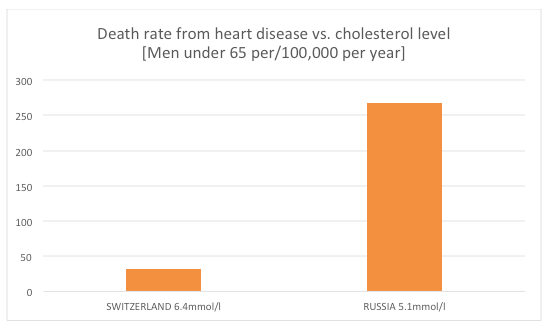
Here, for example, is a little graph looking at only two countries. It compares the death rate from heart disease in Russia and Switzerland, in men under the age of sixty-five relation to the average cholesterol level in those two countries.

lead-post

in Russia, with an average cholesterol level of 5.1mmol/l (197mg/dl) had a death rate 834% higher than that in Switzerland, which had an average cholesterol level of 6.4mmol/l (248mg/dl). Yes, this graph is the right way around. Yes, these data come from the World Health Organisation, and can be found on the British Heart Foundation (BHF) website. These particular statistics are now very deeply buried, but can still be found here: https://www.bhf.org.uk/publications/statistics/european-cardiovascular-disease-statistics-2008

I sometimes wonder if anyone at the BHF actually looks at these data, but that is a question for another day. Of course, when presented with facts like this, the dismissals. and creation of ad-hoc hypotheses rapidly reach into the sky. The word ‘paradox’ will be used pretty heavily, that’s always a good, temporary, escape route. In reality these two figures represent a full-blown black swan. But, hey, facts are slippery things.

Anyway, in my quest to explain everything about heart disease, perhaps the hardest single thing to explain is the fact that the rate of cardiovascular disease (heart attacks and strokes) has been going down in pretty much every single Western country for decades. I would say ‘first world’ country, but my son (a geography graduate) informs me that this terminology is now virtually barred for being racist. I shall be considered an ancient, prejudiced reactionary for using such a term.

So, I will say, Western Europe, North American, Australia, Japan, New Zealand and suchlike.

Now, the decline in CVD did not start at the same time, in all these countries. At this point I will make myself a hostage to fortune and make some sweeping statements. The rate of CVD peaked first in the US, in the late 1950s and has been falling since. It peaked next in Finland in the 1960s. In most of the other countries CVD peaked in the 1970s, before falling. It is impossible to say that there was a uniform worldwide effect. [Today, some countries are on the way up the mortality curve e.g. China and India].

However, I will make the general statement that CVD has been falling in most ‘first world’ countries for decades. This started long before any effective medical interventions were available. In the US, in the 1950s, there were no effective blood pressure lowering agents, no stents, no CABG, no clot busters…. Nothing really.

Possibly the greatest single factor has been the reduction in smoking. At the end of the second world war virtually all men smoked. Nearly 90% in the UK in the 1950s. Since that time the number of smokers has fallen, and fallen.

In addition to this, during the 60s, 70s, 80s and onwards, medical interventions have also greatly improved. In-hospital survival from a heart attack or stroke has improved almost year on year. The figures are complex, but around 60% of those admitted to hospital with a heart attack used to die – it is now around 30%, maybe less.

Some of this is due to the fact that ‘strict bed rest’ following a heart attack, the key medical intervention for decades, was abandoned. A piece of medical mismanagement that killed millions and millions… and millions.

What else may have cause the fall? I think that in the UK, the clean air act has a significant effect. The Great Smog of London, in the early 1950s, killed tens of thousands in less than a week. Much of this was from respiratory complications, but also CVD. It is now more clearly established that air pollution, in general, increases the risk of CVD. Most Western countries have drastically reduced air pollution.

Now, I would like to consider something almost never mentioned. Lead. That is the element, not the verb. Or the noun, as in dog lead.

In the 1920s someone discovered that if you put lead in petrol/gasoline it had all sorts of benefits on engine performance and wear and tear – and so on. Unfortunately, lead also caused all sorts of problem for human performance, and wear and tear. It is a heavy metal and, like other heavy metals, a powerful human toxin.

Despite the fact that lead toxicity was known for decades, it took until the nineteen-sixties before countries starting banning it from fuel – and pipes in housing – and the like. Which reversed a long-term trend of lead building up inside human beings. It lasts for decades within bone – gradually leaking out.

With regards to lead and CVD, is there a link?

A researcher called Weisskopf looked at the amount of lead in bones, and the rate of CVD. He found that those with the most lead in their bones were 837% more likely to die from CVD (relative risk)1 than those with the least lead in their bones. Now, whilst that is a relative risk, it is of the magnitude where we can safely say we are looking straight at a direct cause of CVD.

How does lead cause CVD. Most likely through the following mechanisms

‘Lead causes endothelial dysfunction by binding and inhibiting endothelial nitric oxide synthase and decreasing nitric oxide production.’2

Yes, we are straight back to my old friends, endothelial dysfunction and decreased nitric oxide (NO) production. In the world of cardiovascular disease, if you know where to look, all roads lead to NO.

If lead does cause CVD, is there any evidence that removing lead from the body can reduce the risk of CVD? [‘Reversibility’ and ‘Experimental Evidence’, the two most powerful of Bradford Hill’s canons for causation]. Which brings me to TACT. A trial designed to look at the impact of chelation on CVD. A way of removing heavy metals from the body…

What I love about this trial is that it was set up primarily to prove that chelation was nonsense, to be laid alongside homeopathy, and suchlike – by mainstream researchers. To quote an article in Medscape:

‘The original TACT trial wrestled with enrolment, ultimately taking over a decade to yield results, in part because cardiologists were absolutely convinced that chelation was a load of horse hockey.’ 3

TACT stands for Trial to Assess Chelation Therapy. When I first heard about chelation, I too, dismissed it as horse hockey. However, it turns out that I done the thing that I always advise everyone else against doing. I placed it in the ‘impossible/horse hockey’ category without making the effort of trying to find out what it was really about.

As it turns out, I should have made more effort…

‘TACT found that patients randomized to a regimen involving up to 40 separate three-hour infusions of a chelation-therapy solution (disodium ethylenediaminetetraacetic acid [EDTA], ascorbic acid, magnesium chloride, potassium chloride, sodium bicarbonate, B vitamins, procainamide, and a small amount of standard heparin) experienced an 18% drop in the trial’s primary end point (all-cause death, reinfarction, stroke, revascularization, or hospitalization for angina) compared with patients randomized to a placebo infusion.’3

More extraordinary than this:

‘When we broke the composite down to look at our secondary end points, we found that we had about a 40% reduction in total mortality, a 40% reduction in recurrent MI, and about a 50% reduction in mortality [in patients with diabetes],”3

A 40% – 50% reduction in mortality. Well, well, well. Eat your heart out statins. In fact, eat your heart out every single pharmaceutical product ever tested. What has been the effect on mainstream thinking on CVD? As you would expect, absolutely nothing has changed in the slightest. Still TACT2 is now being set up – so we can all look forward to that being ignored in about seven to ten years’ time.

Anyway, in an attempt to bring some structure to this blog, I am going to return to the start. Why has the rate of CVD gone down in most first world countries over the last fifty years? One of the reasons, I believe, is that the level of heavy metal pollutants (in particular, lead) has been dropping since around the mid nineteen sixties.

I think it could be argued that the US was the first country to embrace the motor car. Thus lead toxicity would have hit the US before anywhere else. I am not going to argue this too strongly, but I place it before you, for your consideration.

I shall finish by saying that, if you want to look for reasons for the pattern on CVD over the last sixty years, or so, you really need to start looking outside the box. For there are more things in heaven and earth Horatio, than are dreamt of in your philosophy.

1: Weisskopf MG, Jain N, Nie H, et al. ‘A prospective study of bone lead concentration and death from all causes, cardiovascular diseases, and cancer in the Department of Veterans Affairs Normative Aging Study’. Circulation 2009;120(12):1056-64.

2: Natalia V. Solenkova et al: ‘Metal pollutants and cardiovascular disease: Mechanisms and consequences of exposure.‘ Am Heart J 2014;168:812-22

3: http://www.medscape.com/viewarticle/814643?pa=QYKVfN05tfWXqq6%2BfjZ30whyKyHVDGvMW4WYyHO8jprcrUBo6WRIR4VFzOaThtqB8SIvl8zjYv73GUyW5rsbWA%3D%3D

Vitamin C – an update

Of course, I am always – ahem – ahead of my time, but I just noted this study that came out very recently. It demonstrates that if you give Vitamin C (along with hydrocortisone and thiamine) for just over two days in patients admitted with sepsis (blood poisoning) the mortality rate falls from 40% to 8.5%. The mortality rate in low income countries is normally around 60%.

Now, this was a small study, but it seems robust. It represents an almost five-fold reduction in mortality, but I think it provides some pretty strong support for the benefits of vitamin C. The conclusions of the study, repeated below were that.

‘Our results suggest that the early use of intravenous vitamin C, together with corticosteroids and thiamine may prove to be effective in preventing progressive organ dysfunction including acute kidney injury and reducing the mortality of patients with severe sepsis and septic shock.’

Hydrocortisone, Vitamin C and Thiamine for the Treatment of Severe Sepsis and Septic Shock: A Retrospective Before-After Study

Paul E. Marik, MD, FCCM, FCCP; Vikramjit Khangoora, MD; Racquel Rivera, Pharm D; Michael H. Hooper, M.D., MSc; John Catravas, PhD, FAHA, FCCP

Author and Funding Information

Chest. 2016. doi:10.1016/j.chest.2016.11.036

Abstract

Background:  The global burden of sepsis is estimated as 15 to 19 million cases annually with a mortality rate approaching 60% in low income countries.

Methods:  In this retrospective before-after clinical study, we compared the outcome and clinical course of consecutive septic patients treated with intravenous vitamin C, hydrocortisone and thiamine during a 7-month period (treatment group) compared to a control group treated in our ICU during the preceding 7 months. The primary outcome was hospital survival. A propensity score was generated to adjust the primary outcome.

Findings:  There were 47 patients in both treatment and control groups with no significant differences in baseline characteristics between the two groups. The hospital mortality was 8.5% (4 of 47) in the treatment group compared to 40.4% (19 of 47) in the control group (p < 0.001). The propensity adjusted odds of mortality in the patients treated with the vitamin C protocol was 0.13 (95% CI 0.04-0.48, p=002). The SOFA score decreased in all patients in the treatment group with none developing progressive organ failure. Vasopressors were weaned off all patients in the treatment group, a mean of 18.3 ± 9.8 hours after starting treatment with vitamin C protocol. The mean duration of vasopressor use was 54.9 ± 28.4 hours in the control group (p<0.001).

Conclusion:  Our results suggest that the early use of intravenous vitamin C, together with corticosteroids and thiamine may prove to be effective in preventing progressive organ dysfunction including acute kidney injury and reducing the mortality of patients with severe sepsis and septic shock. Additional studies are required to confirm these preliminary findings.

What causes heart disease part XXIV

In my long and winding road around cardiovascular disease I have often visited the same themes a few times. In part, this is because we are not dealing with Newtonian physics here. If billiard ball A strikes billiard ball B, at five metres per second, at an angle of 45 degrees, billiard ball B will move off at angle C at velocity D, assuming perfect elasticity. This will always happen, every single time.

On the other hand, with CVD, the complexity of human physiology and psychology, environmental factors, genetics the time of day, even sunspot activity – can have an effect – so some people have reported.

‘Space proton flux and the temporal distribution of cardiovascular deaths.

The influence of solar activity (SA) and geomagnetic activity (GMA) on human homeostasis has long been investigated. The aim of the present study was to analyse the relationship between monthly proton flux (> 90 MeV) and other SA and GMA parameters and between proton flux and temporal (monthly) distribution of total and cardiovascular-related deaths. The data from 180 months (1974-1989) of distribution in the Beilinson Campus of the Rabin Medical Centre, Israel, and of 108 months (1983-1991) from the Kaunas Medical Academy, were analysed and compared with SA, GMA and space proton flux (> 90 MeV). It was concluded: monthly levels of SA, GMA and radiowave propagation (Fof2) are significantly and adversely correlated with monthly space proton flux (> 90 MeV); medical-biological phenomena that increase during periods of low solar and/or geomagnetic activity may be stimulated by physical processes provoked by the concomitant increase in proton flux; the monthly number of deaths related (positively or negatively) to SA are significantly and adversely related to the space proton flux (> 90 MeV).’1

Oh yes, I do cast my net far and wide when looking at cardiovascular disease, as I feel I must. Quite what we are all supposed to do when the space proton flux is greater than 90MeV, I am not certain. Perhaps a tin foil hat would become appropriately protective headgear. By the way, this paper can be found in the National Institutes of Health on-line library – Pubmed. Referenced, peer-reviewed, and everything.

The point being? The point being that if you are looking for ‘billiard ball’ certainty, you are not going to find it here. If you were to do absolutely everything that I believe to be protective against cardiovascular disease, you will shift the odds in your favour, but you could still get struck down by a heart attack or stroke.

Anyway, with that proviso firmly in place, I shall move ahead, or maybe backwards. On the basis that some subjects need a second visit, I have decided to return to look at vitamin C again. First, because I have just been harangued by someone who believes that if you take high doses of vitamin C every day, you can reverse/cure heart disease completely and utterly. He also felt that I had completely ignored the work of G C Willis ‘The reversibility of atherosclerosis’, and also the research of Pauling and Rath on vitamin C.

It is true that I have not actually mentioned Willis before, but I have certainly written at length of Pauling and Rath. However, I realise that time passes, people forget things, and previous blogs settle to the bottom of the sediment layer. Therefore, it is not a bad idea to refresh things from time to time. I am also returning to vitamin C and the issues around it, because I have been getting a lot of correspondence about lipoprotein (a) (Lp(a)) recently. It seems this lipoprotein is gaining increasing attention. Of course, vitamin C and Lp(a) are tightly bound together.

Time, I think, for a quick refresher about this whole area. Particularly as it helps to confirm my central hypothesis that CVD is a disease of blood clotting, and you would struggle to explain the vitamin C/Lp(a) axis in any other way.

To begin. At some point in the distant past, our ancestors lost the ability to manufacture vitamin C. This happened, so I recently read, around sixty-one million years ago. Seems a long way back, but there you go. It has happened to some other animal groups, but not many. Quite why it occurred is unclear. You probably think you know, but I suspect you are wrong.

Interestingly, and as a bit of an aside, vitamin C is synthesized through a multi-step process, and the original molecule is glucose. Humans lack the last step in the process. Perhaps, because of this, glucose and vitamin C have some interesting interactions in the body. Mainly, it seems, that high levels of glucose prevent vitamin C from entering cells. Particularly immune cells, which need a lot of vitamin C to operate effectively. Make of that what you will.

Moving on, because humans cannot synthesize their own vitamin C, we must obtain it from within our diet. If we do not manage to eat enough, we will end up with scurvy. Scurvy presents with many different symptoms, but the one I am going to focus on in this blog is bleeding.

Bleeding occurs, because vitamin C is essential for collagen synthesis – a critical building block of supportive tissue throughout the body. Loss of collagen leads to break down of various structures in the body. For example, the walls of blood vessel walls which, start to break down and ‘crack.’

As blood vessel walls crack, they leak, and bleed. This leads to the best known symptom of scurvy, which is bleeding gums. This was well recognised several hundred years ago, mainly in sailors who had a highly-restricted diet during long voyages. In scurvy there is also bleeding in many other blood vessels, but you can’t easily see it. The usual cause of death in severe scurvy is internal bleeding.

On the positive side, after sixty-one million years, or so, evolution came up with a partial solution to the early stages of scurvy. Namely, the synthesis of a substance to block the cracks in the blood vessel walls, and control the bleeding. This substance is, or course, lipoprotein (a).

Lipoprotein (a) (Lp(a)) is synthesized in the liver, and it travels around in the bloodstream, looking for any cracks in blood vessels walls a.k.a. damaged endothelium. When a crack is spotted Lp(a) is attracted to the area and sticks very firmly, and cannot easily be removed. Of course, the rest of the blood clotting system also moves into action, so all hell breaks loose. Therefore Lp(a) becomes mixed up with platelets, red blood cells, fibrin, and almost everything else in the blood, including all the other lipoproteins.

However, Lp(a) has a very special trick up its sleeve. It mimics plasminogen.

After a blood clot forms, anywhere in the circulation, it has to be broken down, and removed – once the blood vessel underneath it has repaired. I liken this (not very accurately) to road works. If the road surface is damaged, the repair team comes in, sets up barriers and traffic lights and suchlike, then they repair the road. Then all the barriers, and traffic lights, and suchlike, must be removed.

Within a blood vessel, removal of barriers, and traffic lights, is a tricky exercise. Where does the blood clot go? Once a large blood clot has formed, over a ‘crack’ in the wall, it cannot stay there forever, restricting, or totally obstructing, blood flow. On the other hand, if the entire clot simply broke off, and travelled down the artery, it would get stuck as the artery narrowed – causing a complete blockage. Not a good idea.

Ergo, there is a need for a process that removes blood clots that have formed within blood vessels. It is called thrombolysis, or fibrinolysis. To ‘lyse’ means to break down.

The main player in thrombolysis is plasminogen. It becomes incorporated into (almost) all blood clots that form. It is activated by tissue plasminogen activator (t-PA). This turns plasminogen into plasmin, the ‘active’ enzyme that slices fibrin apart [fibrin is a long, and very strong, string of fibrinogen molecules that wraps round blood clots and binds them together].

t-PA can be manufactured and given to people who have heart attacks and strokes, to break apart the blood clots that are blocking the arteries in the brain, or the heart. You may have heard of t-PA referred to as a ‘clot-buster.’ Great stuff, but not so good if your stroke is due to a bleed in the brain, rather than a blood clot. In which case….

t-PA has been around for a while now and, with heart attacks at least, has mainly been superseded by angioplasty. Which is to open up the blocked artery, and stick a metal support (stent) into the artery. T-PA is still use in ischaemic strokes. That is, after you have had a brain scan to work out what sort of stroke you are having.

Sorry to appear to be going off in different directions here, but the systems of blood clotting are highly complex, and I think that explaining where Lp(a) fits in, is important.

Lp(a) is actually a lipoprotein, just like LDL. In fact, it is exactly like LDL, because it is basically LDL. It is the same size and shape, it contains triglyceride and cholesterol. However, it differs in one important aspect. Whilst LDL has a protein stuck to it called apolipoprotein B-100, Lp(a) has another protein stuck to it called apolipoprotein (a). Which is why it is called lipoprotein (a).

The fascinating thing about the protein, apolipoprotein (a), is that is has almost exactly the same chemical structure as plasminogen. So close, that you could hardly tell it apart. However, apolipoprotein (a) is completely unaffected by t-PA. It does not convert to plasmin, it is inert. So, when you want to break down a clot (fibrinolysis), the parts that have Lp(a) incorporated into it, cannot be broken down.

Which means that if you have a high Lp(a) level, you will develop bigger and more difficult to break down blood clots. Exactly what evolution had in mind for creatures that cannot manufacture vitamin C, and need to plug cracks in artery walls when the vitamin C level falls. However, not so good, if you want to stop atherosclerosis from developing.

Because these Lp(a) rich blood clots have to go somewhere, and the only place that they can go is to be absorbed into the artery wall itself, and then broken down. However, these clots are more difficult to break down, so, with repeated clots over the same area of artery wall, bigger and bigger plaques will grow.

That, anyway, is the theory.

What G.C. Willis did in 1957 was to study guinea pigs. Guinea pigs are another animal that does not synthesize vitamin C. He made them scorbutic (vitamin C deficient a.k.a. scurvy). Actually, he did not make them all scorbutic. He had a control group of twelve guinea pigs that he put on a vitamin C deficient diet, then injected them with vitamin C. None of these twelve guinea pigs developed any measurable atherosclerosis.

On the other hand, those guinea pigs on a scorbutic diet rapidly developed atherosclerosis. When I say rapidly, I mean within days. I think this point is worth repeating. If you make a guinea pig scorbutic, it will develop plaques, identical to those found in human arteries within days.

Willis then started feeding his guinea pigs vitamin C, and he found that the lipid filled plaques quite rapidly disappeared. He describes what he saw happening to the guinea after they were fed vitamin C.

‘The results of this investigation indicate that early lesions of atherosclerosis are quickly resorbed. The stages of this process are first a fading of lipid staining in the region of the internal elastic membrane with later a disappearance of all extracellular fat. Active phagocytosis of lipid by macrophage occurs, and when these macrophages finally disappear no evidence of the lesion remains.’ 2

I shall translate that passage for those with a non-science background.

What Willis found was that if you remove vitamin C from the guinea pig diet, they develop fat filled atherosclerotic plaques within days. If you then add vitamin C to the diet again, the plaques rapidly disappear (within days). The process of removal appears to be that the fat/lipid is ingested (phagocytosed) by white blood cells – known as macrophages.

However, if you let the plaques grow for too long, it is far more difficult to get rid of them.

‘More advanced lesions are considerably more resistant to reversal. Extensive lipid deposits clear in some parts of plaque but islands of intensely staining lipid persists in other parts. The macrophage response to such areas is only slight.’

It seems that if you don’t get rid of the plaque pretty much straight away, you don’t get rid of it at all. [Or maybe he didn’t wait long enough to see what happened over months, or years. Although my childhood memory of guinea pigs is that they tend to drop dead at the slightest excuse].

Of course, this was guinea pigs, not humans, so we must be careful not to extrapolate too far. However, previously, Willis had studied humans. Not many, only sixteen. Ten people with identified plaques were given vitamin C, six were not. In those ten treated with vitamin C, the plaques got bigger in three, stayed the same in one, and reduced in size in six. In those six not given vitamin C, three remained the same, and in three the plaques got bigger. Interesting, but hardly cast-iron proof of anything.

At this point there are a number of strands to gather together. We now know that humans cannot synthesize vitamin C, so we need to eat it. Without enough vitamin C, our blood vessels crack and bleed, and in severe cases we bleed to death.

In order to provide a degree of protection against vitamin C deficiency (scurvy), we produce lipoprotein (a) to fill up the cracks the blood vessels. However, unsurprisingly, a high level of lipoprotein (a) Lp(a) is associated with a higher rate of CVD.

‘In summary, elevated Lp(a) levels associate robustly and specifically with increased CVD risk. The association is continuous in shape without a threshold and does not depend on high levels of LDL or non-HDL cholesterol, or on the levels or presence of other cardiovascular risk factors.’ 3

This raises two inter-connected questions. Does vitamin C supplementation lower Lp(a) levels, and does it reduce the risk of CVD? It is of course entirely possible that vitamin C could reduce CVD risk by protecting blood vessels from ‘cracking’ without having any effect on Lp(a) levels.

Now you would think that this would have been an area of research interest to someone…. Anyone. However, the only people who seem to have looked at this area in any details are Linus Pauling (double Nobel prize winner, now dead) and Matthias Rath. A man whose reputation within the mainstream medical profession makes that of Andrew Wakefield look like mother Teresa. This from Wikipedia:

‘The Sunday Times (Johannesburg) has described Rath as an “international campaigner for the use of natural remedies” whose “theories on the treatment of cancer have been rejected by health authorities all over the world.”

On HIV/AIDS, Rath has disparaged the pharmaceutical industry and denounced antiretroviral medication as toxic and dangerous, while claiming that his vitamin pills could reverse the course of AIDS. As a result, Rath has been accused of “potentially endangering thousands of lives” in South Africa, a country with a massive AIDS epidemic where Rath was active in the mid-2000s. The head of Médecins Sans Frontières said “This guy is killing people by luring them with unrecognised treatment without any scientific evidence”; Rath attempted to sue him.

Rath’s claims and methods have been widely criticised by medical organisations, AIDS-activist groups, and the United Nations, among others Former South African President Thabo Mbeki and former Minister of Health Manto Tshabalala-Msimang have also been criticised by the medical and AIDS-activist community for their perceived support for Rath’s claims According to doctors with Médecins Sans Frontières, the Treatment Action Campaign (a South African AIDS-activist group) and a former Rath colleague, unauthorised clinical trials run by Rath and his associates, using vitamins as therapy for HIV, resulted in deaths of some participants. In 2008, the Cape High Court found the trials unlawful, banned Rath and his foundation from conducting unauthorised clinical trials and from advertising their products, and instructed the South African Health Department to fully investigate Rath’s vitamin trials.’

Matthias Rath even managed to fall out with Linus Pauling, before Pauling’s death, and law suits ensued. Rath has also successfully sued the BMJ, received £100,000 in damages. So, as you can see, not really a poster boy for mainstream medical research.

I include this information, as I think it is critical to the entire Vitamin C discussion. Because Matthias Rath is viewed as absolute scientific poison this has made the whole area of vitamin C supplementation a complete no-go area for any respectable scientist. If, as a doctor, you try to suggest that vitamin supplementation may be a possible treatment for, say, CVD, you might as well hand you licence over to the authorities at the same time – to save them the trouble of striking you off the medical register (almost a joke, but not quite).

So, essentially, we have a huge void here. The only research that I have ever seen (maybe I missed some) to establish if vitamin C supplementation does actually lower Lp(a) levels was done by Matthias Rath. And, according to him, it does. More so, in those with higher levels to start with. I am not referencing this research, but I would suggest you have a look around Rath and Pauling and vitamin C and Lp(a). See what you think. I think the research is robust.

With regard to the critical question, does vitamin C reduce the risk of CVD [with or without lowering Lp(a)]. I would say, case currently unproven. This does not mean that it does not (in fact I believe that it probably does). What I mean by ‘case currently unproven’ is that no-one has done a large scale interventional study using vitamin C to find out if it really reduces CVD.

The problem here is that such a study is almost certainly never going to be done. There is no way anyone can make money from doing such a study. Vitamin C cannot be patented, so if a company spend several hundred million ‘proving’ that vitamin C reduced CVD death, they would never get any money back.

You would have to find a Governmental organisation, tax payer funded, to do such a study. And with Matthias Rath around, that just ain’t going to happen. No-one would touch it.

However, there is one way to definitely reduce Lp(a) levels, and that is to take l-carnitine. Here, from a study called ‘L-carnitine reduces plasma lipoprotein(a) levels in patients with hyper Lp(a)’

‘L-carnitine, a natural compound stimulating fatty acid oxidation at the mitochondrial level, was tested in a double blind study in 36 subjects with Lp(a) levels ranging between 40-80 mg/dL, in most with concomitant LDL cholesterol and triglyceride elevations. L-carnitine (2 g/day) significantly reduced Lp(a) levels… the reduction being more dramatic in the subjects with the more marked elevations. In particular, in the L-carnitine group, 14 out of 18 subjects (77.8%) had a significant reduction of Lp(a) vs only 7 out of 18 (38.9%) in the placebo group. In a significant number of subjects the reduction of Lp(a) resulted in a return of this major cardiovascular risk parameter to the normal range.’ 4

Does this then result in a reduction in CVD risk? The answer is that I do not know, for sure. A meta-analysis of L-carnitine supplementation has been done. This consisted of five trials on three thousand people. L-carnitine supplementation did show some benefit – which did not reach statistical significance, but came very, very close.

For those of you who like a bit of statistics, here we go

‘The interaction test yielded no significant differences between the effects of the four daily oral maintenance dosages of L-carnitine (i.e., 2 g, 3 g, 4 g, and 6 g) on all-cause mortality (risk ratio [RR] = 0.77, 95% CI [0.57-1.03], P = 0.08)’5

CI [0.57 to 1.03] – close, but no cigar.

To put this into figures anyone can understand. In the intervention groups (those taking L-carnitine) there were 83 deaths. In the control group (those not taking L-carnitine) there were 106 deaths. Total study population was 3108, split in two groups: control and intervention. This gets as close to statistical significance as you can get (virtually). In fact, if this had been a statin trial, you would never have heard the end of it. ‘Ladies and gentlemen a 22% reduction in overall mortality with L-carnitine supplementation.’ [Oh, what fun statistics are].

So, what do we know?

  • A high level of Lp(a) is associated with a higher risk of CVD.
  • There is a probable causal mechanism linking Lp(a) to CVD death
  • Lp(a) is synthesized in animals that cannot make their own Vitamin C
  • A lack of vitamin C causes blood vessels to crack open – and potentially leads to atherosclerotic plaques development
  • Animal models have shown that a lack of vitamin C does lead to rapid atherosclerotic plaque development, and that replacement of vitamin C causes rapid regression of atherosclerosis
  • Some evidence from humans suggest that vitamin C supplementation causes regression of atherosclerotic plaques
  • Vitamin C supplementation does seem to lead to a reduction in Lp(a) levels
  • L-carnitine supplementation does lead to a reduction in Lp(a) levels
  • L-carnitine supplementation may reduce overall mortality.

What would I now recommend? If you have a high Lp(a) level take lots of vitamin C and l-carnitine and see if your Lp(a) level falls. If it does, keep taking lots of vitamin C and l-carnitine for the rest of your life. If it does not fall? Not sure.

As for the rest of us? Well I have no idea how much vitamin C anyone should take, or how much l-carnitine is required. There is literally no area of medicine that is less clear than our true vitamin requirements. You can find a thousand shouty people supporting high vitamin supplementation – any or all vitamins.

My view. I do not think the RDAs for vitamins are remotely accurate, or useful. They were established in times of absolute deficiency. The agreed Vitamin B12 levels, for example, were based on seven people, over sixty years ago, and remain unchanged to this day. All seven had pernicious anaemia (caused by vitamin B12 deficiency).

So, I do not believe in the RDAs at all. They are often, I believe, too low for optimal health. I can see no harm coming to people from taking lots of vitamin C or lots of l-carnitine. So, supplement away. You will probably reduce your risk of dying from CVD.


References
1: https://www.ncbi.nlm.nih.gov/pubmed/9140214

2: https://www.ncbi.nlm.nih.gov/pmc/articles/PMC1823880/?page=3

3: https://www.ncbi.nlm.nih.gov/pmc/articles/PMC3295201/

4: https://www.ncbi.nlm.nih.gov/pubmed/11213533

5: https://www.ncbi.nlm.nih.gov/pmc/articles/PMC4223629/