Author Archives: Dr. Malcolm Kendrick

Unknown's avatar

About Dr. Malcolm Kendrick

Malcolm Kendrick is a Scottish doctor and author of The Great Cholesterol Con (2008). He has been a general practitioner for over 25 years and has worked with the European Society of Cardiology.

The pharmaceutical industry now controls NHS policy – hoorah.

I noticed the other day that the pharmaceutical industry have managed to achieve something they could surely once only have dreamed of. Creating policy documents. Here is the offending headline from the Guardian newspaper:

NHS hires drugmaker-funded lobbyist

As the secondary headlines say:

‘Conflict of interest concerns as Specialised Healthcare Alliance (SHCA), funded by pharmaceutical companies, advises NHS England.’

A lobbying organisation with links to some of the world’s biggest pharmaceutical companies and medical equipment firms has been asked by NHS bosses to write a report that could influence health policy, it has been reported.’

It seems lobbying is now ‘so five minutes ago.’ Who needs a lobbyist when this organisation, the Specialised Healthcare Alliance (SHCA), which is entirely bought and paid for by the pharmaceutical industry, has been commissioned to write a report on funding specialised services for the NHS.  Services worth £13,000,000,000.00p (£13Bn/$20Bn) per year.

The article does point out, though, that we are misguided to think that this could be in any way an issue. For John Murray, the director of the SHCA, a lobbyist, and author of the report, has made it clear that:

.…..there was no link between his lobbying business and the SHCA other than providing secretariat services and said the SHCA “never takes a position on particular products or treatments in any of its activities”.

John (Pinocchio) Murray’s nose is now in the Guinness Book of Records for being the longest nose ever recorded on a human being, at seven point three miles. He is a lobbyist, paid for by pharmaceutical companies, and his organisation never takes a position on particular products…..hahahahahahahahahaha. Well then, sack him immediately for being useless…. sack him for failing to do what he is handsomely paid to do.

The final part of this newspaper report, which I savoured, is the following:

‘James Palmer, clinical director of specialised services at NHS England, said he was aware of Murray’s role as a lobbyist but “there are no opportunities for lobbying in the process of forming clinical policy”.’

This, of course, is true. There are no opportunities for lobbying in this particular process of forming clinical policy. Once a lobbyist starts to write clinical policy, they have moved well past the annoying requirement to lobby anyone. For the lobbyist has now managed to become the very person that they should be paid to lobby.

Instead of trying to influence someone who may not listen to him, he can just talk to himself…. Imagine that this short section of imagined dialogue is like Smeagol talking to Gollum in Lord of the Rings (Smeagol and Gollum are, or course the same person):

John Murray: ‘We must put the following phrase into the report, my precious. A “clear commitment” to “disinvest in interventions that have lower impact for patients” in favour of “new services or innovations”.

John Murray: “But why would you like me to put this in the report, wont this harm the hobbits? Hobbits have been kind to me…yes they have.”

John Murray: ‘I needs it in the report you fool. I represent precious pharmaceutical companies that are bringing new products onto the market. We needs to ensure that there will plenty of money to pay for them. So they must stop paying for stupid old fashioned treatments…yes, they must, foolish Hobbits.’

John Murray: ‘But won’t the kind Hobbits be worried this will just look like lobbying.’

John Murray: ‘Don’t be so stupid. How can the nasty Hobbits accuse me of lobbying? I am their friend, and I am trying to help them…yes I am.. Yes John Murray likes the friendly Hobbits. John Murray want to help the Hobbits, yes he does.’

John Murray: ‘You are so clever Smeagol, our master will be pleased.’…….

Duchess: ‘You’re thinking about something, my dear, and that makes you forget to talk. I can’t tell you just now what the moral of that is, but I shall remember it in a bit.’

“Perhaps it hasn’t one,” Alice ventured to remark.

“Tut, tut, child!” said the Duchess. “Everything’s got a moral, if only you can find it.”

A sorry little patient tale

Working as a GP in England becomes increasingly difficult as the drive to put more and more people on statins gathers pace. Virtually every day I see a patient taking statins who is suffering a clear adverse effect.

I know that this is a very biased sample, because patients in the area know that I am ‘the doctor who writes stuff about statins.’ So there is a degree of self-selection going on here. People who think they may be having adverse effects choose to see me.

However, there is another degree of self-selection going on here. When I see that a patient is on statins, I tend to be on high alert for any mention of statin related adverse effects. Whilst most other doctors happily dismiss such things as: tiredness, memory loss, joint pains, muscle pains depression, irritability, impotence, stomach pains, skin rashes and the like as ‘nothing to do with statins.’ I tend to think the statin may be the cause.

I then usually say. Stop the statin for a couple of months and see what happens to your, tiredness, memory loss, joint pains etc etc. Very often these symptoms go away. Then what? Then the practice statin prescribing statistics start to look quite bad. The senior partner (who is pretty sympathetic to my cause), has had words. The practice is losing money. I have had to ‘exempt’ more and more patients from the cardiovascular disease indicators.

The prescribing lead from the local Clinical Commissioning Group has also had words. It is clear that my non-prescribing of statins is very much frowned upon. Although nothing concrete has yet happened, the pressure to conform cranks up. At times I wonder why I bother. Should I just focus my anti-statin efforts at a more global level? Writing articles, lecturing, speaking to journalists, writing books, and the like. .What difference can I make with a few patients in the practice?

Yesterday, however, I saw a lady who had been admitted to hospital with severe abdominal pains. So severe that she had scans, tests, and was very nearly taken down to surgery for an exploratory operation. Did she have galls stones, appendicitis, cancer? Nothing could be found.

She was discharged with strong painkillers, and follow-up appointments were arranged. She came to see me between Christmas and the New Year to get more painkillers to tide her over. I suggested that the statin may be causing her stomach pain, and that she should stop them, which she did.

Guess what. Of course, the stomach pains have gone. She also reported that she’d had three episodes of Transient Global Amnesia whilst taking statins. This is where your memory goes, you wonder about as if in a fugue, and can remember nothing of what went on. She had not reported these episodes to anyone, but since being made aware that stains can cause them, she now knows what happened.

Since stopping the statins she also reports that her energy levels are back to normal, and that she feels human again. Her life, her quality of life, has returned.

After thanking me for helping her, she then asked. ‘What do you think I should do, doctor. Should I go back on them again, the other doctors say that I should, but I don’t want to.

Please sign

I just got this as an e-mail this morning.

Friends,

I’ve just heard that companies like Coca-Cola, Nestle and others will be able to claim their products are ‘healthier’ thanks to a new EU regulation on using fructose. But consuming high levels of fructose is a leading cause of obesity around the world.

This decision was made by the EU Food Standards Agency in Parma, Italy. We need to push back on food industry lobbying by demanding the EU Food Standards Agency thinks again.

Can you sign this petition demanding the EU Food Standards Agency thinks again?

http://action.sumofus.org/a/eu-fructose/

So, now, it will be claimed that Coca-Cola is a health food. You really couldn’t make this stuff up, could you? Or if you did you would be accusing of stretching credibility far beyond breaking point.

Anyway, if you feel you can, I would hope that you can sign this petition. It takes about thirty seconds.

For those of you who sometimes feel that big business is now running the world, whilst Governments jerk up and down on their strings. ‘All citizens must now drink Coke for a healthy and fulfilling life…’

“In a way, the world−view of the Party imposed itself most successfully on people incapable of understanding it. They could be made to accept the most flagrant violations of reality, because they never fully grasped the enormity of what was demanded of them, and were not sufficiently interested in public events to notice what was happening. By lack of understanding they remained sane. They simply swallowed everything, and what they swallowed did them no harm, because it left no residue behind, just as a grain of corn will pass undigested through the body of a bird.”  1984

Please protect the community

The primary functions of government are to maintain order, settle conflicts, and protect the community. So I am told.

Generally I am a small state man. In fact I refer to myself, when I don’t think anyone important is listening, as an anarchist. I believe that humans should be allowed as much freedom as is possible, without being allowed to seriously harm others. Rules and regulations and bureaucracy are not really my thing. So I am achingly reluctant to demand that the State gets involved in creating yet another agency, or add to its powers in any way.

But sometimes the State must intervene to carry out one of its three primary functions. Namely, to ‘protect the community.’

Where Governments around the world have to step in, right now, is to gain proper control of the creation of medical guidelines. Something that they have spectacularly failed to do, up to now.

As you may be aware, a row is rumbling under the surface about European guidelines on the use of beta-blockers in surgical operations, guidelines that were based on corrupt research. Doctors following these guidelines have probably killed 800,000 people. Give or take.

Some people have written into this blog stating that the numbers cannot be that high, and that the calculations are probably wrong. They were not my calculations, I hasten to add. My view on this is that many many thousands have certainly died unnecessarily. It doesn’t really matter if it was one hundred thousand, five hundred thousand, or eight hundred thousand.

How many would be acceptable?

The answer is, of course, none. But when guidelines go wrong the potential for killing hundreds, thousands, or even millions, is always there. If, for example, your guidelines state that fifty per cent of the population must take a drug for a condition, and these guidelines are wrong, you can kill millions,.

Recently, I did the back of a fag packet calculation on the number of people who were killed by the advice that patients must be managed with six weeks of strict bed rest after a heart attack. Here is some advice from that era: ‘The patient is to be guarded by day and night nursing and helped in every way to avoid voluntary movement, or effort.’ Thomas Lewis.

According to my figures, and I am not going into them here, strict bed rest for six weeks after a heart attack killed fifteen million people worldwide. Yes, fifteen million. More than died in the fighting in the first and second world wars added together.

This, I hope, gives you some idea of the potential death toll when medical guidance goes wrong. Given this, you would hope that the process that leads to the creation of guidelines would be checked, and double checked, then triple checked, then monitored.

You would also hope that the evidence underpinning the guidelines was free from bias, and corruption. Furthermore, that all data – positive or negative – would be freely available, with no possibility of hiding anything away. You would also hope that those creating the guidelines had no possible conflicts of interest.

The fact is that NONE of these things are true. We have a system that is almost perfectly free from scrutiny of any sort. Many, if not most, guidelines are based on trials that are designed, set up and run by the pharmaceutical companies. They own and control the data, and are under no obligation to let anyone else see it, if they don’t want to. Negative data are regularly buried, never to see the light of day.

A few brave souls e.g. Ben Goldacre, Fiona Godlee (editor of the BMJ), and Peter Gotzsche have been demanding that all clinical trial data are made available for scrutiny, but almost nothing has happened. Currently Roche are refusing to release data on their flu drug Tamiflu. Various studies remain unpublished, no data released. The UK Govt. seems powerless to act. Or maybe it just doesn’t want to, with so much money at stake.

Last year AbbVie and InterMune, two drug companies, took legal action against the European Medicines Agency to stop them releasing any data from clinical studies, and to ensure that no trials data could made available, anywhere, to anyone, ever again. I like to think I helped to kick this monstrous and terrible legal action into touch. But, companies still do everything in their power to ensure that data will not, ever, be released.

Then we have the enormous problem that that ‘experts’ chosen to write guidelines work hand in glove with the pharmaceutical industry. The US guidelines on cholesterol lowering written in 2004 were put together by nine people. Here is a conflict of interest statement. I have put this up before, but I think it bears almost endless repetition:

ATP III Update 2004:  Financial Disclosure

Dr. Cleeman: (Chairman) has no financial relationships to disclose.

Dr. Grundy: has received honoraria from Merck, Pfizer, Sankyo, Bayer, Merck/Schering-Plough, Kos, Abbott, Bristol-Myers Squibb, and AstraZeneca; he has received research grants from Merck, Abbott, and Glaxo Smith Kline.

Dr. Bairey Merz: has received lecture honoraria from Pfizer, Merck, and Kos; she has served as a consultant for Pfizer, Bayer, and EHC (Merck); she has received unrestricted institutional grants for Continuing Medical Education from Pfizer, Procter & Gamble, Novartis, Wyeth, AstraZeneca, and Bristol-Myers Squibb Medical Imaging; she has received a research grant from Merck; she has stock in Boston Scientific, IVAX, Eli Lilly, Medtronic, Johnson & Johnson, SCIPIE Insurance, ATS Medical, and Biosite.

Dr. Brewer: has received honoraria from AstraZeneca, Pfizer, Lipid Sciences, Merck, Merck/Schering-Plough, Fournier, Tularik, Esperion, and Novartis; he has served as a consultant for AstraZeneca, Pfizer, Lipid Sciences, Merck, Merck/Schering-Plough, Fournier, Tularik, Sankyo, and Novartis.

Dr. Clark: has received honoraria for educational presentations from Abbott, AstraZeneca, Bristol-Myers Squibb, Merck, and Pfizer; he has received grant/research support from Abbott, AstraZeneca, Bristol-Myers Squibb, Merck, and Pfizer.

Dr. Hunninghake: has received honoraria for consulting and speakers bureau from AstraZeneca, Merck, Merck/Schering-Plough, and Pfizer, and for consulting from Kos; he has received research grants from AstraZeneca, Bristol-Myers Squibb, Kos, Merck, Merck/Schering-Plough, Novartis, and Pfizer.

Dr. Pasternak: has served as a speaker for Pfizer, Merck, Merck/Schering-Plough, Takeda, Kos, BMS-Sanofi, and Novartis; he has served as a consultant for Merck, Merck/Schering-Plough, Sanofi, Pfizer Health Solutions, Johnson & Johnson-Merck, and AstraZeneca.

Dr. Smith: has received institutional research support from Merck; he has stock in Medtronic and Johnson & Johnson.

Dr. Stone: has received honoraria for educational lectures from Abbott, AstraZeneca, Bristol-Myers Squibb, Kos, Merck, Merck/Schering-Plough, Novartis, Pfizer, Reliant, and Sankyo; he has served as a consultant for Abbott, Merck, Merck/Schering-Plough, Pfizer, and Reliant.

http://www.nhlbi.nih.gov/guidelines/cholesterol/atp3upd04_disclose.htm

Those companies that I have marked in bold sell (or at the time sold) statins and/or other cholesterol lowering medications. A mere eight members (the chairman was employed by the NIH who was not allowed close ties with industry), and we have almost seventy direct financial conflicts of interest with companies who made, and sold, cholesterol lowering agents.

How we can possibly allow doctors with enormous financial conflicts of interest to create guidelines that will be followed around that world, and will affect hundreds of millions (in this case billions) of people….How can this possibly be allowed.

We currently have a system of guideline creation that relies on three things being true, if they are to be sare – all three things:

1: That the clinical trial data are not corrupt, or biased

2: That negative data are made available when requested

3: That the medical experts tasked with creating the guidelines are completely unaffected by their financial conflicts of interest

The fact is that none of these critical requirements are followed….even remotely.

How many other guidelines out there are wrong, damagingly wrong, and horrifyingly wrong? How many millions of people are being put at risk by a system that is wide open to corruption, and bias? I have not the slightest idea, but I suspect many….

The public are most certainly not being protected. We have put the foxes in charge of the chicken coop, with entirely predictable results. Time for the farmer to pull out the shotgun and start blasting away. Time for the state to start doing what it is there to do. Namely, ‘protect the public.’

Guidelines kill 800,000

A few days ago a friend sent me this headline by e-mail.

‘Guideline Based on Discredited Research May Have Caused 800,000 Deaths In Europe Over The Last 5 Years.’

I would replace the word ‘May’ with these two words ‘almost certainly.’ You would think, would you not, that if any other event in the world, at any time, had killed eight hundred thousand people, this would be front page headlines around the world for weeks, probably months, maybe even years.

Governments would spring into action, those guilty dragged into court. Thousands would protest in the streets, petitions would be signed, laws passed.

The reality is, I am willing to bet, that you have never even heard of this gigantic scandal. It will not have appeared in any national television programme, or newspaper. The blogosphere is also, almost totally silent.

Eight hundred thousand people. Please let that figure sink in for a few moments. If you dropped a major thermonuclear device on Manchester (UK) and killed every single living person, this would be roughly equivalent. If you laid the corpses end to end, the line of dead people would stretch from John O Groats to Land’s End (the entire length of the UK). Walking briskly each day, it would take you two months to pass them.

Think on that.

To an extent the actual guidelines themselves are not the most important thing here. They are now in the process of being changed (although they have not yet been changed). Nobody can be brought back to life, those who could have died – are dead. The issue here is that the processes leading to the creation of guidelines, that have almost certainly killed 800,000 people, are still in place, with no prospect of any change.

Those who have read this blog may be aware of my distaste for medical guidelines, and my concerns about their impact. I wrote an earlier blog called ‘Who shall guard the guardians.’ This outlined some of the problems, but even I was overwhelmed by the sheer scale of deaths involved when guidelines go wrong. I could have worked it out, but never did.

Guidelines are based on evidence, and evidence is based on clinical trials. And major clinical trials are, almost without exception, paid for, run, and controlled by the pharmaceutical industry. The great and good of medicine, the ‘Key Opinion Leaders’ KOLs, who put together the guidelines will almost all have very close connections with the industry. In some cases they will have been paid millions by pharmaceutical companies.

Whether they think so, or not, these opinion leaders are biased. Biased in favour of pharmaceutical products that are promoted through biased research, and launched on an unsuspecting world. And there is no-one out there to check what these KOLs and guideline committees are doing. If, to pluck a name from the air, the European Society of Cardiology (ESC) decides to create a guideline committee, how do they do it?

They choose a chairman, who will be on one of their committees. A well regarded, sound chap, with expertise in the area. He, very rarely she, will then decide on which of his friends and colleagues would be most suitable to be committee members.

They will have a few meetings, gather the evidence together, decide on what best practice should be, and produce their guidelines. No other organisation checks on them, or their decision making, or their conflicts of interest. Or, indeed, the evidence itself.

Yet, when the guidelines come out, many countries will slavishly follow them. They will form the basis for instructions to their medical services. Doctors who fail to follow the guidelines can be censured, or lose their jobs. They virtually carry the force of law.

Something this powerful and important and critical to medical care is dealt with in an almost completely cavalier fashion. Which is, frankly, inexcusable.

I suppose you are wondering what these guidelines were? Well, they were on the use of beta-blockers to protect the heart during surgery. To see more on this story go to the Forbes website

I cannot send you to the article published in the European Heart Journal, because one hour after going up on their website, it was pulled. Here is the comment from the authors of this paper, Graham Cole and Darrel Francis, on the decision of the Editor to disappear the article.

‘Our article is a narrative of events with a timeline figure and a context figure. We had not considered it to contain scientific statements, but we admit that it does multiply together three published numbers.

It is not an analysis of individual trials considering design, molecule, dose and regimen. We published last year the formal meta-analysis under stringent peer review in Heart and addressed the questions, including dosing, in that paper and associated correspondence.

The first of our two EHJ articles merely says that our community, which races to take credit when research-led therapy improves survival, must be equally attentive to the possibility of harm.  The leverage of leadership means the magnitude of either may be far from trivial.

Where our article relayed numbers, we made clear that alternative values were possible. The focus for readers was on how serious the consequences can be when clinical research goes wrong.

We thank Prof Lüscher for highlighting the scientifically important point that the pivotal trial, DECREASE I, has not been retracted by NEJM because the investigative committee did not recommend this. Unfortunately the committee could not have done so, because DECREASE I was outside its brief, displayed on the first text page of the first committee report. Can readers suggest why DECREASE I, from the same trial family, was exempted from inquiry?

We admire Prof Lüscher’s diligence in sending for peer review what we thought was merely multiplication. We await the review of the pair of articles. The first narrated one instance of a pervasive problem. The second suggests what each of us can do to reduce recurrences.

We respect the process Prof Lüscher has set in motion. We ask readers to join with us, and the journal, in maximizing the reliability of clinical science for the benefit of patients.’

Well, I am really glad that this article is being sent for peer review, because – as we know – peer review is a jolly good thing. To quote Richard Horton, Editor of the Lancet:

‘The mistake, of course, is to have thought that peer review was any more than a crude means of discovering the acceptability — not the validity — of a new finding. Editors and scientists alike insist on the pivotal importance of peer review. We portray peer review to the public as a quasi-sacred process that helps to make science our most objective truth teller. But we know that the system of peer review is biased, unjust, unaccountable, incomplete, easily fixed, often insulting, usually ignorant, occasionally foolish, and frequently wrong.’

Let me just repeat that last bit. Peer-review is:

….biased, unjust, unaccountable, incomplete, easily fixed, often insulting, usually ignorant, occasionally foolish, and frequently wrong.

Frankly, I wouldn’t hold my breath waiting for peer-review on this matter.

I suppose you may also be wondering how the problem with these guidelines came to light. Well, it turns out that the chairman of the guidelines committee was Prof Don Poldermans. A man who has now been booted out of his job at Erasmus Hospital in the Netherlands for making up his research. The very research that was used to create these guidelines.

Don Polderman’s also had financial conflicts of interest with Merck, Pfizer, Novartis and Medtronic. To name but four. (One conflict of interest statement can been seen here).

Anyway, here is a summary of what has happened:

      • Don Poldermans had financial conflicts of interest with several pharmaceutical companies
      • Con Poldermans carried out corrupt research, supporting the use of pharmaceutical products
      • Don Poldermans was the chairman of an ESC committee that recommended widespread use of drugs to protect the heart during surgery
      • Widespread use of drugs to protect the heart during surgery has killed 800,000 people over 5 years in Europe (alone)
      • The paper outlining the scale of deaths has been pulled by the ESC

I hope the hell there are no more Don Poldermans out there…..but you would have to be a brave man to think so. Personally, I believe there is an endemic problem with bias and corruption in medical research, and we should be very afraid indeed.

How to kill a hypothesis

“Why do people insist on defending their ideas and opinions with such ferocity, as if defending honour itself? What could be easier to change than an idea?” J.G. Farrell.

When the orbit of Neptune was found to be irregular, and not to follow classical Newtonian physics, it was suggested that, perhaps, the laws of physics may break down in deep space. Others, rather more pragmatically, suggested that there was another planet out there, interfering with the orbit of Neptune. It was just too far out, and dim, to be seen.

That planet, no longer called a planet, was Pluto. Once observed, it accounted for the distortions in the orbit of Neptune.

When the orbit of Mercury was found to be irregular, and not to follow classical Newtonian physics, it was suggested that there was another invisible planet orbiting closer to the sun. This planet was named Vulcan.

Of course there was no planet Vulcan. The reason why classical Newtonian physics did not accurately predict the orbit of Mercury is because the mass of the sun bent time and space. Classical Newtonian physics had to be replaced by Einstein’s theory of relativity.

What does this tell us?

It tells us that it is very difficult to know if an apparently contradictory observation actually refutes a scientific theory. It also tells us that you can use ad-hoc hypotheses (there is another planet out there) to support a cherished central hypothesis, and that this is a valid scientific technique.

But at what point do you have to admit defeat? How many contradictory observations can you dismiss before you must accept that the game is up, and that your hypothesis is wrong?

I think about this a lot. Mainly with regard to the cholesterol hypothesis, or the diet-heart hypothesis, or whatever term is now current. I have seen evidence that directly refutes this hypothesis again and again and again and….indeed…again.

If anyone wishes to debate this issue with me, I can produce far more evidence contradicting it, than supporting it. Yet still it stands, untouched. In fact I would suggest more people believe in this hypothesis than at any time in human history. Billions of people also take statins to lower their cholesterol levels. As you can imagine, this is more than a little frustrating.

How can you convince people that this hypothesis is wrong? I have tried in many, many, different ways. As have other members of THINCS (The International Network of Cholesterol Skeptics).

Yes, I have helped to convince many thousands of people that cholesterol has nothing to do with heart disease, or cardiovascular disease, or atherosclerosis, or unstable atherosclerotic plaques…

Indeed, stepping sideways for a moment, one of the major difficulties in this area is that the terminology shifts and swirls in front of you, making it impossible even to pin down what you are talking about.

At one time the experts were quite happy to tell us that a raised cholesterol level caused heart disease. Now we have ‘good’ cholesterol and ‘bad’ cholesterol, and ‘light and fluffy’ bad cholesterol and ‘small and dense’ bad cholesterol (which really should be called ‘evil’ cholesterol, I suppose). We have the ratio of good to bad cholesterol, apob-100 levels, particle numbers, sub-fractions of good cholesterol, dyslipidaemia, LDL particle size, or number,  or…..the list goes on and on.

How can you argue against a scientific hypothesis when the damned thing will not stay still from day to day?

That, however, is a bit of a side-issue, although I have come to realise that this constant creation of new types of cholesterol, and sub-fractions, and ratios, is all part of the game that is played to protect the cholesterol hypothesis from refutation. How can you refute a hypothesis that can change into any shape it likes? Answer, you can’t.

Anyway, in my efforts to work out how to change ideas in the wider population I have spent a great deal of time looking at the history of scientific thought. I wanted to gain any insights I could into how people managed to kill off hypotheses in the past.

As part of my education I have tried not to get too depressed by fellow thinkers on the subject. Such as Max Plank, who said:

‘A scientific truth does not triumph by convincing its opponents and making them see the light, but rather because its opponents eventually die and a new generation grows up that is familiar with it.’

In short, his view is that you should forget trying to convince people. They will never, ever, change their minds. Max Plank, by the way, was the man who published Einstein’s special theory of relativity (against great opposition).

Another of my scientific heroes is Wilfred Trotter. A man you are unlikely to have come across. Unfortunately, however, he was not much help either:

‘The mind likes a strange idea as little as the body likes a strange protein and resists it with similar energy. It would not perhaps be too fanciful to say that a new idea is the most quickly acting antigen known to science. If we watch ourselves honestly we shall often find that we have begun to argue against a new idea even before it has been completely stated.’

I could fill hundreds of pages with quotes saying the same type of thing. Essentially, people love the ideas they have grown up with, and become deeply emotionally attached to them. Changing them is painful; they dislike and fear new ideas and, will bring forth all the powers of their intellect to do so.

Things are made all the more difficult when you try to convince people who have spent large amounts of their professional life studying a specific area. When someone has become an ‘expert’ in something, and their reputation, and position of authority, is inextricably linked to a certain hypothesis, you are not just attacking an idea, you are attacking them. As noted by Leo Tolstoy:

‘I know that most men, including those at ease with problems of the greatest complexity, can seldom accept even the simplest and most obvious truth, if it be such as would oblige them to admit the falsity of conclusions which they have delighted in explaining to colleagues, which they have proudly taught to others, and which they have woven, thread by thread, into the fabric of their lives.’ Leo Tolstoy

Despite all of this being rather depressing, it has all helped me to establish one clear rule. Do not bother trying to convince people who are ‘experts’ in heart disease that the cholesterol hypothesis is wrong. It is a complete waste of time and energy. The only people who can be convinced are inquisitive people who do not have too much invested in this particular hypothesis.

I have also worked out another rule. Facts are almost completely ineffective at convincing people of anything. Recently, I was reading an article on Daniel Kahneman, Nobel prize winner in economics. He was discussing the irrationality of the financial system. He made many interesting points. For example:

The way scientists try to convince people is hopeless because they present evidence, figures, tables, arguments, and so on. But that’s not how to convince people. People aren’t convinced by arguments, they don’t believe conclusions because they believe in the arguments that they read in favour of them. They’re convinced because they read or hear the conclusions from people they trust. You trust someone and you believe what they say. That’s how ideas are communicated. The arguments come later.’

Once again, if this is true, what can be done? How to change ideas…..

I leave you at this point with a small section of dialogue from the film Inception:

Dom Cobb: ‘What is the most resilient parasite? A bacteria? A virus? An intestinal worm?’

Arthur: ‘Uh, what Mr. Cobb is trying to…’

Dom Cobb: ‘An idea. Resilient, highly contagious. Once an idea has taken hold of the brain it’s almost impossible to eradicate. An idea that is fully formed, fully understood. That sticks, right in there somewhere.’

[he points to his head]

The cholesterol hypothesis is one of the most resilient parasites of all. How to kill it off? All suggestions welcome.

Is medical research now beyond redemption?

Below, I have copied an entire article from the BMJ, written by Dr Des Spence, who is a fellow Scottish GP. We communicate from time to time, and share a general view that medicine is heading in a very unfortunate direction with overdiagnosis and over-treatment/polypharmacy becoming a massive problem.

This is driven, in the main part, by the pharmaceutical industry. An industry that would like to see the entire population of the world taking medication every day….. forever. To achieve this they have, effectively, grabbed hold of medical research and twisted it to their own ends.

Anyway, please read this article. It encapsulates much of what I feel, and I believe it needs a wider audience [I have added a few comments into the text to ensure that I am not breaching copyright]

Evidence based medicine (EBM) wrong footed the drug industry for a while in the 1990s. We could fend off the army of pharmaceutical representatives because often their promotional material was devoid of evidence. But the drug industry came to realise that EBM was an opportunity rather than a threat. Research, especially when published in a prestigious journal, was worth more than thousands of sales representatives. Today EBM is a loaded gun at clinicians’ heads. “You better do as the evidence says,” it hisses, leaving no room for discretion or judgment. EBM is now the problem, fuelling overdiagnosis and overtreatment.

[This is now a major problem for GPs who are increasingly measured and monitored, and funded, according to how accurately we follow guidelines mk comment]

You see, without so called “evidence” there is no seat at the guideline table. This is the fundamental “commissioning bias,” the elephant in the room, because the drug industry controls and funds most research. So the drug industry and EBM have set about legitimising illegitimate diagnoses and then widening drug indications, and now doctors can prescribe a pill for every ill.

[As you can imagine, this makes it difficult not to prescribe statins mk comment]

The billion prescriptions a year in England in 2012, up 66% in one decade, do not reflect a true increased burden of illness nor an ageing population, just polypharmacy supposedly based on evidence. The drug industry’s corporate mission is to make us all sick however well we feel. [Absolutely true mk comment] As for EBM screening programmes, these are the combine harvester of wellbeing, producing bails of overdiagnosis and misery.

Corruption in clinical research is sponsored by billion dollar marketing razzmatazz and promotion passed off as postgraduate education. By contrast, the disorganised protesters have but placards and a couple of felt tip pens to promote their message, and no one wants to listen to tiresome naysayers anyway.

[Speaking as a tiresome naysayer I could not agree more mk comment]

How many people care that the research pond is polluted, with fraud, sham diagnosis, short term data, poor regulation, surrogate ends, questionnaires that can’t be validated, and statistically significant but clinically irrelevant outcomes? Medical experts who should be providing oversight are on the take. Even the National Institute for Health and Care Excellence and the Cochrane Collaboration do not exclude authors with conflicts of interest, who therefore have predetermined agendas. The current incarnation of EBM is corrupted, let down by academics and regulators alike. [If anyone has any suggestion how to improve regulation, please let me know mk comment]

What do we do? We must first recognise that we have a problem. Research should focus on what we don’t know. We should study the natural history of disease, research non-drug based interventions, question diagnostic criteria, tighten the definition of competing interests, and research the actual long term benefits of drugs while promoting intellectual scepticism. If we don’t tackle the flaws of EBM there will be a disaster, but I fear it will take a disaster before anyone will listen.

[There have already been many disasters, but nobody has yet listened mk comment]

Original article can be found here

Sorry about the intrusive comments, but I don’t want the BMJ jumping up and down on me – especially as they are the only major journal that seems keen to criticize the industry.

What Des Spence is saying, is what I have been saying for some time now. Evidence Based Medicine (EBM) could have been a great thing – so long as it was not enforced too rigidly. But the evidence has been manipulated and corrupted all the way along the line. EBM is now almost completely broken as a tool to help treat patients.

Some years ago I stated that I no longer believe in many research papers that I read. All I tend to do is look at the authors, look at the conflicts of interest, look at the companies who sponsored the study, and I know exactly what the research is going to say – before I have even read the paper.

I have also virtually given up on references. What is the point, when you can find a reference to support any point of view that you want to promote? Frankly, I do not know where the truth resides any more. I wish to use evidence, and the results of clinical studies, but I always fear that I am standing on quicksand when I do so.

We are at a crisis point. Medical research today (in areas where there is money to be made) is almost beyond redemption. If I had my way I would close down pubmed, burn all the journals, and start again, building up a solid database of facts that we can actually rely on – free from commercial bias. But this is never, ever, going to happen.

Happy New Year.


The state of the NHS today

It’s a beautiful thing, the destruction of words.’ 1984

I still do work for the National Health Service (NHS), although not full time. Over the years, and especially the last few years, it has become an increasingly depressing, target driven, soulless place. When I re-read 1984 recently, virtually every page resonated with the type of management nonsense that rains down upon us each day. Particularly the way that language is distorted into meaningless ‘party’ slogans.

The more we are told that our healthcare trust is ‘meeting and exceeding’ targets, the more the word ‘doubleplusgood’ springs to mind, and I also know that we are, clearly, in big trouble.  The greater the trumpet blast of triumphal news, the worse that things become. War is Peace, Failure is Success, Lies are Truth.

One thing that particularly sticks in my craw, are the pictures of happy staff members that adorn various PR brochures. The production of which seems immune from financial pressures of any kind. They are written in a distorted management language that uses thousands of words, whilst their meaning remains almost perfectly obscure.

A recent example of how dispiriting they are was encapsulated by a recent brochure I received through the post. It had a picture of two nurses on the front. They looked as if they had both won several millions pounds on the lottery.  Their faces a picture of almost uncontrollable glee.

When I opened it, I found that this was a brochure informing all nurses, and doctors, that we would have to pay considerably more money into our pensions. In addition, we were going to receive a much lower pension, at a greater age, than we had been told we were getting in the past. Oh joy, oh joy.

I would have said the picture on the front cover was ironic, but NHS management do not do irony. We are continually exhorted, in a ‘Unite workers of the Soviet Union’ sort of a way, to be smiling and happy in our glorious tractor factory. A frowning worker is a worker who clearly does not love the party with sufficient fervour. A frowning workers needs re-education.

Ah yes, each year we produce more tractors to sell all around the world, with a song in our heart, and a spring in our step. Each five years we are set a new, joyous, production targets. Each year everything, we are told, gets better. The statistics tell us so. Each year, we can see with our own eyes, things are getting worse. I suppose people who do not work in the NHS may feel a certain echo of all of this in their work place.

Whilst mulling over this seemingly unstoppable drive from relying on professionals to be professionals; towards target driven, dehumanising, wearisome micro-management and meaningless jargon. I came across a post on Doctorsnet.uk. A website for UK registered doctors. It was written by a doctor A Boyle, and I thought it should be shared more widely.  (I asked for, and got, his permission to do so).

What I wanted, and what I got?

I wanted to help old people
I got frailty assessments on incomplete information

I wanted to save lives from PEs*
I got VTE2 assessments

I wanted to diagnose the cause of acute confusional states
I got dementia screening on frightened old people at 3am

I wanted to spend my career constantly improving my knowledge
I got mandatory training

I wanted to perform cutting edge research
I got GCP3

I wanted to critically evaluate my performance
I got the audit department asking for a meaningless action plan

I wanted role models to inspire me
I got multi-source feedback forms

I wanted to teach the next generation
I got work based assessment emails

I wanted to be competent
I got competencies

I wanted to be good at difficult procedures
I got cannula care records and central access teams

I wanted to keep people alive, safe and comfortable
I got the four hour target, breach reports, and observation wards to fudge the targets

A.  Boyle

And Amen to that. And a happy Christmas to you all. Sorry if this seems a little off-beam from my normal musings, but I felt the need to get it off my chest.

*PEs = Pulmonary Emboli (clots in the lungs)
2: VTE = Venous Thromboembolism (assessment). VTs can break off and travel to the lungs.
3: GCP = Good Clinical Practice

How to avoid dementia

Most of us fear that we may develop dementia as we get older. I fear that I may have got it already, as my memory for names becomes even worse. One piece of good news is that, for around one third of people, it may be possible to prevent dementia simply by taking three forms of vitamin B. Vitamin B6, B12 and folic acid.

The research work on this was done at Oxford University, and was published earlier this year. I received a copy of the study about a month ago, and I read it with great interest. The key statements from the abstract are, as follows:

‘Our results shows that B-vitamin supplementation can slow the atrophy of specific brain regions that are a key component of the AD processes and that are associated with cognitive decline.

….we go further by demonstrating that B vitamin reduces, by as much as seven fold, the cerebral atrophy in those grey matter (GM) regions specifically vulnerable to the AD (Alzheimer’s Disease) process.’

Some of you may know that Jerome Burne blogged about this a while ago, which is what attracted my interest in the first place. It immediately fired me into instant action. Several weeks later I got hold of the full paper, which was published in the proceedings of the National Academy of Sciences. It is entitled: ‘Preventing Alzheimer’s disease-related gray matter atrophy by B-vitamin treatment.’ Sorry to say that you have to pay to get the entire manuscript.

This study built on earlier work which also demonstrated a significant reduction in brain shrinkage using vitamin B(s) (at lower doses). The brain images themselves look particularly impressive, even to my untrained eye, with far less atrophy to see in the vitamin B treated group.

Unfortunately, this benefit only seems to be available those people who had a high level of homocysteine in their blood in the first place. A level found in about one third of the population.  For the other two thirds, taking vitamins does not seem to help.

Why do vitamin B(s) have this beneficial effect in this group?  Well, it has been known for a long time that people with high homocysteine levels are more prone to developing dementia. It is also known that B-vitamins lower the level of homocysteine the blood (look up Wikipedia if you want more detail on this complex area). However, just because a high level of homocysteine is found in people with dementia, does not mean that it truly is cause. It may be an innocent bystander. An association, rather than a cause.

However, the Oxford group, by lowering homocysteine and slowing brain atrophy, have gone a long way to prove that homocysteine does seem to be an actual cause of dementia. At least in about one third of people who have high levels in the first place. More importantly, the risk of dementia can be significantly reduced using a simple regime of B vitamins. A regime that appears to have no adverse effects – apart from a small degree of damage to the bank balance.

Why, you might ask, is no-one doing anything about this? Last week our glorious UK health secretary, Jeremy Hunt, announced that he was, sorry, we were, going to defeat dementia in twelve years’ time. Or some other such nonsense figure that he plucked from out of thin air. Did he mention research into vitamin B? No, he did not. Why not? Possibly because no-one made him aware of this research. Probably because he has no interest in dementia other than as a career enhancing, five minute, sound bite. He is such a busy, busy, man. Tomorrow he will be curing cancer. Sorry, we will be curing cancer.

A further important reason for the deafening silence in this area is because pharmaceutical companies cannot make money out of vitamins. Vitamins cannot be patented; therefore any profit margin is far too puny to be of interest to them. Which means that there will be no funding from the pharmaceutical industry to support any further research into B vitamins.

Even worse, if vitamins do work to reduce dementia this will significantly erode any pharmaceutical industry profits to be made. In commercial parlance vitamins would be called – ‘the competition’.

And what do we do to ‘the competition’ boys and girls?

We crush it sir?

‘Yes, that’s right, we crush it like an insect under our boot, don’t we boys and girls. Using any means possible……lock and load.’

I am sure a few Grima Wormtongues, sorry pharmaceutical company lobbyists, have already been whispering in various ears, denigrating this vitamin B research. ‘Very preliminary, not very convincing, we need a new approach, you need to support us, the pharmaceutical industry, only we can find a cure…….my precious…..’

Trust in me, just in me
Shut your eyes and trust in me
You can sleep safe and sound
Knowing I am around
Slip into silent slumber
Sail on a silver mist
Slowly and surely your senses
Will cease to resist
Trust in me, just in me
Shut your eyes and trust in me

(Kaa, the python the Jungle Book)

Wake up, wake up!

Of course Vitamin B is not a miracle cure for all forms of Dementia. In fact it is not a cure – in any recognised sense of that word. All that vitamin B(s) can do is to significantly slow the process of brain shrinkage. Once you have lost brain tissue, it does not come back.

In addition, these vitamins only work in about a third of the population, and only for Alzheimer’s Disease.  There are other causes of dementia, and vitamin B compounds will have no effect on them, at all. However, right now, it looks like by far best thing we have got. In fact, it is the only thing we have got. Alzheimer’s meds can slightly improve symptoms, but have no impact on the underlying disease process.

On the other hand, for the sake of a relatively simple blood test, and spending a couple of hundred pounds (or dollars) on vitamins a year, or however much they actually cost you, this decision is a no-brainer (sorry, couldn’t resist the pun).

Indeed, it is such an obvious thing to do that I have started to offer the blood test at my own clinic. (Yes, I suppose this counts as a Disclosure of Interest). Mainly because no-one in the NHS is the slightest bit interested. So someone had to do it.

The daily doses of vitamin B in this study were:

20mg vitamin B6
500mcg vitamin B12
800mcg folic acid

These are considerably higher than the recommended daily allowance (RDA) for these vitamins. But the RDAs for almost all vitamins were established as a bare minimum, many years ago, using virtually zero evidence. They remain unchangeable by any means known to man. I call them the ‘ten vitamin commandments,’ which have been engraved upon stone.

Until a group of idiots…sorry experts, decides to study the benefits of various vitamins in greater depth, we are going to be stuck with RDAs that make no sense, and will certainly not help you to delay, or even prevent, dementia. Until then, get a blood test to check homocysteine levels. Providing, that is, you can find anyone to do it. Then, if it is high, take vitamin B(s).  They can do you no harm, but they could do you a hell of a lot of good. Which is my kind of preventative medicine.

A farewell to statins – part two

And so it begins:

‘ …..a Pfizer rep confirmed to me that they were now telling all GP’s that statins do have side-effects and shouldn’t be prescribed anymore but to prescribe the new post-statin drugs…………. how two-faced can you get!!!!’

This was in an e-mail from a friend and supporter of mine, who has close contacts with the pharmaceutical industry.

Well, if you are going to challenge the dominant position of statins, the first thing that you have to do is to attack them. What is the best line of attack? Go after their greatest weakness, which is that they cause serious adverse effects, and damage the quality of life of many people. Something I have been saying for a long, long, time.

For years the experts have informed us that this is utter rubbish, statins are wonder-drugs, and adverse effect free. All of a sudden, now that the pharmaceutical industry is about to launch new cholesterol lowering agents, we are suddenly going to find that, why, after all, statins do cause a whole range of nasty adverse effects.

If you want to see exactly how this is going to be done, watch this discussion on Medscape.  The Medscape site needs a password, however you can get one fairly simply. In this ‘educational’ discussion we see three professors talking about the new cholesterol lowering agents that are soon to arrive. The dreaded PCSK9-inhibitors.

The names of these three professors are Prof Christie Ballantyne, Prof Stephen Nicholls and – yes, you guessed it – Prof Steven Nissen. Is there a new cardiovascular drug in development that he does not get involved with?

The first part of the discussion focusses entirely on the terrible problem of people being statin intolerant; people being unable to take high doses of statins, and the high burden of adverse-effects from statins.

A slide is shown from the PRIMO observational study showing that 15% of people taking atorvastatin have significant adverse effects, and 20% of those taking simvastatin suffer significant adverse effects. These, of course, are the two statins with by far the greatest market share. My, what a coincidence.

The discussion then opens out into the worrying problems with statins causing both diabetes and cognitive dysfunction (something vehemently denied for many, many years). Ballantyne was particularly eloquent on these issues.

The entire tone is one more of sorrow than anger. ‘Statins….great drugs….hate to see them go, but you know, their time is passing.’ Professor wipes a small tear from his eye at the thought.

I watch this stuff with a kind of morbid fascination. The marketing game is on, billions are about to be spent pushing PCSK9-inhibitors. The Key Opinion Leaders who tirelessly promoted the wonders of statins, and who told us that they were virtually side-effect free, are now singing a completely different tune.

Here is what one the panellists Prof Christie Ballantyne had to say about statin adverse effects in his book ‘Dyslipidemia & Atherosclerosis Essentials 2009’. This can be found on page 91, under the heading Adverse Effects and Monitoring.

Statins are very well tolerated with infrequent and reversible adverse effects. In large placebo controlled studies the frequency of adverse effects was similar to placebo (2-3%).’

Here, however, is what he said in March 2013

“Some people have hereditary disorders and have extremely high LDLs. And so the statin has some efficacy but not enough to get them down as low as they’d like.  Then some people have less response than others, and we don’t understand all of that. Some of that may be genetic. And it turns out there’s an even probably larger group of people that have a hard time taking a high dose of a statin.”

Even though statins are safe for most people, there are those that can’t take them because they experience side effects.

Many people complain of some muscle pain, soreness, weakness, excessive fatigability.  There’s some slight increase in diabetes also. That can occur with high dose statins, and some people [who] say that they may have problems with their nerves or cognition.”1

Well, that is all nice and consistent. Finally, here he is on Sunday 8th Dec, quoted as part of a discussion on the new AHA/ACC guidelines.

“Clearly, the focus is to get people on statins,” said Dr. Christie Mitchell Ballantyne, the chief of cardiology and cardiovascular research at Baylor College of Medicine, in Houston. “But if someone has seen four doctors and tried six statins and tells me they can’t take them, what am I going to do? Tell them they are a failure?”

Ballantyne said he would give such patients a non-statin drug, despite the guidelines.’2

….Ballantyne said he would give such patients a non-statin drug, despite the guidelines.’ I wonder what he could possibly mean by this. Perhaps George Orwell had it right.

‘Four legs good, two legs bad’……becomes….’Four legs good, two legs better.’

“The creatures outside looked from pig to man, and from man to pig, and from pig to man again; but already it was impossible to say which was which.”

[A farewell to statins – Part three will arrive at some point.]

P.S. Please watch the video clip soon, as I suspect it may not last very long after this blog.

1: http://www.houstonpublicmedia.org/articles/1362665170-Promising-Baylor-Research-Reduces-Bad-Cholesterol.html

2: http://www.staradvertiser.com/news/20131114_New_cholesterol_advice_startles_even_some_doctors.html

You absolutely cannot be healthy any more – it’s official

I have been waiting for some time now before it became officially impossible to be healthy. In recent years the boundaries of health have been inexorably squeezed tighter and tighter. Recently, they snapped shut. The land of the healthy now no longer exists. Tis but a memory.

I wondered if it would be cholesterol that would obliterate health first, but it turned out to be blood pressure. This was pretty much second favourite in my book.

As with many areas of ‘health’ the definition of a healthy blood pressure has fallen and fallen. A few years ago we had go to the stage of a condition known as pre-hypertension. A state of having a high blood pressure that wasn’t really high, but represented an ill-defined danger of some sort. This pressure was set at 115/75mmHg. Far lower than the average blood pressure in the Western World.

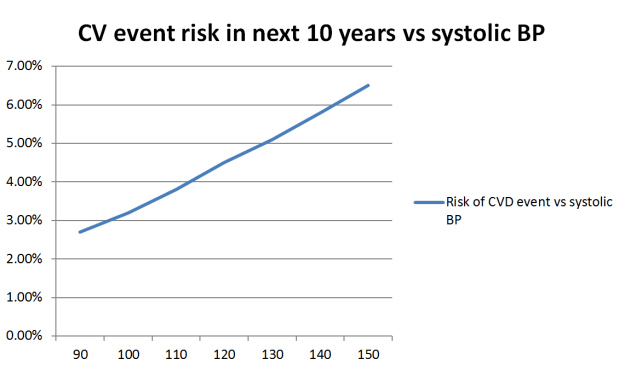
However, with the latest CV prevention guidelines (yes, them again) we have managed to get the optimal systolic blood pressure down to 90mmHg. Underneath, you will see a little graph that I created using the CV risk tool. The tool can be downloaded here:

So you can check out for yourself that what I am saying is true.

CV event risk in next 10 years vs systolic BP

I put in figures for a healthy male, and then only changed the blood pressure level. As you can see, as the blood pressure goes up, the risk of a CV event goes up, and vice-versa. Going from 90mmHg to 150mmHg causes your risk to go up from 2.6% to 6.5%. A 250% increase in relative risk. What this tells us is that 90mHg represents the absolutely optimum blood pressure. Anything higher and your risk increases, and it increases quite steeply.

By definition, this means that a systolic blood pressure of 90mHg is ‘healthy’ and anything above this becomes increasingly ‘unhealthy.’ Now it has to be said that a systolic blood pressure of 90mmHg is low. Pretty damned low. Indeed, I have been asked to check patients out because their systolic BP was 90mmHg, and the nurse was rather worried about them.

I can hardly blame the nurse for this, because the definition of hypotension (dangerously blood pressure), is…yes, you guessed it, a systolic blood pressure of 90mmHg and lower. You can check this ‘fact’ on the National Institutes of Health site.

This means that we have reached a situation whereby a systolic blood pressure lower than 90mmHg increases risk; and a blood pressure higher than 90mmHg increases risk. I suppose you could say that anyone with a blood pressure of exactly 90mmHg is healthy, so the land of health still exists as a microscopically thin sliver of habitable area. But for all intents and purposes, health has gone.

Can it really be true that there is no such thing as a healthy blood pressure?

In order to believe this you have to believe in the linear or log-linear model. A model that can, to a major degree, be laid at the feet of a certain Jeremiah Stamler. He stated that ‘the relation of SBP (systolic blood pressure) to risk of death is continuous, graded, and strong, and there is no evidence of a threshold.’  In short, as BP goes down, risk goes down, and there is no lower limit beyond which this is not true. Well, until you reach 90mmHg, it seems.

This idea is based on mathematics, whereby Stamler took all the studies he could find, matched BP with risk, and then created his perfect curve. You can see how this type of thing is done by looking at a curve created by matching writing score vs. reading score. [I took this example from the internet1]. The dots may seem all over the place, but there is a trend from bottom left to top right.

The curve is a linear model, which smooths out all of the data variations. Excel spreadsheet will even calculate a curve like this for you, if you have a graph with dots which may seem completely random.

log_tr1

In the world of hypertension, the log-linear model rules.

‘This(the log linear model) is the paradigm for the relationship of all cardiovascular risks to blood pressure, and forms the foundation of the current guidelines for hypertension.’ These words from the European Heart Journal in the year 2000, since then the paradigm has not changed, and neither has the model. The latest CV guidelines are based on it.

How could it be otherwise? Do you really think anyone has done a study lowering blood pressure from 100mgHg to 90mmHg? If so, think again. In fact the model was first created from the Framingham study data. This is the world’s longest running, and most cited, study on cardiovascular disease. It has been running since 1948 in a town called, unsurprisingly, Framingham in the US.

Now, this would be all fine and jolly – if the model were actually correct.

In 1980 Ancel Keys, who is not my favourite ever person it must be said, looked at the Framingham data.  He concluded that the linear model, in terms of the relationship between overall and coronary heart disease was unjustified.

Twenty years after this, a group of statisticians from UCLA looked at the data again. And here is what they said:

‘Shockingly, we have found that the Framingham data in no way supported the current paradigm to which they gave birth. In fact, these data actually statistically reject the linear model. This fact has major consequences. Statistical theory now tells us that the paradigm MUST be false for the target population of the study.’2

Was this paper refuted? No, not exactly….

“The National Institutes of Health’s National Heart, Lung, and Blood Institute (NHLBI) issued a statement regarding Port’s findings saying that they found it “thought provoking” but “After careful review of this study, the NHLBI finds that it does not offer a basis for changing the current hypertension guidelines.”

End of.

Which means that we are here. A world where health was finally extinguished by using a mathematical model. A perfect world for the pharmaceutical industry. Everyone is ill, and all shall have medications, for ever.

‘Can you do Addition?’ the White Queen asked. ‘What’s one and one and one and one and one and one and one and one and one and one?’

‘I don’t know,’ said Alice. ‘I lost count.’


1: http://goo.gl/ZlJ7tO

2: Port S. et al: ‘There is a non-linear relationship between mortality and blood pressure.’ European Heart Journal (2000) 21, 1635-1638

The most unpronounceable failure yet

Every day a billion things pop into my inbox, and I find my thought dragged this way and that. Mainly, what should I blog on next, and can I be bothered…..so much wine to be drunk.

However, I thought I should give everyone a quick head up on VARESPLADIB. This is the first and last time you are going to hear of this drug, so listen up. The first thing I would like to draw your attention to is the list of authors

Stephen J. Nicholls, MBBS, PhD; John J. P. Kastelein, MD, PhD; Gregory G. Schwartz, MD, PhD; Dianna Bash, RN; Robert S. Rosenson, MD; Matthew A. Cavender,MD, MPH; Danielle M. Brennan, MS; Wolfgang Koenig, MD; J.Wouter Jukema, MD, PhD; Vijay Nambi, MD, PhD; R. Scott Wright, MD; Venu Menon, MD; A. Michael Lincoff, MD; Steven E. Nissen, MD; for the VISTA-16 Investigators 1

Notice anything. Ah yes, Steven Nissen appears once again on a major study. He certainly gets about does our Steven. Another name that means much to me, but nothing to you, is John P Kastelein….he gets about too. Hardly a day passes without these guys running a major clinical trial, and then writing about it. I think they must have been cloned in the past to get through so much work.

Anyhoo,  enough of them. What is, or was, VARESPLADIB, and why should you care. Here from the study itself.

‘Varespladib methyl is a nonspecific pan-sPLA2 inhibitor with favorable effects on atherosclerotic lesions in animal studies. Initial studies demonstrated that varespladib reduced levels of sPLA2-IIA by morethan 90%,in addition to lowering low-density lipoprotein cholesterol (LDL-C) and C-reactive protein (CRP) in patients with stable coronary disease and ACS.’

So now you know. Or maybe not.

Stripped to its basics, varespladib (which I shall PLAD) is an anti-inflammatory drug specifically designed to reduce the inflammatory cascade that is thought to be a major cause/risk factor for heart disease. Not only that, but it reduces LDL ‘bad/naughty cholesterol’ and C reactive protein too – a sign of inflammation in the arteries. Possibly CRP may even be a cause of CHD… in truth you might think it is a cause, if you are idiot.

Some years ago I wrote that we should await the C-reactive protein lowering agents. On the basis that a high CRP levels had been identified as ‘risk factor’ for heart disease. I wasn’t sure if it would happen, but I suspected it would. I predicted that lowering CRP would be a complete and utter waste of time.

Inflammation cannot, I have always said, be the cause of anything. Inflammation is the way that the body heals itself. If you cut yourself you will develop a red and inflamed area around the cut, otherwise known as inflammation. The inflammation did not cause the cut, the cut caused the inflammation.

However, such is the idiotic thinking in heart disease research that various people, led by Paul Ridker, decreed that inflammation causes heart disease (and not the other way around). They then decreed that if you could lower the inflammation that the risk of heart disease would fall. The noise in the background is the mad stampede of pharmaceutical companies rushing off to find drugs to block the inflammatory pathway, lower CRP, and cure heart disease.

Enter PLAD. Here we have a drug that lowers inflammation, lowers CRP, and as an extra added bonus  lowers LDL ‘bad/naughty’ cholesterol, so it should provide a triple benefit. And guess what we find:

‘At a prespecified interim analysis, including 212 primary end point events, the independent data and safety monitoring board recommended termination of the trial for futility and possible harm.’

The conclusions:

‘In patients with recent ACS (acute coronary syndrome – a heart attack to you and me), varespladib did not reduce the risk of recurrent cardiovascular events and significantly increased the risk of MI. The sPLA2inhibition with varespladib may be harmful and is not a useful strategy to reduce adverse cardiovascular outcomes after ACS.’

I am sure that there are a whole new bunch of anti-inflammatory agents out there, being trialled as I write this. I am also sure that they will fail. Hey guys, you could save billions if you read my stuff.

Now, repeat after me. Blocking inflammation blocks healing. Block healing and you die. End of. Time for a glass of wine.

1: Varespladib and Cardiovascular Events in Patients With an Acute Coronary Syndrome The VISTA-16 Randomized Clinical Trial. JAMA. doi:10.1001/jama.2013.282836

A farewell to statins – part one

In the end I knew that statins would be overthrown. Their time, like the dinosaurs would come to an end.  I also knew it would be nothing to do with me, or any of the other critics. Nor would it have anything to do with the fact that their terrible burden of adverse effects finally came to light.

No, it would be because their patents ran out, which meant that the big pharmaceutical companies could not make eye-watering profits from them anymore. Inevitably, therefore, they would be replaced. Indeed, for years I have watched, with varying degrees of amusement, the unending efforts to unearth the ‘new’ statins. The wonder drugs to be taken by everyone, for the rest of their lives. The ones that will make billions for the pharmaceutical companies, and several millions for the key opinion leaders promoting them.

Steven Nissen had a go with apoA-1 Milano. This is a little story you may want to look up on Wikipedia.  Basically, a small village was found in Italy (near Milan) where people had very low rates of heart disease, and they also had very low levels of HDL ‘good’ cholesterol.

Turning science on its head, it was therefore decreed that their HDL must be especially ‘good’ at preventing heart disease. [Rather than accept that HDL had bugger all to do with heart disease]. So attempts were made to synthesize their form of HDL, then inject it into patients. This was done in small scale clinical studies.

So brilliantly did Nissen sell the results of these studies that a start-up company called Esperion, which funded the trials, was sold to Pfizer for over a billion dollars on the back of the results. If you want to find out more, the HDL synthesized was called ETC-216, not apoA-1 Milano.

This is what Steven Nissen had to say about the trials.

The fact that you can actually pull major amounts of plaque out of the artery in five or six weeks is an epiphany,” Nissen says. H. Bryan Brewer, chief of the molecular disease branch at the National Heart, Blood & Lung Institute, adds: “Quite to everyone’s surprise, this indicates that we might be able to be much more successful in a shorter period of time than we thought possible.”

By golly it all sounds very exciting, does it not.  Pulling significant amounts of plaque out of artery walls, in six weeks! This is quite amazing, what a brilliant drug. In truth, though, that quote was from 2003. Has anything since happened since to this magical plaque munching HDL? Is it now on the market, saving lives? Well, as you ask, the answer is no.

However, several other HDL raising agents have also been developed in the last few years. Unfortunately, they also raised the risk of heart attacks and strokes – then disappeared. Torcetrapib, dalcetrapib, anacetrapib…. A yes, anacetrapib, not quite gone yet.

Anacetrapib has a knock-your-socks-off effect on HDL and a jaw-dropping effect on LDL,” said Chris Cannon in an AHA press release.  He also said “The lipid effects are jaw dropping in both directions,” Yes, indeed, they were.  Although I am not sure that ‘jaw dropping’ and ‘knock your socks-off’ are truly scientific terms.

But then Forbes ran this headline on the 22nd October

Merck Heart Drug Runs Into New Worry.’ 1

As an aside, you can find out far more about drugs in development by reading Forbes magazine than you will ever get from the scientific journals.

Anyway, I wouldn’t bet the house on anacetrapib as I suspect it will soon follow the other ‘trapibs’ into an early grave. But never mind, Lilly has yet another HDL raising agent waiting in the pipeline, evacetrapib. What is it with these unpronounceable names, and why don’t these companies just give up? However, perhaps this one has a better shot than most, because as Steven Nissen said of dalcetrapib…

Dalcetrapib was always a long shot,” said Steven Nissen, chairman of cardiovascular medicine at the Cleveland Clinic. “The worry all along was that it wouldn’t have enough effect to produce a benefit,”

Then, as he went on to say of evacetrapib

We got everything we could hope for from this drug, and maybe more,” remarked study co-author Steven Nissen, adding that “we are going to move evacetrapib forward as rapidly as possible” into a late-stage trial.” Gosh, he is running a study on evacetrapib too.  He was also lead investigator for Torcetrapib2.

That Steven Nissen, what a busy chap he is?  Wasn’t he the one who said about the new cardiovascular prevention guidelines.  “The evidence was never there” for the LDL targets, he said. Past committees “made them up out of thin air,” he added.  Why yes, I think he was.

Anyway. They have tried raising HDL…fail. They have tried a different way of lowering LDL using ezetimibe. It lowered LDL, and has had absolutely no effect on cardiovascular disease…fail. They have tried combing different HDL raising agents with statins….fail.

You know, you might even begin to think that raising HDL wasn’t that good an idea. Billions have been thrown this target, everything has miserably failed. It is also interesting that LDL lowering agents, other than statins, have failed to have any impact on cardiovascular disease. Has this had any effect on the lipid hypothesis? You must be joking.

Given this litany of disastrous drugs trials, why do I now believe that statins are about to be overthrown? What agents could be out there that are going to sweep them into the dustbin of history.

Clearly it cannot be an agent that lowers LDL even more than statins. Can it? Well, Steven Nissen has recently said the following about LDL lowering. This quote is in connection to new drugs being developed3.

 “….it matters how you lower cholesterol, not just by how much.”

It matters how you lower cholesterol, not just by how much….. Interesting.  Well, if cholesterol does cause heart disease, then it doesn’t really matter how you lower it, does it? The only question is, by how much? Or is Steven Nissen trying to say something else?

As a further aside, if you want to know where the really big bucks are being spent in cardiovascular research, and what is in the pipeline, all you need to do is follow Steven Nissen’s pronouncements. He is the weather vane. You don’t need to be a weather man to know which way the wind is blowing.

…… (to be continued)


1: http://www.forbes.com/sites/matthewherper/2013/10/22/merck-heart-drug-runs-into-new-worry/

2: http://online.wsj.com/news/articles/SB10001424052702304363104577389353232022644

3: http://www.forbes.com/sites/johnlamattina/2013/09/05/esperions-novel-approach-to-lowering-cholesterol-will-it-be-successful/

What is your ‘Statin by date’?

Somewhat to my chagrin, I filled in my risk factors into the new ACC/AHA guidelines on cardiovascular disease prevention. I now find that I should have started statins eight weeks ago. Naughty, naughty, me. My blood pressure was a bit higher than the calculator liked 138/82, my cholesterol quite a bit higher at 6.0mmol/l.

Which means that I have already passed the 7.5% ten year risk score. O….M…..G. (I think my picture makes me look a bit younger than I am, although it was only taken last year – honest)

What to do?

I am now well beyond my ‘Statin by date.’ No longer can I be healthy without taking a statin. By the way, a friend came up with the concept of ‘statin by date.’ It did make me laugh, conjuring up the image of a sell by date on a can of baked beans. Or maybe Logan’s run. If you remember that film, once you reached the age of, I think it was thirty, you had to leave the colony as you had reached your sell by date.  ‘No this is not au-revoir…. It is goodbye.’

Can I be reassured that my parents are both alive and healthy in their late eighties. My grandmother, on my mother’s side, lived to one hundred and two. No idea about my father’s side. WWII did for both my grandparents on that side.

Can I feel comfort in the fact that I play squash three times a week, go to the gym twice a week and walk when I can? Mind you all of this is wiped out by my excess consumption of alcohol I suppose – unfortunately. Also, I am in the overweight category with a BMI, of 28. But wait, isn’t the entire English rugby team obese, using the BMI. Must be all the training and muscle bulk that does it. Yes, the jolly old BMI.

No, I thought I was a pretty healthy chap. I have no real risk factors for heart disease at all. A resting pulse rate of 48, a reasonable blood pressure……

In truth I feel terribly sorry for the Swiss. They have the highest average cholesterol level in Europe at 6.4mmol/l (250mg/dl in those inconvenient US units). Surely the entire nation must be put on statins straight away. But, hold on, wait just one gosh darned minute. Don’t they have the second lowest rate of heart disease in Europe?

Why yes, they do. Only beaten by the French. Who have an average cholesterol levels higher than most other countries, they also eat the most saturated fat in Europe, and yet they have the lowest rate of heart disease. About one quarter that of the UK and US. I wonder how the ACC/AHA calculator works for them? Perhaps not that well.  Ah oui, bonne chance. Zey must be, ‘ow you say ‘une paradox’. (Or would that be ‘un paradox’)

As you can tell I think I am grasping at straws. Who am I to attempt to stand against the massed intellectual power of the ‘experts.’ The reality is that I feel the breath of the grim reaper on the back of my neck, scythe in hand. I am now eight weeks past my statin by date, and I am not taking statins. The clock ticks in the background, I can sense the disapproval of cardiologists around the world weighing heavily upon me.

‘Forgive me father, for I haven’t statined.’

You need a statin – now what was the question?

As many of you are aware the American College of Cardiology (ACC) and the American Heart Association (AHA) came out with new guidelines on cardiovascular disease prevention a few days ago. As part of this, they produce a risk calculator. Using this calculator, if your risk of heart attack or stroke is greater and 7.5% over the next 10 years, you should take a statin – for the rest of your life.

I downloaded this calculator, and I have been playing around with it. I think I would tend to agree with the headline in the NY times 18th November 2013:

Risk Calculator for Cholesterol Appears Flawed

To be frank you can fiddle around with the figures on this calculator for hours. I think my OCD is getting worse. (Maybe I should take a statin to cure my OCD). One of the questions I wanted to find an answer to was the following, at what age would a perfectly healthy man (with ‘optimal’ risk factors) have to take a statin for the rest of his life.

So, I fed in the figures, and use the ‘optimal’ figures for cholesterol and blood pressure on the risk calculator

THE PERFECTLY HEALTHY MAN

  • Male
  • Age 63
  • Race: WH (white)
  • Total cholesterol 170mg/dl [This is 4.4mmol/l in Europe i.e. very low]
  • HDL cholesterol 50md/dl [This is 1.3mmol/l in Europe]
  • Systolic blood pressure 110mmHg
  • Non-smoker
  • No treatment for high blood pressure
  • Non diabetic

CV risk over the next 10 years = 7.5%

So, there you are. You can do absolutely everything ‘right’ be as healthy as healthy can be – according to the AHA and ACC. Yet, by the age of sixty three you need to take a statin – for the rest of your life.

The next question I wanted to find the answer to was, at what age does a ‘normal’, very healthy man have to start using a statin? In the UK, the average total cholesterol for men is 5.0mmol/l. [this is 193mg/dl in the US]. The average blood pressure in the UK systolic is 129mmHg.  (To be frank, I think the average cholesterol level for men is higher than this, but the WHO says not).

Feed these figures in, and you would need to start taking a statin, for the rest of your life, by the age of fifty eight. Which means that very healthy men, with no real risk factors for cardiovascular disease – at all – have to start statins at fifty eight.

What of women. Well, they get another seven years of statin free life. A super healthy woman, with optimal risk factors, reaches the dreaded 7.5% risk aged 70. An ‘average’ healthy women, with average BP and cholesterol levels, would have to start a statin aged sixty three.

In summary, using this risk calculator, extremely healthy men will be starting statins at fifty eight, and very healthy women at sixty three. This, then, marks the age at which life becomes a statin deficient state. You can be as healthy as healthy can be. You can do everything right, have no risk factors at all for cardiovascular disease, and yet you still need to take medication to reduce the risk of cardiovascular disease.

Sorry, what was the question again?

European cardiovascular disease statistics can be found here.

They have now, officially, all gone mad?

The Mad Hatter: ‘Have I gone mad?’

Alice: ‘I’m afraid so, you’re completely bonkers, but let me tell you something, the best people usually are.’

Alice in Wonderland

I find myself quoting Alice in Wonderland more and more these days. I now think it was never a children’s book, it was an accurate scientific analysis of human behaviour.

As many of you are aware the American medical authorities have come up with the latest guidelines to reduce cardiovascular risk. A major part of the guidelines is now to inform us all that we should forget about lowering cholesterol (LDL) levels, and just take a statin…. no matter what¹.

This is how the New York Times put it:

First, the guidelines have moved away from achieving target cholesterol levels.
Americans have long been urged to focus on their laboratory numbers. Many people are obsessive about checking their cholesterol levels and pursuing even better numbers. Doctors have been told to focus on these numbers and, in some cases, the quality of their care was assessed by the percentage of their patients with low cholesterol levels.

Those days are over. The new guidelines recognize that for patients who have exhausted lifestyle efforts and are considering drug therapy, the question is not whether a drug makes your lab tests better, but whether it lowers your risk of heart disease and stroke. Studies over the past several years have shown that improving your lab profile with drugs is not equivalent to lowering your heart risks².

One of the most influential cardiologists in the world, Steven Nissen, had this to say:
“The evidence was never there” for the LDL targets, he said. Past committees “made them up out of thin air,” he added.

Past committees made them up out of thin air….. Let me try that statement again…. Past committees made them up out of thin air. Exactly. Ex-bleedingly-zactly.

So, ladies and gentlemen, you have been conned. Utterly, completely and barefacedly conned, for the last thirty years. Your cholesterol level has absolutely no impact on your risk of cardiovascular disease. You think not? Well, that is precisely what they are saying in these guidelines. If not in quite such plain words.

But, of course, I am not being entirely fair to them. The level of LDL may actually matter after all – according to the same guidelines. For, as the New York Times article goes on to say.
There’s one exception to the numbers rule. People with very high levels of the harmful cholesterol known as LDL still need to worry about targets. The new guidelines set that LDL level at 190 milligrams per deciliter – but the principle is that if people have very high cholesterol levels, then their cardiovascular risk is so high that it is likely that treatment to reduce the levels would offset any risks of the drug treatment.

So, your LDL level doesn’t matter in the slightest, unless it is a very high level. Then the level does matter a great deal. Please explain, oh great cardiologists, does LDL, or does it not, cause cardiovascular disease.

Well, it seems that it both does, and does not, simultaneously. Amazingly, we have achieved a quantum state with LDL. It simultaneously exists as a molecule that can both cause – and not cause – CVD. Which means, of course, that the levels must be both lowered, and not lowered. Yes, well, this makes perfect sense. At least it would to a lunatic.

Perhaps if we open the box with the ‘at risk cat’ in it, we will find that this new version of Schrodinger’s cat died of a heart attack caused by LDL. Alternatively, it did not. Before opening the box, it exists in both possible states. It is an interesting variation on a theme.
The most astonishing thing is not that these people are now talking the most complete gibberish. They have been doing this for years. The most astonishing thing is that the vast majority of the population will still listen to what they have to say – and follow their advice.
Well, good luck with that all you billions of mad people, following the advice of these mad scientists Good luck with that indeed. I salute you. Meanwhile I shall attempt to find the answer to a far more important question than what causes heart disease.

“Why is a raven like a writing desk?”

1: http://circ.ahajournals.org/content/early/2013/11/11/01.cir.0000437740.48606.d1
2: http://well.blogs.nytimes.com/2013/11/12/3-things-to-know-about-the-new-cholesterol-guidelines/

The backlash begins

(Catalyst under fire)

Those who read this blog will know that Maryanne Demasai, a journalist at the Australian Broadcasting Company (ABC), put together two programmes. One questioning the cholesterol hypothesis; the other very critical of the over-prescribing of statins. They can be seen here.

Heart of the Matter Part 1 – Dietary Villains

Heart of the Matter Part 2 – Cholesterol Drug War

Over several months I helped Maryanne to put together the scientific arguments, and I feel proud to have done so. I warned her, though, that she should expect a vicious backlash if the programmes ever went out. Of course, it has happened.

Also, exactly as I told her, the attacks are not on the data. They can’t be, as the science she presented is pretty much spot-on. They are personal attacks on everyone who took part. Those she interviewed are being accused of being “crack-pot quacks”, ‘into earthing’….and ‘snake oil salesman selling vitamins’ etc.

You can see the latest (evidence free attack) here. A programme by media watch, which includes such scientific observations as the fact that Maryanne did not smile when speaking to a conventional ‘expert.’ Off with her head, the biased hussy! http://www.abc.net.au/mediawatch/

Of course none of this surprises me. I knew exactly what would happen, and how it would happen. This is not because I am sort of a genius. It is that I have seen it all before, many times. Here follows a personal testimonial from a Dutch Journalist Melchior Meijer, who had the temerity to criticise statins in the past:

My name is Melchior Meijer. I’m medical reporter for several magazines and newspapers in The Netherlands. Reporting about the many obvious flaws in the cholesterol hypothesis, shedding light on the biologically plausible adverse consequences of statin therapy, is as close to 21st century blasphemy as a medical journalist can come.

I experienced this in 2004, when I wrote an article about statins in a national newspaper. In the article, several doctors and scientists expressed well founded doubts about the safety of statin therapy in the general population. I also presented a few `anecdotal’ cases of statin induced harm, which were extremely easy to find.

The medical establishment reacted in fury and started an aggressive media offensive. Carefully avoiding the arguments in my article, they used their authority to hang me out on TV as a liar, a potential mass murderer. They called for `official measures’ to prevent naive journalists from making similar `tragic mistakes’ in the future.

They also took me to the Press Court, but they didn’t reckon with the fact that the Press Court checks facts and figures. The Court did an investigation and decided that I had just done my job, observing and questioning. [As an aside: the chief of my newspaper, born into a family of influential physicians, was not happy with the Court’s decision. He had already apologized on television for `this tragic mistake’.]

After this statin users started calling and mailing to the media, always reporting the same symptoms: various degrees of (muscle pain) and loss of muscle mass, exhaustion, personality changes and amnesia. But my colleagues didn’t like to take up this serious issue. That is, until last March when the TV-colleagues of TROS Radar, a consumer programme with an average of 2 million watchers (we have 16 million inhabitants), took up the subject.

Dutch cardiologist Dr Paul de Groot expressed his doubts about cholesterol as a causal factor, and postulated that statins sometimes do more harm than good, especially in primary prevention. Dr Uffe Ravnskov, who by the way was honoured yesterday with the prestigious Leo Prize for independent science, pointed out the many flaws in the cholesterol hypothesis.

The programme also interviewed people who had experienced devastating side effects from statins, which quickly disappeared upon discontinuation – although sometimes they did not. I was on the programme to explain how Unilever had succeeded in keeping an unfavourable article about its cholesterol lowering spread Flora out of the press.

When the shit hits the fan…

My time is limited, so I will make it short. Radar was vigorously attacked from all directions. Professors Martijn Katan and John Kastelein used various media outlets to shamelessly fire irrelevant, slanderous attacks on Dr Ravnskov. As usual, they did not address any of the scientific arguments. Radar invited Katan and Kastelijn for a public debate with Drs Ravsnkov and Kendrick, but they declined.

The Dutch Cardiologists Association, together with the Healthcare Inspectorate – and this is critical – announced official guidelines for medical journalists who plan to cover `delicate medical matters.’

History, you see, does repeat itself, and so I can predict what now happens in Australia. There will be calls to bring in ‘official guideline for medical journalists who plan to cover ‘delicate medical matters.’ This is also known as press censorship. It has been popular in various dictatorships over the years. Currently, North Korea is the best place to see this in action.

Believing in impossible things – there is a trick to it

At times, all you can do it shake your head in amazement, and wonder at the ability of people who think of themselves as scientists to make statements that are impossible to reconcile with reality, or logic….or pretty much anything to do with science.

Yesterday, I was sent a copy of a paper called ‘High coronary plaque load: a heavy burden.’ Published in the European Heart Journal in August 2013. It looked at the use of statins to reduce the volume of plaque in arteries. I include three verbatim quotes from the paper:

  • Of particular interest, neither LDL cholesterol levels at baseline nor those after high dose statin treatment could independently predict major adverse cardiovascular events (MACEs)
  • One of the most striking results of this study is the fact that LDL levels at baseline or after statin treatment showed no predictive value for MACEs. This could lead to doubt about the beneficial effect of LDL-lowering therapy. However, as also discussed by the authors, there is overwhelming evidence for the beneficial effects of statin therapy on plaque progression and MACEs.
  • Currently statin therapy is so fundamentally established in clinical practice that its beneficial effect is beyond doubt. Even though it has been demonstrated that in patients receiving statin therapy LDL levels have no additional prognostic value, further lowering of LDL cholesterol levels with novel PCSK9 monoclonal antibodies could further reduce the residual risk in these patients1.

So, the researchers discovered that LDL (‘bad’ cholesterol) levels did not predict major coronary events:  angina, heart failure, heart attacks and suchlike. Neither did the degree of LDL lowering with statins have any correlation with coronary events. At this point, having very clearly established that their research flatly contradicts the cholesterol hypothesis, they finished off by remarking that when the new cholesterol agents arrive, which will lower LDL levels even more than statins, they will ‘further reduce the residual risk in these patients.’

I shall try to reduce this paper to its ineluctable essence.

  • We have found that LDL levels have nothing to do with cardiovascular disease
  • We have found that the degree of LDL lowering with statins does not correlate with cardiovascular events
  • We think we need to the lower the LDL more to prevent cardiovascular disease

‘Alice laughed. ‘There’s no use trying,’ she said. ‘One can’t believe impossible things.’

‘I daresay you haven’t had much practice,’ said the Queen. ‘When I was your age, I always did it for half-an-hour a day. Why, sometimes I’ve believed as many as six impossible things before breakfast. ‘Lewis Carroll – Alice in Wonderland.

I suppose it becomes easier to believe in impossible things if you have a few conflicts of interest to help you along the way…..smooth the pathway of belief, so to speak. Here follows the conflict of interest statement from the paper:

Conflict of interest:

J.W.J. receives research grants from and was a speaker at meetings sponsored by Astellas, AstraZeneca, Biotronic, Boston Scientific, Bristol-Myers Squibb, Cordis, Daiichi Sankyo, Eli Lilly and Company, Medtronic, Merck-Schering Plough, Pfizer, Orbus Neich, Novartis, Roche, Servier, the Netherlands Heart Foundation,the Interuniversity Cardiology Institute of the Netherlands, and the European Community Framework KP7 programme. M.A.dG. has no conflicts to declare. The Department of Cardiology received research grants from Biotronik, Medtronic, Boston Scientific

Corporation, St Jude Medical, Lantheus Medical Imaging, and GE Healthcare.

For those paying attention, you may have noticed the mention of PCSKP monoclonal antibodies earlier.  What are these, I hear you cry. These are the next monstrous regiment of cholesterol lowering agents that are waiting in the wings, engines running smoothly. If you thought statins were heavily promoted – you ain’t seen nothing yet.

You may not be astonished to learn that one or two of the companies listed in the conflict of interest statement of that paper are developing PCSK9 monoclonal antibodies. I wonder if that could have anything to do with the statement……’further lowering of LDL cholesterol levels with novel PCSK9 monoclonal antibodies could further reduce the residual risk in these patients.’

And if that thought depresses you, as it does me, here is a little poem by W.H. Auden to cheer you up:

‘Give me a doctor partridge-plump,
Short in the leg and broad in the rump,
An endomorph with gentle hands
Who’ll never make absurd demands
That I abandon all my vices
Nor pull a long face in a crisis,
But with a twinkle in his eye
Will tell me that I have to die.’

1: Michiel A. de Graaf and J.Wouter Jukema. ‘High coronary plaque load: a heavy burden.’ European Heart Journal (2013) 34, 3168–3170

If not cholesterol – what?

(Part 2 of an occasional series about what really causes heart disease)

One of the greatest strengths of the cholesterol hypothesis is that there is no obvious alternative to replace it with. Stress? Well I believe that, in fact, stress is the number on cause of premature cardiovascular disease (although there are many provisos attached to this statement).

But if stress does cause heart disease, how does it do this? With the cholesterol hypothesis you have the massive advantage of superficial simplicity

  • You eat too much cholesterol
  • The level of cholesterol in your blood rises
  • The excess cholesterol is deposited in the artery wall, causing narrowings/thickenings (plaques)
  • Eventually these block the circulation, causing heart attacks and strokes

Dead simple?

Of course, when exposed to the harsh light of critical thought, each link in this neat and tidy causal chain crumbles to dust. But it is such a seductive hypothesis that the mind is drawn back to it again and again, like moths to candlelight. It seems so perfectly simple that it must be true.

On the other hand, as I write this, I am also studying the cover of a recent British Medical Journal (BMJ). The headline is ‘Cardiovascular Disease and Aircraft Noise.’ You may have heard about this research in the mainstream media. It seems that living near an airport raises the risk of stroke by 24%, and the risk of heart disease by 21%. It is suggested this is due to the noise pollution. Okay, nice idea, but how?

How can aircraft noise cause your arteries to thicken and narrow?

I believe that this can be explained, but only if you completely discard the cholesterol hypothesis of cardiovascular disease, and look afresh at what heart disease may actually be, and how it is caused.

Atherothrombosis

At this point I am going to introduce a relatively arcane term, ‘atherothrombosis’. No, I have not just made this word up. Nor is it recent. In fact, the basic idea has been kicking around for the last one hundred and sixty years. The concept of atherothrombosis was first proposed by Karl Von Rokitansky in 1852. He believed that thickenings in arteries, or plaques, were the end result of thrombosis (blood clots) forming on the arterial wall. Mainly because plaques looked exactly like blood clots, and seem to contain the same materials e.g. fibrin (a key ingredient of blood clots).

Virchow, another doctor and researcher, who lived during the same era, and who was significantly more influential, argued that this was nonsense. He had noted that plaques were to be found underneath the lining of the artery (endothelium). He argued that it was not possible for a clot to form within the artery wall itself. Frankly, a pretty good argument in the light of their knowledge at the time.

It was also Virchow who noted that plaques contained a lot of cholesterol, and so he hypothesised that cholesterol in the blood irritated the lining of the artery and then entered the arterial wall. Thus began the cholesterol hypothesis.

Although Virchow won the argument, the atherothrombosis hypothesis has sprung back into life at various point over the years, only to die back again. A fellow Scot called Duguid promoted the idea heavily around the second world war, and just after. Various other researchers have also supported the concept that heart disease is primarily due to blood clotting (thrombosis) – in some way.

Interestingly, at one point Pfizer also started to promote atherothrombosis as the cause of heart disease. For sentimental reasons I have kept hold of an educational booklet produced by Pfizer in 1992. On page four it states

Several features of mature plaques, such as their multi-layered pattern, suggest that the platelet aggregation and thrombus formation are key elements in the progression of atherosclerosis. Platelets are also known to provide a rich source of growth factors, which can stimulate plaque development.

Given the insidious nature of atherosclerosis, it is vital to consider the role of platelets and thrombosis in this process.’ [Well, quite]

There is little point in referencing this document, as I probably have the only copy left in existence. It is called ‘Pathologic triggers. New insights into cardiovascular risk.’ Produced by Medi Cine Inc. For Prizer Inc Copyright 1992, All rights reserved etc. etc.

It is interesting that when Pfizer did not have a statin, they were looking away from cholesterol as a cause of cardiovascular disease. It will come as no surprise to you that this was not through some altruistic attempt to discover the truth about the true cause of heart disease. It was to help market their drug doxazosin (a BP lowering drug) which had some additional anticoagulant properties.

Of course, as soon as atorvastatin arrived on the scene, no more was heard from Pfizer about the ridiculous concept of atherothrombosis. It was cholesterol, cholesterol, all the way, and fifty billion dollars in profit from atorvastatin.

Pity, really, because in my view, Pfizer had it right in 1992. C’est la vie.

Perhaps I am straying from the issue here. What is atherothrombosis? Or, what is the hypothesis of atherothrombosis?

It goes something like this:

  • The lining of the artery (endothelium) is damaged
  • A thrombus (blood clot) forms over the area of damage
  • After a very short time the blood clot stops growing – and stabilises
  • Blood cells called endothelial progenitor cells (EPCs) are attracted the surface of the clot
  • The EPCs grow bigger, join together at the edges, and form a new endothelial layer on top of the thrombus [so the thrombus is now present inside the artery wall]
  • Various repair systems go into action, to clear away the thrombus from within the artery wall

Rokitanksy did not know there were such things as EPCs, so he had no explanation as to how the thrombus could be found underneath the endothelium (single later of cells lining artery walls). The answer is, of course, that the endothelium was not there when the thrombus occurred. It reformed on top of the thrombus. Yes, simple when you know how.

Had Rokitansky known this, and won the argument, we would possibly never have heard of cholesterol ever again. Unfortunately, as he didn’t know that EPCs existed, Virchow kicked the idea of atherothrombosis into touch, and so cholesterol became the single molecule that has triggered more Nobel prize winning research than any other.

The role of endothelial Progenitor Cells

I recently asked a medical student who had the misfortune of being stuck with me for the day.

Me:  ‘What happens in you scratch your skin.
Medical student : ‘You bleed.’
Me: ‘Then what?’
Medical Student: ‘A scab forms.’
Me: ‘Then what?
Medical student:  ‘The scab falls off after your skin has healed.’
Me: ‘Good, so what happens if you scratch/damage the lining of your artery?’
Medical student: ‘A scab/thrombus forms.’
Me: ‘Then?’
Medical student: ‘Then it falls off…..’
Me: ‘Then what happens?’
Medical student: ‘It….’
Me: ‘It travels down the artery till the artery narrows, and the blood clot gets stuck somewhere?’
Medical student: ‘Ummmm….’
Me: ‘Ummmm, indeed.’

Clearly, you cannot have blood clots breaking off and travelling down arteries to get stuck further down. This would be horribly damaging.  Strangely, human physiology is a bit cleverer than that. Yes, if you scratch your skin the clot/thrombus falls off after the skin has healed. This causes no harm to anything. But a damaged blood vessel has to be able to get rid of the thrombus that forms without it breaking off and travelling to the nearest organ e.g. the brain, where it blocks a blood vessel and causes a stroke.

Also, the lining of the artery wall is nothing like the skin. The most superficial layer of the skin (the epidermis) is a single layer of cells. But this layer starts life deeper down, in the dermis. Cells formed in the dermis gradually move towards the surface where they then fall off.

However, the single layered of cells lining the artery walls do not start life deeper in the artery wall, and grow outwards (or inwards). These cells come from within the bloodstream itself. These are Endothelial Progenitor Cells (EPCs). They are formed in the bone marrow and float around in the bloodstream. They are attracted to areas of endothelial damage. They stick to these areas, grow into mature endothelial cells, and form a new layer of endothelium.

A neat and perfect system for ensuring that damage to blood vessels can be covered over, and the resulting thrombus does not end up jamming up the downstream blood vessels. Ask the average doctor about EPCs and I can guarantee they have never heard of them. Never, ever. Important little things though.

As you age, the production of EPCs falls. If you are stressed, the production of EPCs falls. If you take steroids the production of EPCs falls. If you have kidney disease, the production of EPCs falls. Guess what. All of these things are associated with a vastly greater risk of cardiovascular disease. Vastly greater.

For now just to look more closely at one of these risk factors, steroids. Steroids are used in a wide range of medical conditions such as asthma, rheumatoid arthritis, and inflammatory bowel disease. Essentially, they are the most potent anti-inflammatory agents known – and in any disease where inflammation is a major problem steroids work brilliantly (for a while at least).

Steroids can be more accurately called corticosteroids, because the basic building block of all steroids is cortisol. This is one of the natural steroid hormones made within the adrenal glands. It is a stress hormone, which will be produced in much greater amounts under a situation of threat/stress.

So, what happens if cortisol levels are chronically raised? Well, there is a condition called Cushing’s disease. The underlying problem in Cushing’s disease is excess production of cortisol, which can happen for various reasons….that I do not have the time to discuss here.

People with Cushing’s disease develop a range of metabolic problems: high blood sugar levels/type II diabetes, high levels of clotting factors, raised triglycerides, low HDL, high blood pressure, central obesity etc. Production of EPCs also falls. This abnormal metabolic pattern is also seen in those who take a high dose of steroids over a long period of time, where production of EPCs also falls.

Of greatest interest is the fact that people with Cushing’s disease suffer a greatly increased rate of heart disease. Relative risk increased by around 600% – 700% (Or more). People who take steroids long-term have a ~400% increased risk of dying of CHD.

These are not small increases in risk. They are far greater than any of the standard accepted risk factors for cardiovascular disease. In fact, we are talking molehills next to Mount Everest here.

For now, taking the discussion back to those who live near to airports. It is known from a great deal of research that people who suffer long-term negative stress exhibit abnormal cortisol production.  Although it won’t be nearly as extreme as those with Cushing’s, or those taking steroids. They also have an increased risk of dying of heart disease and stroke.

It is known that noise pollution creates long-term negative stress. It is now known that people living next to airports suffer a high level of strokes and heart disease.

Try and use the cholesterol hypothesis to explain the increased risk, and you can’t. Try and use the atherothrombosis hypothesis to explain this phenomenon and, it all fits together without any trouble at all. So, who wins this argument? Virchow, or Rokitansky?

Of course it is not nearly as simple as: stress > increased cortisol secretion > reduce EPC production > atherothrombosis…… But it is one important link in the chain.

More on this, at some point.